My Own Fluff and Buff
By SydFirst, let me say a couple of things about what this
article is not. It’s not about trigger jobs and it’s not about repairing
problems in troubled guns. For full reliability tuning of the M1911
pistol, see John Marshall’s superb
“Reliability Secrets”. Second, there
is very little in this article which cannot be accomplished by running a
few thousand rounds through the pistol. What we’re talking about here is
smoothing moving surfaces, reducing friction and insuring trouble-free
operation of a new handgun. While I’ll talk about M1911 pistols, this
process isn’t limited to that gun alone. The inspiration for the article
actually came from the break-in of a Kel-Tec P32.
The first thing you want to do with your brand new box-stock pistol
when you get it home is to open the box and RTFM (“Read The Flippin’
Manual” … well, that’s not really what it stands for, but you get the
idea). Understand how to do a basic field strip on the pistol. In most
cases, this means removing the slide from the frame, the guide rod and
recoil spring from under the barrel, the barrel from the slide, etc., so
that you can lube and clean it. (For field strip instructions on the
M1911, click here.)
Usually, this does not include disassembly of the fire control
mechanism. On the M1911 pistol, the field strip does include removal of
the firing pin stop, firing pin, barrel bushing, and extractor from the
slide.
Examine all of these parts for rough spots and burrs in the metal,
paying close attention to the areas where metal slides against metal in
the following areas: the slide rails, the cocking lug on the underside
of the slide which depresses the disconnector and cocks the hammer as
the slide cycles, and the area inside the slide in front of the ejection
port which locks down on the barrel. Examine the feed ramp in the frame
(the polished crescent at the top of the magazine well on the M1911),
the barrel throat and the chamber. On many pistols the feed ramp will be
a part of the barrel. On the M1911 (and other pistols which allow for
the removal of the firing pin, examine the channel which holds the
firing pin to be sure that it is smooth and free of burrs. Some
autoloaders like the S&W and Beretta pistols do not lend themselves to
having their firing pins removed easily and on these it is best to leave
this sort of thing to a professional unless you really know what you’re
doing. Examine the bushing area of the slide. This is the area which
holds the muzzle end of the barrel when the pistol is in battery. On the
M1911, this is a separate part which should be removed during the field
strip. Many other pistols have their “bushing” integrated into the
slide. This bushing area where the barrel makes contact with the slide
should be smooth and free of burrs.
Examine the feed lips of your magazines checking for catches. If you
notice deep scratches on your spent brass, you may have some rough spots
on the feed lips which can be smoothed down. I will generally use a
stone to smooth the feed lips of a magazine. Be careful not to change
the basic shape of the lips.
Touch is good. Often you can feel roughness using your fingertips
which isn’t readily apparent to the eye. Do these moving surfaces feel
smooth? They should. You shouldn’t feel roughness or catches as you run
your fingers across them. Examine the feed ramp and chamber with a
lighted magnifying glass. The little Kel-Tec had a rough spot in the
chamber at about 5 o’clock just inside the breech. Feed ramps and
chambers may have mill marks. You don’t need to remove every mill mark
but if you suspect that an area might be rough enough to cause problems,
you may want to polish it, gently, doing the minimum removal of metal
that you can get by with. If your pistol design permits it, put just the
slide on the frame without the barrel and spring, and move the slide
back and forth. Does it feel smooth or does the slide seem to be binding
or catching as it moves?
At this point you may determine that all of these surfaces are smooth
and properly finished. Congratulations. You have bought yourself a
quality handgun. Apply a light coat of lube to the moving surfaces and a
bit of grease to the slide rails and cocking lug, and you’re good to go.
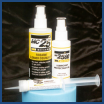
I like Break-Free CLP and Rem-Oil for lubricant and Mil-Tec,
Mil-Comm,
and Wilson Ultimalube for grease, but I have also been known to use
military surplus rifle grease in a pinch.
On the other hand, you may have discovered some rough spots or burrs
and want to clean them up. Perhaps you just want to polish the feed ramp
and chamber a bit. Even quality guns can sometimes have little rough
spots that need to be dressed. Or, you may have an Eastern Bloc gun
which is a good reliable shooter but has a lot of mill marks and
roughness that you want to clean up. With some guns, like the little Kel-Tec,
it is generally advisable to do what is called a “fluff and buff” on all
of the internal moving surfaces to enhance reliability and function.
(For the absolute best “fluff and buff” for the Kel-Tec P32, visit
Golden Loki’s site at
http://www.goldenloki.com/guns/keltec/prep.htm )
Basic Principles for a Successful Fluff and Buff:
- Easy Does
It
- Less Is
Best
- Most of this is going to happen in time anyway
- It is much
easier to take metal off than to put it back on
- Polish,
don’t cut
- It’s
better to stop too early than too late
My Tools:
- Variable
Speed Cordless Dremel with polishing kit
- Red
Jeweler’s Rouge
- DMT
serrated knife sharpening wand
- Extra fine
steel wool
-
Curved-edge Arkansas white whetstone designed for sharpening gouges
- Brownell’s
44/40 Instant Gun Blue for touch-up
Notes on the Dremel Tool:
The Dremel tool is a highly capable and flexible instrument,
especially the new variable speed models. Remember also that a lot of
guns have been ruined with Dremel tools. The old single-speed Dremels
ran too fast for most gun work. I don’t use any of the abrasive bits on
the actions of my guns; only the felt polishing heads. I have used the
fine stone tips to take off sharps on the outside of Eastern Bloc guns,
but that’s all. Some folks will use extremely fine sandpaper, like 600
or 1200 grit to do this sort of work. While this will work on some
surfaces and edges, I prefer the Dremel or stones. Professional
gunsmiths like stones for many of these tasks.
I like the polishing effect of the Dremel with felt pads and rouge.
If you need a bit more grit, the polishing compound that comes with the
Dremel polishing kit is OK. I got some wooden-shafted Q-Tips and cut
them in half. They fit the collet of the Dremel perfectly and once some
extra cotton is removed, they make excellent polishing tools for small
areas like the inside of firing pin channels. If I have to take away
more metal than the polishing head will do, I’ll use steel wool. If I
have to do more than steel wool will take away, I’ll use a fine emery
stone, but for a “fluff and buff” you really shouldn’t have to go
further than this.
Polishing the feed ramp with a Dremel:
Use one of the felt polishing tips, either the bullet shaped pad or
the small felt wheel. Use red jeweler's rouge. Jeweler's rouge is color
coded. Red is the finest grit. It doesn't even feel gritty. It's the one
jewelers use to polish watch cases and such. Take your time and go slow.
Polish the inside of the chamber also, especially the area toward the
top of the chamber where the bullets make contact with the barrel when
they feed. Polish, but do not remove enough metal to change the shape of
the ramp or chamber. The rouge will leave a residue which should be
cleaned off with powder solvent or lighter fluid. If I find a
particularly rough spot inside the chamber, I will tie a bit of steel
wool on a ¼” oak dowel and carefully smooth that place down.
Gunsmiths have traditionally “throated” the beveled surfaces of the
barrel where the bullet enters the chamber in the G.I. M1911 and M1911A1
pistols. This is done by extending the bevel up higher around the
breech, rounding the angle where the beveled throat meets the chamber,
and in some cases increasing the angle of the throat bevel. Kids, don’t
try this at home. Unless you are a certified armorer, you can blow up
your gun by taking away metal that supports the cartridge case. Polish
this area with the greatest of care. Less is best. You do not want to
change the shape of these critical surfaces. With most modern
M1911-pattern pistols, this “throating” is done at the factory and you
do not need to do more (The barrel in the picture to the right has
already been throated). You may, however, need to do some polishing of
the ramp, throat and chamber.
Slide Rails:
One of the traditional “accurizing” operations done on the M1911 is
tightening the slide rails. This, along with carefully fitting a
slightly over-sized bushing, gives Old Slabsides a tighter and more
consistent barrel lock-up. On the slide rails, the tightening is done by
peening the rails down a little with a hammer and then lapping them to
smooth the contact surfaces. The lapping is done by putting a bit of
polishing compound in the slide rail grooves and moving the slide back
and forth on the frame until it smoothes down. For the M1911, a little
tool was developed which locks into the slots which hold the bushing at
the front of the slide. It’s just a little handle which makes it easier
for the gunsmith to work the slide back and forth during the lapping
process. The point of this little digression is that the slide itself is
the polishing tool for the slide rails. You can dissolve a bit of
jewelers rouge in lighter fluid and paint this fluid into the slide
rails. Then put the slide on the frame and work it back and forth.
Some guns may require a bit more work on the slide rails. If you find
burrs and catches in the grooves or the rails themselves, these should
be carefully worked out with steel wool (or the ultra-fine sand paper).
The DMT diamond sharpening wand is long and narrow and is excellent for
hard to reach spots in the grooves. The red handled model is their fine
grit and it does a good job. Use a very light touch because this
instrument can quickly cut metal. The sharpening wand was particularly
helpful with the tiny slide rail grooves of the P-32.
The objective with polishing the slide rails is to get a slide which
moves smoothly without any grittiness or catches. A slide which is not
being slowed by excess friction will feed ammo more reliably and cycle
faster.
Other Areas of the Slide which may require attention:
On the slide, I polish the inside of the barrel bushing, the cocking
lug which depresses the hammer when it cycles, and the area in front of
the ejection port where the locking lugs are found on the M1911. I will
also do a bit of polishing on the breech face. The firing pin channel
should be checked for smoothness and given a light coat of oil. The
firing pin hole in the breech face should be checked for burrs.
The Five Minute Trigger Job for the M1911
Well, not really, but this is a trick which will help smooth a
trigger break which is slightly rough. Cock the hammer and dribble a
drop of oil down the front of the hammer. The drop of oil will roll down
the hammer onto the sear hooks. Cock and release the hammer a couple of
times to get the oil into the sear hooks. Then (with the gun unloaded
and ammo stored safely in an adjacent county) dry fire the gun while
applying light pressure to the back of the hammer. Do this about ten
times. Don’t get muscular with it. This will have the effect of
lubricating the sear face and the sear hooks and polishing the sear
face. It’s not a huge difference, but depending on the gun, it can
result in a noticeable smoothing of the trigger break.
Break-in
The break-in of a pistol does not involve the mysticism and voodoo
often afforded precision high powered rifles. Just take it to the range
and shoot it, a hundred rounds or so, watching for any malfunctions or
strange behavior. Then bring it home and clean it well and re-apply
lubrication. If you get through five of these hundred-round cycles
without a malfunction, you have a solid and reliable pistol. Be sure to
test any new service ammo with 200 rounds before adopting it. At 1000
rounds you can consider the pistol fully broken-in. Don’t be afraid to
dry fire your pistol. It’s good practice and, despite a lot of mythology
which goes around about dry firing, it will not harm modern center-fire
pistols.
Lubrication
Different models of guns have different needs for lubrication.
M1911’s tend to like some oil and slide grease. Glocks and Berettas
don’t seem to need much. Climate also plays a role in this equation too.
In a very dry and dusty environment, grease can catch grit in a tightly
fitted gun and hinder reliability. In a wet climate, a light coat of oil
will guard the metal from rust. In an extremely cold climate, oil and
grease can congeal and even freeze. A one-size-fits-all prescription for
lubrication is just not possible. If you operate in a moderate climate,
some protective oil and slide grease will most likely help the gun to
function better and protect it from rust, corrosion and excessive
friction on the moving parts. We recommend
Mil-Comm grease, oil and cleaner.
Get a Grip
There is one part of autoloader reliability which is not hardware
related: your grip. Even the most superbly reliable autoloader can be
tricked into a malfunction by a weak grip. The physics of the situation
is that an autoloader needs a firm support against which it can recoil.
If you find that you are having jams on a pistol which other experienced
shooters fire without malfunctions, it may be that you need a firmer
grip on the gun. It may be as simple as remembering to grip the gun
firmly when you fire it. It may also mean doing some exercise to
strengthen your hands and arms. Squeezing a tennis ball, push-ups, and
punching a bag all help. If you watch the master pistol shooters, you
will notice that they don’t allow the muzzle of their guns to flip up
much if at all. The more the pistols flips up and back during the recoil
cycle, the greater your chances are of experiencing a malfunction.
The Single Best, Cheapest, Easy-To-Do Reliability
Enhancement for the M1911 Pistol
If you shoot full-powered ammo, install an extra power recoil spring.
I recommend an 18.5# spring for Government Models and 22# springs for
Commander-length guns. This modification reduces or eliminates feed
failures and reduces the battering on the frame of the gun. Some have
said that it also reduces felt recoil, but I don't notice much of a
difference. Don't do this if you're planning to use light target loads
because the light loads may not have enough power to cycle the slide
completely. Another option is to save your original spring and switch it
back in for the lower powered ammo.
Wrapping it up
The fluff and buff is basically a matter of helping along the natural
effects of friction and wear, and it grows out of the primary
observation that guns which are broken in well tend to be more reliable
than pistols which are new. Many will say that a pistol is broken in at
500 rounds. My observation is that this should be considered a bare
minimum. 1000 rounds, especially for a serious duty gun, is a better
mark. As I said at the outset, very little of this cannot also be
accomplished by running a couple thousand rounds through the gun. The
trouble is that we don’t always have the luxury of firing 2K rounds
before we put a gun into service. Be gentle with your polishing and let
logic guide you and you won’t have any problems. It is entirely possible
that you may buy a gun which will need none of this whatsoever. This is
no cause for alarm. Sometimes a pistol just comes off the line right and
nothing more is needed.
|