Modifying the 1911
By Jim Higginbotham
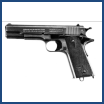
The Browning designed 1911 pistol is arguably the finest close
quarters combat pistol ever made. It is also the most modified or
customized pistol ever made. Some of the myriad of changes made to
John Moses Brownings masterpiece are indeed enhancement but not all
that glitters is gold. So, lets take a look at what is out there
and just what utility it might serve.
First off, let me say that this is not a piece advising you to
modify your personal pistol. You should be aware that there is some
debate on whether it is advisable, from a legal liability standpoint
to do so. The idea is that should you be forced to use your pistol in
self defense the prosecutor, should there be one, might make a case
that you were irresponsible and were so interested in guns that you
were just itching to use it. I dont personally put much stock in
this argument but never the less it is out there. At any rate I am
merely discussing the various modifications and their effects and will
leave the decisions on your own weapon to you alone.
Secondly, I should point out that I am not discussing the various
mods that are mere affectations or strictly meant to be used in
competition for I am about the serious use of the handgun. Nothing at
all against competition and gadgets here it is just that I am not
discussing this except for some overlap in features which can be used
both competitively and in the real world of shooting to live.
With that out of the way lets start with the basics. There are
many 1911 clones out there so let me specify that we are discussing
the real military pistol or the equivalent Colt commercial Government
Model for the most part. Actually the 1911 or 1911A1 is a fine pistol
just the way it came way back when. The most obvious drawback to it
was that the sights are so small (slightly larger on the A1 but you
would hardly notice). One who really knows his Colts knows that there
was a 1/10 inch optional front sight (fixed rear) available on request
and that there were several pistols actually shipped with this option.
So far as I am concerned, with this option, you have just made an
original 1911 a 9.5 on a scale of 1 - 10. The rest of the discussion
is how to make it a 10. Now one may legitimately ask about the trigger
pull but nearly all of the real 1911s I have seen ( those not reworked
by some arsenal or have been "repaired") had triggers in the
4-5 pound range. One really doesnt need much better though a
lighter trigger might be desirable as we inch toward that
"10". There are also some commercial equivalents to the
early guns available today. One such pistol is the Colt 1991A1. Right
now its future is in doubt but as an example it is quite a pistol. I
have examined several dozen of these ( usually in the process of
customizing them) and I must say almost all ran right out of the box,
the sights are decent and the trigger pulls were just about 4.5 pounds
on average. I might want a more robust rear sight - since I walk into
walls a lot - but that is sort of picking nits. I might also want to
enhance its accuracy just a little though it is certainly more
than adequate for defense and to take off some of the sharp corners.
Another pistol that comes about ready to go out of the box is the
Kimber Custom Classic. Yet another is the Springfield Armory 1911s,
though these might use a little work on the feed system in order to
function reliably. No doubt there are others so dont take my not
mentioning them as a slam on these other brands.
If you happen to have a pistol which has the minimal requirements
of highly visible sights and manageable trigger then there are many
options open to you. A good sturdy set of sights which are snag free
will cost you somewhere between $50 and $100 installed. Tritium night
sights ( which will last about 10 or 12 years) are a bit more and,
while nice, are not essential. Adjustable sights can be up to $250 or
even $300 but in actuality they are a disadvantage, prone to breakage
and they tend to get "unadjusted" as well as adjusted. Most
serious gunsmiths that I know have fixed sights on their personal
1911s. A good crisp 4 pound trigger job will run anywhere between $40
and $100 from a reputable smith. Dont take chances here, an
unreliable trigger is dangerous.
OK, so we have a basic pistol which feeds ball ammo with monotonous
reliability ( to insure this always use quality magazines), has sights
which are at least 1/10" wide (.100"), .125 is better, and
at least .140 - .200" tall, and has a reasonably crisp 4 - 5
pound trigger. Noting that there are 1911s from custom smiths out
there that cost up to $3,000 you might inquire - what am I getting for
my money? I will attempt to tell you, without stepping on the toes of
too many gunsmiths - most of whom are dear acquaintances to me. In
some case the news is not good though.
To my mind the priority goes to function. The original military
weapons ( and Colts up to about 1969) were not noted for feeding
unusual ammunition such as semi-wadcutters and the newly designed
hollowpoints ( oddly enough the ammunition manufacturers have only
recently discovered that they can make JHPs with a roundnose profile
which feeds just fine in older guns). So the first major consideration
after sights and trigger are modifications which actually enhance the
reliability of the weapon. A gun that wont work under the worst
possible conditions should be repaired or thrown away as it is a
danger to the shooter. Most smiths offer a "reliability"
package which usually consists of modifying the feedway ( both in the
frame and barrel), polishing the breechface and adjusting the
extractor tension as well as removing sharp edges from the extractor
"hook". Not everyone can do this work so be careful. Dont
let anyone tell you that the separated feedway in a 1911 ( part in the
frame and part in the barrel) is a big disadvantage - it is not. Nor
is it necessary to have a "ramped" barrel to have a chamber
which supports the case head for some of the hotter loadings ( however
many commercial barrels - either ramped or unramped - do not support
the case head so be careful with +P loads).
Leaving accuracy enhancing modifications for later ( I will explain
why) lets look to the Controls on the pistol. Likely the most common
modification in this area is the thumb safety. Most people want a
larger safety to enable them to disengage it more surely when speed is
of the essence and in a fight for your life speed is usually of the
essence! Many want to augment this with an ambidextrous safety which
can be manipulated by either hand. Such modifications are fine and
even desirable, however there are some pitfalls. Most common is that
just drop-in in a safety can leave you with basic controls that have
sharp edges and can cause problems with your handling of the weapon.
Some are even sharp enough to lacerate the skin. Another is that if
the safety is too large - especially on the right side of the frame
for right-handed people - then it can get inadvertently disengaged.
This is one reason I do not opt for "bilingual" safeties on
most of my 1911s. Not that it worries me too greatly to find I have
bumped the safety off. Good gun handling and a good holster are the
essence of firearms safety not the mechanical device too many have
grown dependent on. Of all the safeties on the market I am most
impressed with the Chip McCormick speed safety. It is extended but it
has no sharp edges and literally "melts" into the gun. Yet
there are other good safeties if you want to put in a little work
de-burring them. One must make sure that they actually function, I have
seen many a "custom" 1911 which would drop the hammer when
the trigger was pulled with the safety off ( usually they drop the
hammer when you release the safety and usually they do not fire but it
is scary).
These days a popular control modification is to replace the grip
safety with a wider version that not only helps to spread the recoil
over wider area of your hand but also allows a higher grip on the
weapon which is an aid in controlling recoil. Done correctly this
enhances the handling of the pistol though I have never noticed that
it has a great effect on my shooting a particular drill it helps to
make those long practice sessions more pleasant and a higher grip is a
good thing. Again, you want to make sure the safety functions. The
most common problem I see is that the shooter will fail to disengage
the safety with his higher grip. Many such safeties now come with a
"speed bump" on the lower part to help insure disengagement.
Years ago many folks pinned their grip safeties - Jeff Cooper, the
Father of the Modern Technique was prominent amongst them. Personally
I dont see any need to do this since the grip safety surfaces can
be "adjusted" to disengage at the slightest movement but
then again, I dont depend on mechanical devices for my safety so it
does not bother me much to see an inoperable grip safety. Mine work
since someone else might be shooting my pistol and expect it to work.
Then there is the slide stop. Now we start to tread in dangerous
waters. A thing as simple as a slide stop can end your life. The
purpose of the slide stop is - of course - to stop the slide from
closing when the last shot is fired. The trouble arises when the part
stops the slide BEFORE the last shot is fired - sometime the first or
second! One sure way to invite such a problem is to install and
extended slide stop - or even worse - ambidextrous extended slide
stops! Not only are these not usually well made but the fact that they
extend back nearer the firing thumb makes them more likely to be
inadvertently engaged by that thumb in recoil. This is very bad as you
might imagine. To install one of these dinguses on your pistol is to
mark you as a tactical amateur anyway. First, and more importantly,
the thinking gunman reloads anytime he CAN - meaning the first chance
he has when bullets or people are not coming his way - no matter if he
has fired 2 rounds or 6, get the gun back up to capacity just in case
the Bad Guys have help! The second thing, recognizing that we all cant
count rounds in a gunfight ( not something I try to do anyway) and
that comes the day we actually do run dry - no problem, just speed
reload ( from behind cover please) in the normal fashion and trip the
slide release with the thumb of your weak hand - which just seated the
magazine and is in perfect position to do so. Or, as is the current
rage in tactical schools ( in order to have a uniform movement between
all autopistols) simply retract the slide with that hand and release
it. In plain words, avoid this modification like the plague.
One other possible modification to the slide stop is to
"dimple" or slant the bearing surface where it meets the
plunger. This helps to ensure that normal recoil will not
inadvertently engage the slide stop and yet allows proper function
with most magazines ( some 8 rounders may be a little week). I dont
regard this as a must unless you have noticed the problem in your
particular gun.
Yet another control on the 1911 is the magazine release. Here too
we can get in real trouble. In order to enhance their ability to
reload faster, many folks have given up sure function. Reloading is
something emphasized in competition - and indeed it should be a skill
one has - but it is highly overstated. I have only recorded two cases
in which a person was able to finish a fight in better shape because
he reloaded quickly ( and both should have been over long before the
reload) in my decades of research. Gunfights tend to be over in 2 to 3
seconds, reloading is not one of those things that figures highly in
them though, to be sure, there are a couple of cases where failing to
reload might have been a problem - Newhall comes to mind. The great
danger in an extended or enlarged mag release is that it will get
bumped in the holster and the mag will be released without your
knowledge leaving you with a single shot pistol ( it is even worse
with a S&W since the gun wont work with the mag down 1/4"
). Best leave the mag release alone. The Kimbers have a slightly
extended button which I can live with but otherwise leave it alone.
Left- handers can actually operate the standard button better than
right-handers so ambidextrous releases should be avoided also.
While I know many are champing at the bit to hear about some of
those "extreme" gunsmith mods and little secrets to tuning
race guns, bear with me while I talk about really important stuff.
Externally your gun should feel like a well used bar of soap ( though
not necessarily slick). Meaning, it should not have any razor sharp
edges that cut hands, clothing and leather - or plastic these days.
You should be able to comfortably run your hands all around it. The
only thing that should stick to your hands is the actual gripping
surfaces of the frame. Old Colts and military 1911s are usually OK in
this regard but even they could use a little "dehorning".
Modern commercial Colts - especially the Enhanced models which I refer
to as "disenchanted" models - and Springfield Armory's as
well as several others are pretty poor in this regard. One exception
is the Kimber. Almost all the edges ( if you dont count the recoil
spring plug around the goofy guide rod) are nicely blunted without
exaggeration. Make sure your weapon does not hurt you to handle and
shoot. It is a hand tool, it should be comfortable.
One thing I like that sounds out of place when talking about bars
of soap, is either stippling or checkering on the front and back
straps of the frame. Checkering on the stocks is something I can take
or leave. The gripping is done fore and aft on a 1911 and these
surfaces should be non-slip. Some folks get by on the cheap by
applying some skate board tape or other rough temporary surface. Some
even just glue sandpaper to the surface - "True Grit". Good
checkering is not only practical it is very attractive. It is also
expensive running about $150 to the inch. Stippling works just about
as well and I personally like it but it is a bit too rough for some
folks taste. I am not fond of wrap around rubber grips with either
checkering or finger groves. This does not release the gun easily
enough when the grip is relaxed to perform a reload nor does it allow
enough leeway when establishing the grip on the draw. If you do like
them I can think of no really serious drawbacks except to warn against
any stock that covers the toe of the magazine when it is inserted. You
might need to use this protrusion to strip a stuck magazine out of the
gun in case of dirt or a double feed. Obviously stocks with thumb
rests should be avoided since they block access to the magazine
release.
Though not really controls, lets examine some of the various
accessories one is tempted with when perusing all those gun magazines.
How about starting with hammers. There are literally dozens of shapes
and sizes of hammers. For the most part I think this is strictly a
matter of taste with the exception that if you install a high and wide
grip safety then you will likely need some sort of
"commander" hammer to fit with it. Functionally I can find
nothing wrong with the standard G.I. hammer. If it bites you then
"bob" it by about ¼" . However if you want one of
those high / wide grip safeties then you will have to install a hammer
that will accommodate it. A "Commander" hammer is in order
and there are many out there. Most of the top names, Wilson, MGW,
McCormick, etc. are well made and you can simply pick one whose looks
suit your taste. Many of these relocate the hole that the strut pin
anchors through in the manner of the Gold Cup since that takes a lot
of load off of the hammer as it rests on the sear, resulting in a
lighter trigger pull. Since the 1911 is carried in condition one (
cocked and locked) when in service it does not matter much if the
hammer is easy to cock or not.
While we are on the rear of the pistol lets look at the
mainspring housing. You can have them in flat or arched or in between.
Since the serious gunman uses the sights for the most part, this is a
matter of personal taste and he can usually pick up a gun with a type
of MS housing different from his and do quite well with it. However,
even the sighted fire used in the Modern Technique is quite reflexive
and a strange feeling pistol will slow you down a little I simply
could not live with my Glock 23 or 22 ( early models) because I
constantly had to pause to push them down on target after a smooth
draw. So, naturally I made them point more like a 1911. While I like
the feel of the flat housing, I learned to shoot a 1911 with an arched
so the vast majority of my guns have the arched. I prefer mine
checkered 20 LPI. I also prefer mine to have the military lanyard
loop. This is not so important but it is a nice touch to be able to
attach a lanyard when you are canoeing or backpacking ( particularly
if you sleep in a hammock on the trail). For self defense under normal
conditions it probably does not serve a purpose. It does however, make
a handy bottle opener if there were bottles to open anymore.
Another related MS issue is the Extended Magazine Wells that are so
common today. Often these are part of the custom MS housing itself.
Personally I think they are unnecessary for the serious pistolero.
Sure they make hitting the mag well easier for competition but in real
life you likely wont have to reload and you have made your pistol
taller and less concealable. The main thing I have against them is
that it makes using a standard magazine without a pad very difficult
and almost impossible to reload with quickly. Hardly worth the effort
for what little gain you get. One exception I have seen is on the
Officers Model. By attaching one of the S&A mag wells which
taper off before it gets to the "toe" of the magazine, on
the OM you have extended the rear of the pistol which helps most
normal hands get a better grip while extending the front none at all.
This means the pistol is really just as concealable as before the way
most of us carry our guns with the barrel canted to the rear. Gun
designers should realize that when you sit a gun down with the floor plate
of the magazine flat on the table, then the barrel should
be parallel to the table not pointing up ( or down). This is the way
the hand is shaped and it promotes concealability. At any rate the OM
with magwell will take a standard 1911 magazine without a pad and you
wont fail to seat it. A word of caution, longer mags in an OM can
malfunction if you put upward pressure on the floor plate while firing
so dont use the "cup and saucer" grip.
Lets move up to triggers. We have talked a bit about trigger
pull but lets discuss the part. There are many triggers available
and most of them are fine so I would say, if you want to change your
trigger at all, then pick the one that suits your hand and your
tastes. Stay away from the cheap ones with aluminum trigger stirrups
but the material of the trigger itself is almost irrelevant. At first
I thought plastic was a bad thing but I see that it moves easily and
is almost indestructible. I still prefer some sort of metal for taste
or perhaps to prevent melting in an extremely hot environment ( I mean
where you might store the gun not for me as anything that would melt
the trigger on my Kimber would melt me). The most important
characteristic of the trigger, after assuring that it fits your grip
style, is the actual weight of the part. Not so important for shooting
but when you reload from slidelock or drop the slide on an empty
pistol ( this is NOT a good idea but likely someone will do it to your
gun sooner or later) the inertia of the trigger its tendency to
stay still will trip the sear when the gun lurches forward as the
slide slams shut. This causes the hammer to "follow" from
the jar and usually it will catch on the "half cock" notch (
safety shelf on series 80s). This is not a good thing. Choose a
good gunsmith for your trigger job and choose a light part for your
trigger.
Speaking of slides slamming forward, lets talk about recoil
springs. This is another area where you can get into trouble with the
neat gadgets available in parts ads. Let me state right up front. A
recoil spring guide rod is not one of the stellar ideas to dawn on gun
designers in the 20th century. You will not that none of
John Brownings designs have them. That is because they are not
needed. To be sure, some guns work OK with them, Glock, S&W,
Kimber, Wilson ( who makes guns both ways) etc. The problem is
twofold. One is reliability. If they are designed well, as those in
the aforementioned pistols seem to be, then fine. However some
after-market designs are not well thought out. It takes more than just
sticking a rod through your recoil spring. In the 1960 there were
several after-market rods that sold through mail order which were less
than stellar we called them malfunction kits. You could put one in
you Colt that was monotonously reliable and then get a chance to do
remedial action drills. The more pertinent point is that the rod under
the barrel prevents you form applying pressure under the barrel to
draw the slide back, preventing convenient one hand operation. If you
find one hand disabled or occupied during a gunfight and you do need
to clear a malfunction, reload an empty gun from slide forward ( slide
stops dont always work) or simply need to check the condition of
your weapon you can place the recoil spring plug on the edge of a
table or desk or the sole of your shoe and press the slide back by
using only one hand. Another handy trick is to "press check"
your piece in the dark by pinching your thumb to the inside of the
trigger guard ( just the tip and not too far inside please!) and the
index finger under the barrel ( you approach this from the underside
and NEVER let actual muzzle point at your finger). With seemingly
little pressure you can bring the slide back about ¾" which will
allow you to take your trigger finger ( you have the gun in a firing
grip) and feel the cartridge in the ejection port. There are other
ways to do this that can be applied to guns with the rod but they are
a little more difficult. Let me say. If you have a guide rod on your
1911 and the gun works then dont feel like you have to rush out and
get rid of it. These are sort of minor points. Besides, some of the
compact models out there were designed with them and it would be
difficult to change them.
OK, now what about recoil springs and buffers. The standard Govt.
Model spring is 16 pounds. I am sure that the gun will work just fine
with this if you replace the spring when it is worn out. The military
uses the gauge of spring length. When the spring has worn until its
uncompressed length is 5" then it is time for it to go. Military
parts these days are "low bid" so they were getting about
1,000 round on a spring before replacing them in the mid 80s as the
1911 was being phased out of service. Personally I prefer an 18.5 or
20 pound spring for the 5" guns ( 20-22 pounds for the 4.25"
guns) but one must be careful not to go too high lest he run into the
problem of short cycling the slide due to a lose grip. The 1911 is one
of the most forgiving designs I have ever seen it will even
function when held with 2 fingers or even held upside down but all
autos eventually have the point where less resistance to recoil will
result in a malfunction. 18.5 pound springs work for almost everyone
with normal ammo and they will overcome any slight resistance to
feeding that perhaps a 16 would not. At the same time one does not
want to go too high on the spring weight as there can be battering
when the slide closes as well as when it is shoved to the rear. Stick
with this range. While on the subject of springs, do not change the
weight of the Main Spring ( the one that drives the hammer). Many
amateur or even professional bullseye gunsmiths will cut or reduce
this spring in order to make a light trigger pull easier to obtain.
Dont do it. The pressure of the hammer in its forward position is
part of the lockup timing cycle of the slide, less resistance here
means more battering and has much more effect on it that 4 or 5 pounds
of pressure in the recoil spring.
What about recoil shock buffers. Well, I have experimented with
these for years and was on hand when the Wilson version was invented
or at lest conceived. I can see the logic in this but over the
years I have gradually gotten away from using them in my serious self
defense guns. I do use them in my practice guns just to be on the safe
side. The problem is, and it is different with each individual gun,
that these things can get chewed up and spread out and cause the gun
to become unreliable. This is a bad thing in a defense gun. I was
having trouble with a Wilson Combat Master ( this was a $1500 pistol
in 1985) running with ball ammo and McCormick magazines. Now the gun
was good, the mags were good, the ammo was Winchester ball and the gun
was clean when I started shooting it. Oiling the barrel hood made it
run better but it still choked. I did not discover the problem until I
got home. The shock-buff was smashed and a bit of it was pushing
upwards on the underside of the barrel. Needles to say, that gun no
longer carries a shock-buff. Yet they seem to work in some other guns.
What is really needed is a sort of "sandwich" which has
steel in front buffer in-between and steel in the back so that it wont
get chewed. However this can all interfere with the reward travel of
the slide and the odds of the slide locking back on the last shot
especially on a Commander. Shock buffs may save your gun from
battering if you shoot 1,000 rounds a week but it may also cause
problems buyer beware.
So far I have not mentioned barrels. I am not going to talk about
them much. I strongly feel that most folks do not shoot quite well
enough to appreciate the difference between a run of the mill barrel
and a match barrel. My dads Remington Rand 1911a1 which is
unmodified and was made in 1943 shoots about 5" groups at 50
yards with ball ammo. My most accurate 1911 will do 1" at this
range but I doubt that I can tell the difference when shooting a man
at 10 feet or even at 25 yards from a field position. However, some
folks want a super accurate piece so that they at least know it is
them doing the missing rather than the gun. My advice on barrels is
this. If the fit of the bushing is not extremely loose and you cannot
move the barrel by pressing down on the barrel hood while it is locked
in battery then you likely dont need a new barrel or bushing. If
the former is true you might need a new bushing. If the latter you
might get by with a new link ( it will not be locking up in the
preferred manner though). My friend Dane Burns, who builds
extraordinary 1911s, believes that there never was a G.I. or Colt
Govt. Model to ever come out of the factory with a
"properly" fitted barrel. One where the "legs" or
bottom lugs of the barrel as well as the link rub evenly on the slide
stop as it goes into lockup. I tend to agree with him though the law
of averages says that there must be some which are properly fitted if
only by accident. My point is that unless you want a pistol that
shoots 1" at 50 yards then you dont have to have perfect
lockup. The G.I. guns until they are simply shot out will have
all the accuracy a person needs for self defense and a little fitting
even less than perfect fitting can get you to 3" at 50
yards which is much smaller than the front sight. I cant see
3" at 50 yards!
Barrels, especially the feedway and the chamber dimensions, affect
the reliability of the gun. Here, the things that enhance accuracy
tight tolerances work against us so we have to have a compromise
of sorts. Danes guns are EXTREMELY accurate yet he emphasizes that
they must work. He is one of the few smiths who can accomplish this.
His guns also cost $2500 and are some of the few that are worth
it. However, most out of the box Kimbers will shoot 3" at 50
yards and they usually work pretty good ( I have not had any gun
related malfunctions out of either of mine since I bought them). One
after-market barrel that I have experience with, the Wilson, seems to
be very accurate and is cut with sufficient tolerance to work well, I
dont even have to modify the feedway in the barrel, though I do
polish it just a little which is likely unnecessary. The critical
lockup on a 1911 barrel is in the rear. The bottom lugs, I mentioned
as well as the barrel hood should reposition the barrel the same every
time. The bushing fit can be a little more loose than most people
think. Whatever you do dont buy a two-piece barrel and I would
recommend replacing the two-piece barrel that comes in the Springfield
Armory guns immediately. Bottom line here is that if you spend your
$200 on practice ammo then you will likely find you have a much more
accurate gun that you thought you started with.
Well this has gone overlong and though I have only scratched the
surface I must stop. I hope it has given food for thought. Good
shooting.
Praise the Lord and pass the ammunition. See also
Custom M1911A1 Modifications - A Pictorial Guide |