Is "Cocked and Locked" Dangerous?
By SydQ: The one and only problem I've ever had with the classic 1911
is having to carry "cocked & locked.” In your opinion, are the double
action only models offered by Para-Ordnance the way to go when safety is
concerned?
There are really two parts to your question so I'll deal with them
separately.
First, yes the P-O LDA is an excellent option when the cocked and
locked 1911 is a problem. Charles Riggs wrote a nice article for me on
the LDA which addresses this:
http://www.sightm1911.com/lib/review/para-ord-745.htm
Second, I believe that the concern about the safety of the “cocked
and locked” (condition 1) pistol is more a matter of perceptions than
reality. It looks scary. When you're new to the 1911, it feels scary. I
started out with wheel guns and it took me some time to get used to
cocked and locked. But, given the huge number of M1911 pistols which are
out there in service, you would think that we would hear more about
accidental discharges if this were a problem. The fact is that we don't
because they don't go off by themselves. I have only heard one story
from one police officer who claimed one went off in his holster when it
bumped against a banister as he descended a set of stairs, but when I
pushed him for details, he refused to say anything more. He wouldn't
tell me the kind of holster, if the gun had been modified, its state of
repair or any other circumstances. This led me to believe that he was
either blowing smoke or there was something about the gun he didn't want
to tell me.
What do we mean by
“cocked and locked”? The M1911 pistol is loaded by inserting a charged
magazine and racking the slide. This action chambers a cartridge and
cocks the hammer of the pistol. The thumb safety is then pushed up
toward the sight. This “locks” the pistol. The safety is on and the
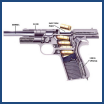
slide will not move. Inside the gun, a piece of the safety rotates (red
area in diagram) and blocks the base of the sear which prevents the sear
from releasing the hammer. If the sear hook on the hammer were to break,
the sear would be captured by the half-cock notch preventing an
accidental discharge. The stud that locks the sear will also not allow
the hammer to fall if the safety is engaged.
But what about the cocked and locked pistol taking a hard hit on the
hammer? Could it go off then? Listen to this report from Terry Erwin:
"About ten years ago, I was working as an
armed-plain clothed-security officer. During a struggle with an
arrested subject the Combat Commander I was carrying cocked and
locked, holstered in a Bianchi "Pancake" on my strong side hip, struck
the center door jam of a set of double doors. The center door jam was
knocked loose, and two belt loops were torn off of my jeans. The
hammer was bent inward and the safety would not move. A gunsmith had
to press out the safety, hammer pin, and sear pin. The edge of the
sear had cracked off, and a piece of one hammer hook also cracked
off. The gun did not discharge upon that impact. I have carried
several Colt's, including that repaired Commander for most of my adult
life, and have never once worried about the weapon (myself or someone
else is a different story, but not the gun)."
The 1911 is a single action semi-automatic pistol so it has to be
cocked in order to fire. People deal with this in one of three ways:
cocked and locked (condition 1), or they chamber a round and carefully
lower the hammer (condition 2) so they have to thumb cock the gun to
fire it, or they carry it with an empty chamber and rack the slide when
they bring it into action (condition 3). I would advise either condition
1 or 3 for home defense, but not condition 2. I don't advise condition 2
under any circumstances. (For more discussion on the conditions see
“The
Conditions of Readiness”) If you are only using the gun for home
defense, there is nothing wrong with leaving it in condition 3 with a
loaded magazine but with an empty chamber – as long as you have the
presence of mind to load the weapon under stress. (Don't give me a "duh"
on that one because weird things happen to one's mind when someone is
trying to get into your house at 3 AM).
When the gun is cocked and locked, the sear is blocked from releasing
the hammer. Further, unless a firing grip is on the pistol, thumb safety
swept off, and the trigger is pulled, the gun will not go off. For my
money, this is much safer than a Glock or some of the other new pistol
designs which have no external safety. The Glock, by the way, is also
pre-cocked which is why it can have a much lighter trigger than a real
double action gun. It could be said that the Glock is “cocked and
unlocked” which is called “condition zero” with the M1911. Anecdotally,
we hear of many more "accidental discharges" with Glocks than with M1911
pattern guns. The 1911 has two manual safeties. It may look scary, but
it is really much safer than many current designs.
If an M1911 has been butchered internally, all bets are off, and I
have seen a couple like that. But if the gun is in good repair, it is
safe and will not go off unless the thumb safety is swept off, a firing
grip is on the handle, and the trigger is pulled. If you buy a used
M1911 pattern pistol, be sure to have it checked out by a competent
gunsmith just to insure that the gun has not been modified or made
dangerous by a tinkerer and that it is in good working order.
A sideline: of the pistols I have carried, the M1911 is the only one
I carry with the safeties engaged. I carry S&W and Beretta DA/SA guns
with the safety off. Glocks and wheel guns don't have a safety at all
(and no, I don't consider the trigger flange on the Glock a real manual
safety). In this respect, the cocked and locked M1911 is the safest
pistol. It is unique in the fact that it has not one but two manual
safeties which have to be acted upon to make the gun fire.
Now, to argue the other direction for just a second, do I feel safer
with a true DA/SA with a firing pin block and a manual safety like a S&W
or Beretta? Yes, in an absolute sense, I do when I'm in the world of
theoretical possibilities, but again, I think this is more a matter of
feeling than reality. Some weird combination of events could conspire to
take the safety off, push down the grip safety and pull the trigger all
at the same time, but I can't visualize what that circumstance would be.
Nevertheless, when I’m backpacking and I know the gun may have to ride
in my backpack and flop around in a tent with me, I will often carry a
S&W DA/SA just because some of these strange possibilities come to mind.
For the purposes for which a gun is needed, I feel safer with the M1911
because I know I'm going to shoot it better and faster than these other
options.
I have seen "accidental discharges" with M1911's, but without
exception they have been instances in which the finger was on the
trigger or the fire control group had been modified by an incompetent. I
have yet to document a single case in which an M1911 simply experienced
a catastrophic failure and went off while cocked and locked. And I do
hunt for such stories because this is a concern for a lot of people.
Another interesting “safety feature” of the M1911 was first observed
by Massad Ayoob. In the event that a bad guy might get your gun away
from you, confusion about the controls of the cocked and locked M1911
could cause him enough hesitation to give you a chance to either get the
gun back or flee. The current generation of thugs have cut their teeth
on double action semi-autos and revolvers and many do not know how the
M1911 operates. Ayoob tested this with people who were unfamiliar with
pistols by giving them unloaded pistols of various designs and measuring
how long it took them to figure out the controls and make the hammer
drop. The M1911 proved to be considerably slower to fire than double
action guns in the hands of those who are unfamiliar with the gun.
Q: Is the cocked and locked M1911 a problem for people who are new
to firearms and want to keep one for home defense?
In my opinion, cocked and locked does not present either a safety or
handling problem. In fact, I would be inclined to argue the other way,
that it is very intuitive and simple, and very quickly brought into
action. 90 years of successful service tends to bear this out. All you
have to do is to sweep the thumb safety down with your thumb and the gun
is ready to fire. It is a natural motion and people learn it quickly.
Other issues come into play when you’re considering keeping an 1911
loaded for home defense, such as if you have small children in the home
and how much access your friends have to your home, but there is nothing
inherently dangerous with having a cocked an locked gun at the ready. If
you have really small children who are too young to train on firearms
safety, then condition 3 – empty chamber – is definitely the way to go
because the child will not know to rack the slide to load it and they
will lack the strength in their hands and arms to do it. If you are a
very social person who has a lot of parties and people running through
your house all the time, then you really should wear it, concealed of
course, so that the pistol is under your immediate control and you don’t
have to worry about someone finding it and doing something stupid. If
that’s not possible, lock it up or find a smarter circle of friends who
won’t go through your stuff when you’re not looking.
Finally, the real cure for cocked and locked anxiety is to get
"un-new" to the gun. Shoot it, get used to it, learn it so that you
don't have to think about it. Familiarity will dispel that anxiety. Get
some training if at all possible. Pistols really require some training
and practice to use effectively. A good training session with a
qualified professional trainer will help to separate the fact from the
fantasy about what you can actually do with your pistol when the chips
are down.
I feel that the 1911 is the fastest, best shooting pistol which has
ever been built, but that doesn't mean that there aren't some other good
designs out there. You should be comfortable with your gun, and if you
just can’t get over that fear about the cocked hammer, find another gun
that feels good to you. I love the 1911 because of the way it shoots,
but I had some nervousness with them when I was new to them. Practice
and familiarity made it go away.
"Due to misplaced concerns about safety and liability, the police
have shunned the Condition One (Cocked and Locked) SA auto, mostly in
favor of DA autos that aren't any easier to use than a DA revolver.
Claims that the SA auto is unsafe or requires special training are
hogwash, something that too many people accept without challenge. And if
you don't believe it, come see me at any
CTASAA course and I'll prove it to you." – Chuck Taylor
|