
By Syd
I have been a gun owner in my own right for 45 years, having received my first firearm, a Winchester Model 94 30-30 at the tender age of nine years old. In all of those years, I have maintained constant surveillance on my firearms for that dreaded moment when one would come to life, fire several rounds by itself and thereby commit an act of “gun violence.” Stay tuned, but it hasn’t happened yet. People, animals, perhaps even storms could be said to commit acts of violence. They have volition, the capacity to act. Guns just sit there inert until a human agent possessed of volition picks them up and does something with them.
“Gun violence” is a misnomer. Guns do not do violence. People with guns certainly have the ability to do violence. I suppose an ape could pick up a gun and manage to make it go off, but would that be the “gun violence” we hear so much about? No, not really. The ape would have no understanding of what was happening. “Gun violence” occurs when a human being picks up a gun and uses that tool to injure another human being. The human being rather than the hardware is the agent in the event, so, if we wanted to speak accurately, we would have to call this “human being violence.”
Am I straining at gnats here? Yeah, just a bit, and this certainly isn’t a new revelation, but it demands repeating because the media and the gun prohibitionists continue to mistakenly characterize a current societal problem in the United States as “gun violence.” This is a form of scape-goating. Guns may make violence easier to commit (as do knives, bats, rocks and sticks), but guns are incapable of violence. My grandfather was fond of saying, “’Tis a poor workman who blames his tools.” Blame the gun. It can’t defend itself. That way, we don’t have to blame ourselves, the human beings who are actually responsible for the violence. A crisis of violence does indeed exist, especially in the inner cities, but not exclusive to them. Philadelphia has suffered 275 homicides this year. Numbers like that create a lot of pressure on lawmakers to do something, anything, even if it’s wrong, so that they look like they’re doing something and addressing the problem. After all, elections are coming up, don’t ya’ know. The net result is usually more useless gun laws that do nothing toward curbing crime, but make life much more difficult for law-abiding gun owners.
The implied message of “gun violence” is that if we could just make the guns go away, the violence would stop. This is a false hope and an intellectual idol. The basic premise, that we could make the guns go away, is unreasonable and unrealistic, and the conclusion, that violence would cease if this science fiction scenario could be accomplished, is simply erroneous. Anyone who has lived long enough to get into a sandbox squabble knows you don’t need a gun to do violence.
Into this mix of mayhem and misunderstanding come groups like the Brady Campaign and the Violence Policy Center touting their tired, failed agenda as salvation. They dance on the graves of the victims when they exploit every crime as some kind of support for their political agenda, and often the cases they cite actually prove the opposite – that less gun restriction might have enabled citizens to defend themselves instead of being slaughtered like sheep. “Ban concealed carry… One gun a month… Ban .50 caliber sniper rifles… Resurrect the Clinton Assault Weapons Ban…” You know the drill. As if any of these things had any relevance to inner city gun crime. You could do all of those things on their gun prohibition agenda and not impact violent crime one iota, except perhaps to make it worse.
The gun rights people respond with our predictable set of clichés: “Guns don’t kill people; people kill people,” “Criminal control; not gun control.” While I am more sympathetic to this line of reasoning, I have to admit that these old chestnuts are starting to sound hollow to me. I believe that when we rely on these old truisms and clichés without reflection, especially when we throw in a couple of quips about “improving the gene pool,” we risk being seen as callous and indifferent to the carnage being wrought in many of our cities. The perception of indifference will not serve us well in the political arena in years to come.
Right now, there are several groups trucking around the Philadelphia area that call their outfits names like “The Coalition to Stop Handgun Violence.” I’m sure that most of them have good intentions but they’re wasting their time with their rallies and bus rides to Harrisburg. I would feel a lot better about them if they would name their organization something like “The Coalition to Stop Senseless Human Being Violence,” and spend some time trying to understand the reasons and root causes that lead so many young inner-city males to kill each other.
I think that both gun rights and anti-gun people would agree that senseless human being violence is a bad thing and should be stopped or curtailed as soon as possible. Imagine if we spent just one tenth of the energy that we devote to beating up on each other over hardware to the task of identifying and fixing the root causes of the violence that plagues our cities. What would happen if we began to look at the issues of joblessness, lack of self esteem, the collapse of social values and pathological self-centered behavior? We might actually accomplish something. What will you bet me that it never happens?
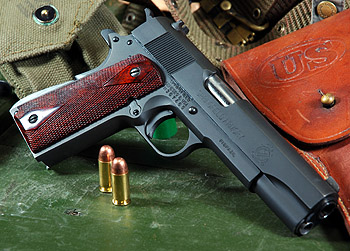
During the time I have been writing this, I have kept one eye on the .45 automatic pistol sitting on my desk. It hasn’t budged.
“The media insist that crime is the major concern of the American public today. In this connection they generally push the point that a disarmed society would be a crime-free society. They will not accept the truth that if you take all the guns off the street you still will have a crime problem, whereas if you take the criminals off the street you cannot have a gun problem.” – Jeff Cooper
Comments, suggestions, contributions? Let me know