|
Weapon-Mounted
Tactical Light Systems
By Syd
It seems that most new firearms are coming equipped
with an accessory rail for lights and/or laser sights. Tactical lights
appeal to the gear-head in us all. They have a really high coolness
factor. But what are the issues, benefits and drawbacks of these
systems?
Is the light on the gun an asset or is it just a
bad guy target acquisition indicator? The light helps you to identify
your target, but it also shows the target where you are. Is it more
important to be able to positively ID your target or to keep your
position concealed? Or, is a separate flashlight not mounted on the gun
a better arrangement? Of equal importance are the legal implications of
using a weapon-mounted light. Once the light is mounted on a firearm, it
becomes part of the firearm, and pointing it at another human being can
be a crime.
Have you ever been in the kind of situation where
some illumination could prevent a tragedy, like the kid next door coming
home after the prom dead drunk and going to your house instead of his
own and trying to get in, or a beloved family pet getting something
caught on his collar, dragging it around in the basement and making
sounds like a home invasion? In these types of situations, the time
allowed for the shoot or no-shoot decision can be very short. Make the
wrong decision and a tragedy or legal disaster can occur. Can the
tactical light help here? Or put another way, what are the rights and
wrongs of using a weapon-mounted light?
Parallel Beams
One factor that quickly emerges in this discussion is the distinction
between law enforcement and armed citizens. Law enforcement loves
tactical lights. For the armed citizen, they can be a bit more
problematic. The difference is in the mission. There are times when law
enforcement (and military) must go on the offensive: they have to go
into places and clear buildings. The role of the weapon system for the
armed citizen is purely defensive. As a lone, armed citizen, you should
never attempt a building clearing alone except in the most extraordinary
circumstances. If you notice, when the professionals do that, they
always do it in teams. Doing it alone can be characterized as, “hunting
for someone to shoot me.” Consequently, we have to put on the bifocals
when dealing with tactical lights. They perform different roles
depending on the mission and the person behind the gun.
The Light Side of Law Enforcement
Police officers face two kinds of situations in which the tactical
weapon-mounted light can literally be a life saver: dynamic entries and
building clearing. During a dynamic entry, the ability to
instantaneously identify threats and non-threats saves lives. In a
building clearing situation, having the light mounted on the weapon
allows for a free hand to open doors and move things while still
maintaining the readiness of the weapon.
“When under-barrel lights
(aka: muzzle lights, tactical lights) first came into vogue I got one
for my SWAT pistol and I loved it. It was big, it stuck out several
inches from the muzzle, it added some weight to the pistol, but I loved
it. I no longer needed a third hand to search a building or room. It was
great, my pistol and my light were searching where a threat might be and
I had a free hand to open doors and move objects.” – Sgt. Mike Burg,
“Under-barrel Lights: They're not just for SWAT anymore!” Police
Marksman Magazine
Even in this context, law enforcement officers
cannot put a weapon-mounted light on someone unless it is a situation
which would justify pointing a gun at them. Actually, the same legal
rules apply to LEO’s (Law Enforcement Officers) as apply to the armed
citizen, but LEO’s do have a bit more latitude in this matter due to the
nature of their job. But a LEO cannot threaten a person with a gun for
no reason.
Enlightening the Armed Citizen
(You notice I don’t use the term “civilian” when talking about citizens
and law enforcement officers. The reason for that is that law
enforcement officers are civilians also, although they don’t act like it
sometimes. The only way to quit being a civilian is to join the armed
forces. Once you are a soldier, seaman, airman or marine, you cease to
be a civilian, but not before.) For the armed citizen, the issues are
different. When polling my friends and correspondents, the consensus
was, “It’s great for a ‘house gun’ but useless for concealed carry.” The
problem of weapon-mounted lights for armed citizens is that they can
encourage us to break the basic rules of gun handling: “Never cover with
the muzzle anything you don’t intend to destroy,” and “Know your
target.” Also, in some circumstances, pointing a gun at another human
being can be a felony in itself unless it is justified by the
circumstances. You can’t use the weapon light as a simple flashlight.
You have to remember that it is part of the sighting system of the
firearm.
With those caveats said, there can be a role for
the weapon-mounted light in the context of home defense. Everyone can
imagine situations in which one might have to move through the dark and
quickly identify targets and no-shoots.
Let There Be Light
One thing that’s very clear is that the weapon-mounted light does not
substitute for or replace a flashlight. If you had to choose one or the
other, the flashlight would be the choice. It’s more flexible, less
complicated legally, and can perform most of the functions of a
weapon-mounted light. Don’t think for a minute that a weapon-mounted
light will allow you to dispense with a flashlight because it won’t.
When you get into the matter of low-light
combatives, you will find a lot of voodoo, strong and conflicting
opinions, and hand-gun-light positions that would give a Kung-fu master
a charlie horse. Some say that the light only shows the bad guy where to
shoot; others point out that bad buys don’t automatically think “gun”
just because they see a flashlight. Most believe that it is more
important to identify a target than to maintain concealment, but the
weapon mounted light may not be the best way to identify targets in many
situations. For the armed citizen whose primary role for the
weapon-mounted light is home defense, most do not want to wander around
their own homes pointing guns at whomever just because they heard a bump
in the night. In most of these kinds of situations, a handheld
flashlight is a safer option. Walt Rausch summed it up well when he
said:
“In reality, gun-mounted
lights are simply shooting aids, which have only very limited
application as search and identification tools. Yes, we are all treated
to watching endless repeats of law enforcement officers performing light
shows worthy of Las Vegas or Disneyland on TV and in movies, but they
are not exposed to being charged criminally or civilly for assault or
reckless endangerment. Use the light judiciously for what it is: one
more limited but good addition to your self-defense package.” – Walt
Rausch,
Guns & Ammo Handguns
Better to Light a Candle than Curse
the Darkness
The weapon-mounted light is most useful when you already know some
information about the situation, particularly, that there is something
very wrong happening and you will have to quickly determine shoots and
no-shoots. A possum in the garage knocking over gas cans probably
doesn’t qualify, but may get you a visit from local law enforcement
inquiring as to why you’re running around the yard in your underwear
with a gun at 3 A.M. When you are suffering a home invasion, and know
there’s bad guys in your house, and also know that you don’t know the
location of all of your family members, the weapon-mounted light could
be a big help. As Walt pointed out, the range of applications for the
tactical light is very limited, but within that narrow range, it could
be extremely important.
For LEO’s the value of the weapon-mounted light is
clear and unambiguous. For the armed citizen, the use of the tactical
light is more problematic, but the value is still there. I think some
professional training in low-light combatives (by a responsible trainer
with some real-world experience with an emphasis on the legal issues)
would benefit any armed citizen who chooses to deploy a tactical light,
just because there are some mistakes which can be made, and walking
through the scenario with a professional critic can show you where the
trapdoors are.
A Story from My Own Experience
Once I was awakened by noises in my basement at approximately 3 A.M. My
house is a two story with a full basement. All of the family’s bedrooms
are on the second floor and no one should have been in the basement at
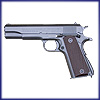
this time of night. I grabbed my 1911 and a Streamlight Scorpion
flashlight and went downstairs as quietly as I could. As I reached the
foot of the basement stairs, I could still hear movement in the far end
of the basement. My heart was pounding, and I’m sure I was suffering an
“adrenaline dump.” I didn’t do any fancy ninja gun/light hand positions.
I just leaned around the corner, Streamlight high in my left hand,
pistol with safety off at low-ready in my right. Surprise, surprise: it
was my eldest son, then about 15, sleep-walking in the basement. He was
disoriented and bumping into things. The learning that came out of this
for me was that a good flashlight is essential for home defense, and is,
in some ways, more important than the gun. Had I been using a
gun-mounted light, I would have had no choice but to point the gun at or
near my own child. The tactical gun-mounted light does not replace the
flashlight.
Summary
The gun-mounted tactical light has its role to play, especially in
low-light situations in which the shoot/no-shoot decision must be made
almost instantaneously, but the gun-mounted light also introduces its
own set of safety and legal problems. It tempts us to break two of the
cardinal rules of gun safety: “Know your target” and “Never cover
anything with the muzzle that you do not intend to destroy.” And
remember, boys and girls, that pointing a firearm at another human being
without justifying circumstances is a felony in most jurisdictions. The
gun mounted light may be a helpful addition to your personal defense
system, but it does not replace the flashlight, and in many
circumstances, the flashlight is far more useful and flexible.
|