|
Sistema
Colt by Jan Haluska
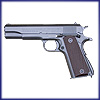
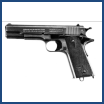
The Sistema has an interesting history. Manufactured in Argentina
from 1927 to around 1960 with Colt-supplied tools, it had parts
interchangeable with any other standard government model, unlike the
Ballester-Molina which also comes from Argentina. When the Argentine
military changed pistols in the late 90s, their Sistemas were
arsenal-refinished for sale in the U.S. at $300 or less. When I found
that price for a Sistema online, it seemed too good a deal to pass up,
especially after I’d heard positive things about the pistols from a
local gunsmith. Mine turned out to be a decent shooter for the money,
if a little quirky.
That Sistema had the usual markings. Along the left side of the
slide was a row of letters: “D.G.F.M. (F.M.A.P.).” These stood for
Direccion General de Fabricaciones Militares (Fabric Militar de Armas
Portatiles). On the right side was “SIST. COLT 11.25 mm MOD.
1927. It had been manufactured in the late 50s, then had apparently
sat unused for most of its career.
The pistol arrived at the gunsmith’s with near-perfect Parkerizing,
a pristine barrel whose serial number matched the others, nice walnut
grips, and a lock-up as tight as a tick. The aftermarket magazines
that had come with it were obvious junk, so I replaced them with two
surplus USGI mags. They worked fine, with only a few failures to feed
or eject, either with ball or hollowpoint.
After about 1,000 rounds I had the gunsmith add new sights,
re-contour the feeding ramp, and sweeten the trigger a little. I
still liked the gun, but by then I’d found out a few things.
Purchasing actual U.S. military surplus magazines had been a lucky
accident. With any others, the pistol was almost certain to jam
trying to eject the last round, and the gunsmith never could figure
out why. I learned this the hard way with two McCormick 8-rounders I
had bought for IPSC matches. They simply would not function properly
in the Sistema, though naturally they worked fine in other people’s
1911s.
Meanwhile the gun was getting a lot looser, and I had begun to
notice a few metal shavings on the interior of the slide where it
fitted into the top of the barrel. Somebody explained that the
equipment Colt had supplied in 1927 was only able to handle the softer
steel of that era, so later models could not be made of newer, harder
metal. Therefore the pistol was going to wear faster than is usual
with today’s guns, and as a result wouldn’t ever be very accurate. (I
was amazed at what a friend’s target-tuned Kimber could do in
comparison.) But it was a plain military pistol after all, and I
consoled myself with the price difference while continuing to have fun
plinking and stumbling my way through practical matches using a couple
of extra USGI magazines. As time went on, my greenhorn mistakes and
mishandling gave it a combat-worn appearance, but that only made it
seem full of character.
Finally a guy who liked how it felt in his hand offered me more
than I had paid for it, and that was that. He’s using it as a
glove-box gun for his old pickup, and I’ve upgraded to a target-grade
Springfield Loaded, so we’re both happy. All in all the Sistema
wasn’t a bad first .45—cheap enough to ding up as I gained experience,
and fun to shoot despite its eccentricities. |