
By Syd
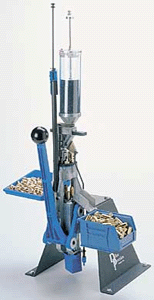
When I decided to buy a Dillon Square Deal B reloading press, I knew zip about reloading. I had never done it nor had I even watched someone else reload ammo. The whole idea of loading my own cartridges was scary to me. What if I made a mistake and injured myself or someone else with a reload? Quality control was foremost in my mind. The second issue was economy. With four active shooters in the family, the cost of store-bought ammo was simply prohibitive. With all of us shooting, we could easily burn up 500-1000 rounds in a single range session. So, I knew that I needed a press which was high quality and fast—a “progressive” reloader.
I talked to friends, read magazines and surfed the web for information on reloading presses. I guess I was responsible for starting one of the endless “Lee vs. Dillon” debates on rec.guns. After all of the debate and discussion, I settled on a Dillon Square Deal B. In one of my queries on the net, I said that what I really wanted to do with reloading was to crank out goodly quantities of practice ammo for pistols in standard calibers, nothing exotic. One guy who responded to me said that if I just wanted to crank and run without a lot of hassle and fiddling with the machine, the SDB was the way to go, and he was right. I’m glad I didn’t go the single stage route because I think the speed would have killed my interest in reloading. When you can sit for an hour and turn out $60 worth of ammo, that’s enough incentive to keep your interest level up.
I talked to a lot of people about presses, particularly about the Lee Pro 1000, the Dillon 550, the SDB and the Rock Chucker. The sense I got was that the Lee was more versatile and a terrific value, but prone to initial difficulties and adjustment headaches. The 550 seemed to be the most popular progressive but expensive when fully dressed out with the cool add-ons you want. The 550 does not auto-index (shell plate turns with the pump of the handle) and I like that feature. The Chucker is a classic and still works very well, but is slow. The SDB imposes certain limitations: it only does a set of pistol calibers with proprietary dies which come only from Dillon, essentially, the standard pistol calibers from .32 S&W to .45 Colt. But the SDB is as close to a “plug and play” reloader as one can get. The SDB ran out of the box and the only thing I had to set was the charge. Once I felt confident enough to set the powder charge and load the press, I started cranking out cartridges, no hassles. Dillon said the press can do 400-500 rounds an hour, and that seems a bit optimistic to me, but 200-300 in an hour would not be hard if you were all set up and ready to run. In the three years I’ve had it, it has produced approximately 20,000 rounds of ammo which is reliable and accurate.
My worst gripe has to do with the priming system. From time to time, it starts to flip the primers and I have to fool around with the adjustment screws to get it to start feeding primers right again. This is especially true when changing calibers. On the gripe list, you could also include the proprietary dies and the fact that the SDB only loads pistol.
There was one real surprise: my hand-loaded ammo was more accurate than any store-bought I’ve used. With my very first batch of cartridges, I was suddenly shooting a ragged hole in the center of the target. I knew that the heavy duty precision shooters did their own loading, but I hadn’t counted on getting a significant improvement in my accuracy off of my first set of reloads. This, of course, has set off that quest for the perfectly tuned load for the forgiving and accurate S&W 9mm (M669).
The first session at the range with the Dillon-reloaded ammo was great. We burned up 250 rounds. In that 250 rounds, I didn’t have a single stoppage, misfire, or failure. I cranked them out last night in about 2 hours. Cost to me (bracketing out the cost of the reloading machinery) was 7¢ a shot, or about $17.50 as opposed to $50, had the same ammo been bought in the store—a 65% savings. It was fun to rapid fire magazine after magazine without worrying about the cost of the ammunition. I did quick double taps at a group of 4 boxes spaced at different depths. Don’t know how many time I hit, but I did some high speed soil cultivation and made some wonderful noise.
At that rate, the Dillon would pay for itself in about a week and a half. Of course, what they say is true: You don’t save money that much money; you shoot more. I really like to practice at least once a week. It’s my belief that your PD gun should be as familiar to your touch as an old glove, and to get that familiarity means lots of practice. The reloader lets me shoot the amount I want to shoot without feeling bad about it.
I bought the complete quick change for .38/.357 which includes not just the dies and shell plate, but also an extra powder measure and head plate. Once you get it set, all you have to do is switch the head assembly, powder measure and shell plate, which is about 5 minutes work. I thought about getting a second press so that I could just leave the two set up for .45 and 9mm, but that seemed to be a little too “into it” somehow. I have a nice little reloading bench set up in a quiet corner of the basement. It’s clean and uncluttered. I think a second press would tend to clutter and confuse things. It does take about ten minutes to change from one caliber to the other once all the adjustments are set.
I have acquired dies for .380, .38/.357, 9mm, and .45, and I reload them all. During that same time, I joined IDPA and shoot matches once or twice a month in addition to my normal practice schedule. It is safe to say that the SDB has saved me thousands of dollars in ammunition expense and allows me to shoot a load which is more dependable than anything you can buy off the shelf. In the three years and thousands of rounds we have loaded, we have experienced two bad cartridges. One was a double charge on a .38 Special and one was a squib load (no powder) on a 9mm. Both of these mistakes can be attributed to the operator taking the cases off of the shell plate and putting them back on the press in the wrong position. Neither mistake was fatal: the Airweight .38 Special held up to the double charge fine, leaving me only with a stinging hand. The squib was fired in the Beretta 9mm, which finished its day at the range, but the bullet was easy to remove from the barrel with an oak dowel and a mallet. The only other problem with the loads that emerged was that the dies will work out a bit after many thousands of rounds. I loaded a batch of .45 ACP that was too long, and this contributed to some feed failures in the 1911s. I would suggest that you check the OAL of your cartridges every 500 rounds or so.
I have spent a lot of time with the SDB and it has proven itself to be a worthy tool. Dillon’s technical support is the best in the business. The press itself is very solid and doesn’t give the operator trouble. I would highly recommend the SDB to anyone who shoots a lot of pistol. It will make you a better shooter in two ways: first, you will understand your pistol and ammunition much better by building your own ammunition, and second, you will get more practice because you will have all of that inexpensive but high quality ammunition on hand. You will also get a lot more popular with your pistol shooting friends because they will want to shoot that good ammo too.
Comments, suggestions, contributions? Let me know