|
My Springfield Mil-Spec
M1911A1
by Syd (1997)
I took the SA Mil-Spec to the range today for the first time. I stepped into a lane
next to two guys who were trying to train on a .40 S&W Glock. They were all over the paper. I
put on my shooting gloves slowly, and with a certain degree of ceremony, loaded a
magazine, ran the target out to about 10 yards, and proceeded to shoot a ragged hole in the x-ring, and then, to ice the cake,
loaded a second magazine and shot a second ragged hole into the ocular cavity zone. The
boys with the .40 packed their gear and went home.
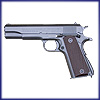
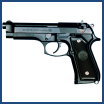
This particular gun is Springfield Armory's rendering of the Mil-Spec
M1911A1. It's as close as they want to get to the original configuration that was issued to
the troops. It varies from the true mil-spec M1911A1 on some small details: the ejection
port is larger and lowered; the magazine well is slightly beveled; the manual safety is a
bit larger; the front sight leaf is larger and thicker; the barrel is
throated for modern hollow-point ammo, and it has a black parkerized finish
rather than the greenish gray of the WWII guns. It is milled from better steel with the
benefit of contemporary tool technology, so, in a way, you could say it is
"better" than the original Colt Government Model, while maintaining the look and
feel of the original. It lacks, of course, the cache of those wonderful old pieces
that
fought their way across Europe and the Pacific, but those guns are museum pieces now, and
I wouldnt take one out to play with it.
I have read so much about people "tricking out" these guns, essentially
rebuilding them into custom pieces, that I expected to immediately launch into a series of
mods. But now I find myself debating if I should do anything with this one. I don't get
slide and hammer bite, so I really don't need to change the beaver tail and hammer. I
don't like super-light triggers, and the trigger on the Springfield is fine
– it
"breaks like a glass rod." Being a true M1911A1, it doesn't have the magazine
safety like the Hi-Power, the firing pin
block of the Series 80 Colts, or the firing pin block and mag safety of the S&W DA/SA's, so
the trigger is already light and smooth to my touch. I really like the Parkerized
finished. I'm the kind who grieves a lifetime over rust spots in blued steel. I added a
full length guide rod from Wilson Combat and a set of Pachmyar grips. I will probably
change out the hammer and sear because I want to put an extended beavertail on it, and
I'll probably have Novak combat sights installed on it. I'll do stuff to it because that's
part of the reason I wanted it
– the 1911 is the hot rod frame of pistols like the Model A
Ford and the `57 Chevy are with cars. But it's nice to feel like I don't need to do a
damned thing to it for it to be a very enjoyable shoot.
My first real shakedown cruise with the big .45 was an IDPA match, and I was delighted
with it. There were no stoppages or malfunctions and the accuracy was impressive. The
shots went where I wanted them to go. I can definitely see why a lot of people view the
M1911A1 as the greatest fighting hand gun ever built.
It's not easy to find things to criticize about the gun. With 2500 rounds downrange, it
has proven itself to be highly reliable. Although not "match grade," the
accuracy is excellent and more than adequate for tactical action shooting like IDPA.
It is capable of 3" groups at 25 yards. It
did experience a half dozen failures to feed within the first 300 rounds. However, after
adding the Wilson full-length guide rod and completing the 500-round break-in period, it
has experienced no further malfunctions. It has never experienced other types of failures
such as double feeds or extraction failures. The front sight blade is square on the back
and can snag on a holster if the holster isn't perfectly fitted for a Government Model
1911. The gun is also large and heavy, a little too big for comfortable extended concealed
carry. I know people who do it, but at 39 ounces empty, the Government Model is a load.
There are some things about the 1911 that you have to experience to appreciate,
particularly the way it feels in your hand, the accuracy, and the surprisingly mild recoil
it creates in launching that big old bullet. Some of it is emotional and aesthetic. It is,
after all, the handgun carried and fought with by American forces through four terrible
wars. It was affirmed and proven in those trials by fire by those who had to use it. That
counts for something.
To me, the thing that sets the 1911 apart is the way that it shoots. In my hand, a
Government Model 1911 is just more accurate and faster than any other autoloader I have
used. Some of this is the trigger; some of it is the inherent accuracy of the .45 ACP
cartridge, and some of it is in the design of the gun. In terms of accuracy and power, I
find myself comparing the 1911 not to other autoloaders but to long-barreled wheel guns.
There are other good combat guns, but if I knew I had to take one pistol to a fight it
would be a 1911.
As to what empirical data might be drawn upon to substantiate the superiority of the
1911, perhaps it is that so many old gunfighters seem to like
them. This follows the logic of Hagar the Horrible when asked if you had to be smart to be
a Viking. He answered, "No, you just have to be smart to be an old Viking."
For more on this issue, see "Why
the 1911?"
The main thing is that they're just so much fun. They shoot great, look great, and feel
great. Five Years Later This gun has
served well. I shot it in a lot of matches, and then, when in my
fickle way, I moved on to other models, my son adopted it for his
match gun and he has come to love it more than I do. In five years of
heavy service the only problem I have had with the gun was that the
front sight post worked loose and I had to have it re-staked. I
replaced the factory 17 lb. recoil spring with an 18.5 lb. spring from
Wolff. I did a bit of polishing on
the feed ramp, throat and chamber, but nothing extensive. I never
did add a beavertail, Commander hammer, or custom sights. I decided
that I just liked the gun the way that it was, and if I wanted to do
extensive modifications on a gun, I would do it to another and let
this pistol maintain the classic form it has.
While these guns have gone up in price a little, they remain an
excellent value. I paid $400 for mine NIB in late 1997. I'm still seeing
them in the $475-$550 range. Whether you want a pistol that is a close,
if slightly enhanced, reproduction of the G.I. gun, or if you want a
solid platform upon which do build up a custom gun, it's hard to do
better than the Springfield Armory Mil-Spec. Nine Years
Later This is the pistol I bought in 1997 to start shooting
IDPA. It's the pistol that inspired The Sight M1911. It's the one
that, when I fired the first magazine, I said, "Wow!" It's the one
that my son, Alex, prefers over his $1K Kimber for matches, and he
never ceases to try to get me to give it to him, and calls it "my
pistol," but I won't give it to him, at least not yet, not until I'm
too old and feeble to shoot it. I haven't shot it in several years, in
part because Alex is always shooting it, and in part because I have
come to prefer the
Combat Commander for matches. The Government Models are a little
slow for me in terms of getting onto the target. Yet, I love this gun
like few others. It’s in that rarified rank with the Winchester Model
94 with which I took my first deer. I have other pistols, but none of
them have the psychic power that this one does.
My dad was a tremendous repository of bullshit about the Government
Model .45. Most of those tales like, "If you hit a man in the thumb
with one it will spin him around," and, "A normal person couldn't hit
a door at 20 feet with one," I heard first from him. The irony was
that he had carried one during his brief stint in law enforcement
before I was born. He was Navy and I don't know if he actually got any
training on the gun during the war. But, nevertheless, one of the
first tasks I had with the gun was to work through the lore and
stories, and separate fact from fiction.
The SA Mil-Spec was a game gun for me from the start. I wanted to
check out the sport of IDPA which was new at that time. That's why I
bought a big, heavy gun. I think I only actually carried it for
personal defense once. It’s just a bit too heavy to be comfortable for
me for carry. Big guns like this are more pleasant to shoot for
matches and such. The follow-up is excellent; accuracy is inspiring,
and abuse to hands is kept at a minimum. It never was about the
calibers. It was about "shoot-ability." I just noticed immediately
that I got better hits faster with the SA/45 ACP combo than with the
other handguns I had tried. The inherent accuracy of the pistol, its
excellent trigger, and the .45 ACP cartridge make it a rewarding
handgun to fire. However, I didn’t get rid of my lightweight snubs and
compact 9mm’s that served for personal defense. The rest, as they say,
is getting to be history at an alarming rate. The Sight M1911 will
celebrate its first decade in January of 07.
The main frame home page of The Sight M1911 has had 1,112,731 hits.
That's over a million hits on one page of that web site, and the site
has well over 300 pages at this point. That's an honest number. I
started the counter at 0 in ‘97 and I have never messed with it. I
won't say that The Sight is the "best" thing I have ever done, but it
has definitely had the most impact of any piece of writing I have
done, and this pistol was the impetus for it.
Unconsciously, this particular pistol has influenced a million people.
I find that statistic staggering – the miracle of the internet, I
guess. It has never “fired a shot in anger.” It didn’t have to. It’s
an icon. I started my e-mail newsletter in 1999 just to alert people
on what was going on in gun rights, and on my mind at the time was
defending my right to keep and bear this pistol. This pistol is
“mythical” in the sense that it is a symbol that points to a reality
that is beyond it, and for the most part, inexpressible. How do you
describe freedom and heroism? This gun points to that level of
meaning. It demands that you search out the stories of heroes and
villains who have fought with the M1911, like York, Basilone,
Dillinger and Barrow. That’s where this gun takes you – to some of the
darkest moments of the 20th Century. There is perhaps one other
handgun that has this kind of effect, and that would be the Colt
Single Action Army revolver. The old six-gun is an antique, obsolete
for anything except cowboy action shooting. The 1911, old as it is, is
not at all obsolete, and is probably more popular and more in use
today than at any time in its illustrious history.
I do consider the M1911A1 to be the greatest fighting handgun, but
that’s just my opinion and you know what they say about opinions.
There are other fine pistols that will do the job, but none to my
knowledge have seen the moments of greatness that Old Slabsides has.
There are none that feel quite as “right” in my hand, or burn up the
stages quite as well for me. Most of all, no other firearm has fired
my imagination and sustained a decade-long effort to understand and
describe it that this one has.
The Mil-Spec is really nothing special when viewed objectively, just a
95% true reproduction of the G.I. M1911A1 of World War II. But to me,
it’s something more like a magic carpet.
 |