Kimber Compact
By Syd
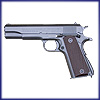
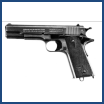
The Springfield Government Model 1911A1 is a great gun for target and competitive
shooting, but it's a really big gun, weighing 39 ounces empty. Its size makes it hard to
conceal and it's something of a burden to pack around all day. Although I love the
performance of the pistol, I found myself longing for a smaller, lighter 1911-pattern gun,
having the cool custom features that everyone likes in a 1911 and yet a reasonable price
tag. At the same time, I didn't want one that would be so small and light that it would
sacrifice accuracy or be unpleasant to shoot.
I searched the Web, went to the gun shows, and cruised the shops looking for this
"best of all possible worlds" .45. The Colt Commander was ok, but the finish and
detailing were not where I thought they should be. The Colt Defender looked too fat and I
was concerned that it might be too light to shoot comfortably. The new Colt CCO looked
like it was made of plastic even though it isn't. Additionally, I have some political
issues with Colt at the time. The
Springfield Ultra Compact and Champion just looked like chopped down Mil-Spec. The
Springfield V-10 was attractive, but the barrel porting is not something I like and it
disqualifies the pistol for IDPA shooting. The big-name custom shop pieces, such as the
offerings from Wilson and Baer, while gorgeous, were just too doggone expensive. (I even
tested a Glock 30 but found it too fat, too ugly, and lacking in accuracy. I will say that
the Glock 30 is a nice pistol to shoot that's easy on the hands but the Un-Safe Action
trigger makes me nervous.)
I walked into one shop and the proprietor asked me what I wanted to see. I said,
"A compact .45." Without hesitation, he reached into the case and retrieved a
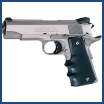
Kimber Custom Compact. It was parkerized with diamond checkered rosewood grips. I liked it
right away. The Custom Compact is a hybrid: an almost Commander length slide and 4"
bull barrel with an Officer's grip. It takes Officer's magazines, and comes with one
7-round Shooting Star. (I bought 3 more McCormick 7-round Officer's magazines so I'd have
an adequate load-out for IDPA. Even though the Kimber mag is a Shooting Star, there is a
slight difference in the cutaway on the left side and when I first put the mags in the
gun, they didn't want to lock back the slide. However, in range testing, the McCormick
mags functioned properly with no failures to feed or lock back.)
Other nice "custom" features on the gun include the McCormick skeletonized
hammer and trigger, extended beavertail, checkered slide release and mainspring housing,
McCormick Low Profile combat sights, overall de-horning, and single recoil spring. Since
the Compact uses a bull barrel which aligns directly on the slide, there is no barrel
bushing. Take-down is accomplished by locking back the slide and placing a small wire
"disassembly tool" in a hole in the guide rod. With the "tool" in
place, you gently release the slide lock and ease the slide forward,
which traps the recoil spring and causes the guide rod
bushing to slip out of the slide. Then the slide stop is removed, and the slide, guide rod
and spring, and barrel can be removed for cleaning. I didn't really like the wire tool
disassembly arrangement, but after seeing the way the gun performed, I came to view it as
a necessary evil to accomplish the reliability and accuracy that the gun displays.
Although I had read a couple of glowing reviews about this particular pistol, I had
some apprehension about buying a Kimber product. I've followed their triumphs and defeats
fairly closely. My first experience with a Kimber was with a Classic belonging to a
colleague in a tactical shooting class. That particular pistol was an absolute
jam-o-matic. While it could have been operator error or a poorly
maintained pistol, it was a bad first impression. I was aware of problems with slide stops on
some of the early models, of some after-market mags not locking back, and the sight
problems with the early production Gold Match models. Most disturbing was buzz I continued
to pick up about their customer service and custom shop. Personally, I don't see how a
service/custom shop can function without a test range, and it's my understanding that the
Kimber shop does not have a range for sighting in and reliability testing. With that said,
the overwhelming majority of Kimber owners report tremendous satisfaction, accuracy, and
reliability with their pistols. Since I know several decent 1911 mechanics, I decided to
take a chance on the pistol with the idea that if I did get a problem gun there would be
local technical support to iron out the problems.
Putting the Custom Compact through its Paces
The pistol has performed superbly. At four hundred rounds through the gun, it has
experienced no stoppages, failures to feed, or malfunctions of any kind. Test ammo was
Fiocchi 200g jhp and my own reloaded hardball.
At the outdoor range, shooting at thirty yards offhand, I could keep the shots in a
saucer-sized area (A-zone on an IDPA target) with most grouping in a very tight little
pattern two inches below center. I tried to jam it by shooting "gangsta" style,
weak hand, rapid fire, and upside down. There were no stoppages. In the indoor range,
shooting at 15 yards offhand, ragged holes were easy.
With reliability, accuracy, and magazines tested, the next step in checking out the
pistol was to run it through an IDPA match. My scores were excellent, especially
considering that it was a new gun with a longer Chip McCormick skeletonized trigger which
has a different feel than the short trigger of the M1911A1. What I noticed the most was how
quickly the pistol acquired the target and got back on target during double taps. The
purpose of the tapered bull barrel design is to help in this regard because it adds some
weight to the muzzle and balance to the gun.
One would not think that the reduction of six ounces of weight and an inch in slide
length would make a huge difference in the way the gun carries, but it does. The handle is
.4" shorter than a government model, sacrificing one round in the magazine but adding
to the concealability. At 34 oz., the pistol is on the heavy side, but with a good
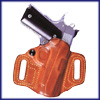
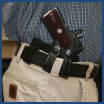
holster, it is not uncomfortable to carry for extended periods of time. The holster I
selected for it is the Galco Quick Slide. It is quite comfortable and offers excellent
concealment.
Is the Kimber Compact the "best of all possible worlds .45?" If it isn't,
it's pretty darned close. When you take in the whole picture of appearance, features,
performance, and cost, it looks like one of the very best options.
Three Years Later...
I felt that it would be worthwhile to update my
original review of the pistol which has become my favorite handgun,
the Kimber Compact. I bought it in the summer of 1998. I wanted a 1911
that was smaller than a Government Model but sturdy enough to stand up
to a lot of match shooting and training sessions. At that time, this
meant either a Kimber Compact, a Colt Compact, or a Springfield
Champion (at that time, the Champion was a Mil-Spec with a 4"
barrel). Of the three, the Kimber appealed to me most, and I was
intrigued with the new builder of 1911-pattern pistols. This was
before Springfield Armory and Colt had seen the light and started to
add the "custom" features to their guns such as extended
beavertails, extended manual safeties, and snag-free combat sights.
(Compare the sights, grip safety and magazine release of the Colt
Compact to the Kimber.)
I haven’t been sorry.
Since ’98, the gun has been my constant companion
for matches, training session, backwoods expeditions, road trips and
daily carry. I have lost count of how many rounds the Compact has sent
downrange, but I estimate it in the vicinity of 10,000. Spending as
much range time as this with the gun has given me a certain confidence
in it and comfortable familiarity that I don’t have with other pistols. I know it will put the
rounds where it is aimed. I know it will go "bang" every
time. I know it takes me exactly 1.43 seconds to get it out of the
holster and put two rounds into the A-zone of a target. I don’t have
to think about drawing it, sweeping the safety off, getting the front
sight on the target and squeezing the trigger. My muscles have all
that memorized. Actually, I don’t really have to use the sights
because I know by the feel of the gun where the bullet is going to go.
It isn’t fussy about ammunition. I have run all sorts of loads and
bullet shapes through it, and it handles them all with equal aplomb. I
have compared it head-on with hand fitted custom jobs costing three
times as much and found that it compares quite favorably.
Troubles
Reliability: When the gun was new, it was
perfect. Unlike many new 1911 pistols, it did not experience feed
failures. Somewhere around 3,000 rounds I began to experience feed
failures and an occasional premature
slide lock. This really distressed
me because the gun had been so clean up to that point. It took me a
couple of months to scope out the problems. As it worked out, there
were actually three problems rather than one.
The first problem was, that after thousands of
reloaded rounds, the seating die on my reloading press had backed out
just a bit and I was cranking out rounds which were too long. A
second, and the most important problem was that my recoil spring had
begun to spread out at the rear, to the extent that the slide would
bind on the spring when it went fully to the rear during the recoil
cycle. I may have exacerbated this problem by putting my recoil spring
in "backwards" meaning the open end of the spring to the
rear. (Note to Compact owners: the open end of the
recoil spring goes toward the muzzle end and the closed end of the
spring goes to the rear.) I always had doubts about the "metal
injection molded" slide stop, and at this point in the gun’s
life, it was beginning to look a bit battered. A fresh Kimber recoil
spring, installed correctly, and a Wilson Bullet-Proof slide stop
coupled with an adjustment of the reloading press, solved these
problems. The second Kimber recoil spring lasted about another 2500
rounds when it too began to spread out at the back end and bind the
slide even though it was definitely installed correctly. This time, I
replaced it with a Wolff 22 lb. Commander spring and I have had no
other problems since. I will add that when I needed customer support
from Kimber, I got it promptly and it was helpful.
Finish: The gun came with your basic black
phosphate finish. I have heard the Kimber phosphate finish criticized
by more than one user, and it didn’t hold up for me. The Kimber
phosphate finish does not seem to be as deep and tough as the mil-spec
parkerization of the GI guns. During one camping trip, the gun was
laying in the tent in a leather holster during a bad rain. The tent
leaked and unfortunately, a pool of water gathered and soaked into the
holster while I was asleep. By the time I discovered the problem, the
chemicals in the leather had stripped a section of the finish off on
the left side. I did my best to touch it up with cold blue, but it
never looked really right. Finally, the rear stake of the plunger tube
came loose and I knew it was time to go to a gunsmith. I had the gun
parkerized by a local 'smith, Danny Jackson, who really knows how to do
a park job. Click here for before and
after pictures of the parkerization.
"My Gun"
The Compact remains my favorite gun to shoot, the
most familiar in my hand, the most trusted member of the arsenal. Were
the proverbial doo-doo to collide with the air circulating device, it’s
the handgun I would want at my side because I know that I would have
the best chance of getting the job done with it.
"...I have now fired more than 1,500 rounds during my test
and evaluation of the Kimber Compact Custom. There have been no
stoppages of any kind...This is the first production-series compact
caliber .45 ACP M1911-type pistol that requires no custom gunsmithing
to bring its reliability up to acceptable standards. It's ready to go,
right out-of-the-box, and, like the full-size Kimber Custom Classic
.45, it has all the custom features you need on a fighting .45. In
conclusion, the Kimber Compact Classic .45 is simply outstanding."
Peter Kokalis, Soldier of Fortune, 4/98
|