|
Crimson Trace Lasergrips
By Syd
I have an abiding mistrust of battery-operated gee-gaws
that are supposed to make my guns work better. My basement is a
veritable graveyard of electronic gadgets that suddenly and mysteriously
quit working, never to come to life again. Being a dedicated adherent
to Murphy’s Law, I have observed that the tool with the fewest parts
tends to be the one still functional at the end of the day. I have sent
any number of mowers to lawnmower heaven, but Granny’s garden hoe still
works. So, is there any room in my
Luddite self-defense universe for a 21st Century laser
aiming device?
Maybe so, and besides, they’re really cool.
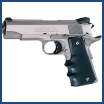
The Crimson Trace Lasergrip is a creative concept
which integrates a laser aiming device into the right grip panel of the
gun. The grips are sculpted to nearly the same shape as the original
grips so that all of your holsters still work. There is only a small
hump at the top of the right panel under which the laser is mounted and
the activation switch midway down the grip panel. The
grips are made of a sturdy black polymer plastic material (or “combat
rubber” depending on which model you buy) that is tough and feels good
in your hand. Lasergrips are installed by simply replacing the factory
grips. In the case of the 1911, this mean four screws and you’re done.
No other modifications need to be done to the gun. It is adjusted for
windage and elevation with two of the tiniest Allen wrenches I have ever
seen. It is powered by two wafer-style 2032 lithium batteries.
So, what can Lasergrips do for you?
- Aid in training.
- Enable target acquisition in low light
situations
- Provide rapid and positive sight indexing on the
target
- Make possible easier target acquisition from
weird positions and from behind cover
- Facilitate visual communication and muzzle
awareness
- “Threat de-escalation”
Training Aid
The first thing that got my attention with the
Lasergrips was their capacity to give instant visual feedback for what I
was doing with the gun. The little red dot will quickly show you if you
are milking the trigger, flinching, or pulling your shots to one side or
the other. People with "mixed dominance" vision (right-handers with
left-dominant eyes and vice-versa) can get a clear sense of the tricks
their eyes may be playing with their sight picture. While it's a
controversial technique, point shooting can be dramatically improved by
watching the dot when you draw. At twenty five yards, I found it easy
to keep all the shot in the A-zone while holding the gun at
approximately chest level and putting the red dot on the target without
ever looking through the sights. I have pretty good eyes, so I’m
speculating, but I have a hunch that people with impaired vision would
be helped in getting onto the target by the laser, and I think they
would find it much easer to get good hits with the laser than by trying
to use iron sights. Instructors could be assisted in diagnosing problems
by watching the student and observing the behavior of the laser on the
target.
Target Acquisition in Low Light Situations
I never have been overwhelmed with Tritium night
sights. They’re better than no illumination at all, but not by a whole
lot. The laser sight is much quicker and more positive in low light
conditions. It’s not a flashlight, although it does splash a little bit
of light around. If you’re going into a pitch-black darkness, you still
need a flashlight, but if there is any ambient light at all, the laser
will get you on target quickly and in a very positive way without having
to force your vision through those dim Tritium notches and posts. The
advantage that the Tritium does have over the laser is that they don’t
give away your position like a laser beam can.
Rapid and Positive Target Acquisition:
Crimson Trace Lasergrips are no replacement for
iron sights, and if I had to make a very precise shot, I would still
rely on the iron sights as long as I could see them. At the same time,
getting the red dot on the target is very quick and bypasses the need to
align the rear notch, the front post and the target. It is a medical
fact that as we age, the eyeballs become less flexible. The eyes adjust
their focal point by flexing, becoming slightly longer or shorter to
focus at different points in the distance. Older eyes, being less
flexible, do not adjust as quickly or at all to different focal points.
Some people have difficulty getting a sight picture even under optimum
conditions. For those with less than perfect vision, getting a sight
picture can be slow, and they may not even be able to get just the front
sight in focus well enough to make the shot. In these situations,
Lasergrips can be a real help in getting on the target quickly. With
relatively good vision, corrected with glasses, I found that getting the
dot on target quickly in a match setting was easy. I have always had a
tendency to drop my shots just a bit, and when you’re shooting Pepper
poppers at a distance, dropping the shot can cause the popper not to
drop by hitting it too low. Using the laser sight, my percentage of
quality hits definitely improved on the poppers at longer distance. At
closer distance, I think the laser may have actually slowed me down just
a bit because I was looking for the red dot rather than just shooting
the target with “front sight… press.” One situation did completely
defeat the Lasergrips. A popper had been painted fluorescent orange and
the red dot simply disappeared in the orange paint. I had to revert to
iron sights on that one.
Easier Target Acquisition from Weird Positions and
From Behind Cover:
When using iron sights, you must place at least
part of your head behind the gun, and expose the gun and some of your
face and head to hostile fire. With the Lasergrips, if you can see the
target you can aim the pistol without exposing as much of your head.
Under certain circumstances, this could be a distinct tactical
advantage. Additionally, an officer who was down and wounded could still
aim his pistol even if his wounds prevented him from aiming the pistol
in the normal way.
Visual Communication and Muzzle Awareness
In a team context, the laser sight could be used as
a pointer to indicate the position of a hostile or to signal potential
paths of movement without making any sound. In a team training setting,
the laser can be used to increase muzzle awareness and allow instructors
to see clearly who is covering who.
"Threat De-escalation"
I love euphemism like this. "Threat de-escalation"
simply means making the little red dot dance on the chest of a potential
evil-doer and producing a rapid change of heart in said evil doer by
giving him a clear visualization of where the hole is going to go if he
decides to pursue his current course of action. Of all the benefits of
the Lasergrips, this one is the most problematic for me. Why? Well,
there's no assurance that the aggressor is going to see the dot and make
the right decision about it in the desired time frame. Second, this
capability could tempt a person to draw and point their gun at a person
in order to control them, but this could leave the user open to a charge
of brandishing or even assault with a deadly weapon. Put another way,
pointing a gun at another person has serious legal ramifications, and
should only be done in circumstances that justify the use of deadly
force. Nevertheless, a goodly number of police officers and soldiers
have reported successful "de-escalations" in violent aggressive subjects
with the use of the laser, and if the laser – legally applied – prevents
a shooting, that's a plus.
A Few Things That Lasergrips Aren't:
They aren’t a replacement for your iron sights.
They aren't a shortcut to practice and good marksmanship. They aren't a
flash light, and most of all, they aren't a cool toy with which to
intimidate and mess with people's heads. A couple of years ago a cadet
in our local police department got into a verbal confrontation with a
patron at a bar. The cadet was in uniform and, while tempers apparently
got heated, the mouthy bar patron finally backed down and left. But as
he walked away, the cadet drew her service pistol which was equipped
with a laser sight and put the dot between the patron's shoulder blades.
This moment of indiscretion resulted in the cadet losing her job and the
possibility of ever working as a police officer. Had she been a
civilian, she probably would have been charged with a felony. The moral
of that story is, don't put the little red dot anywhere that it wouldn't
be appropriate to put a bullet.
Testimonial on Toughness and Water Resistance:
A SWAT Team Captain and
Instructor writes:
"I teach basic to advanced
building search classes and SWAT tactics. I have been using the Crimson
Trace laser on my Glock 17 for almost five years now. [We will forgive
the captain for his poor taste in guns for now…] I use my weapon each
time I instruct to demonstrate the use of white light as well as the
tactical advantage a laser sight has in a CQB/building search
environment.
I carry my weapon on a
daily basis while on and off duty, subjecting it to the daily 'wear and
tear' of being jostled about and bumped around while getting in and out
of a unit, etc. It has never failed to function properly when I needed
it.
More importantly, I also
work the major holidays on the Colorado River for our Department's
“Boating under the Influence” (BUI) Program. This duty requires being on
the water in a patrol boat 10 to 12 hours a day. It is not uncommon to
respond to emergencies that require entering the water to assist
someone.
When this occurs there is
no time to remove your weapon or other gear. The first time I went in
the water with my weapon on I didn't give a thought to the fact that I
subjected the laser system and its electrical components to complete
emersion in water.
Later, after I got off
duty, I was in the process of getting ready to clean my weapon when it
dawned on me that I had probably destroyed the laser system by going in
the water with it. I hit the pressure switch, and quite honestly, to my
amazement… IT WORKED!
I can't tell you the
amount of times I have been in and out of the water with my weapon on,
but each time I go in so does Crimson Trace's Laser System. It has never
failed to work when I need it, even after being completely immersed in
water on numerous occasions. This is quite a testament to the
reliability and durability of your product.
I thought it important for
you to know this and be able to tell other users of the reliability of
your system and the type of abuse it can be subject to and still
operate.
Although I can't state the
agency I am employed by, you may use my personal experiences, confidence
and endorsement of Crimson Trace and your Laser System."
-- Captain James D.
Stalnaker
Testimonial on Toughness and “Threat De-escalation”
My name is SSG Sieler. I
am currently deployed in Tikrit Northern Iraq in support of Operation
Iraqi Freedom with B Company 2-4 Aviation Regiment 4th Infantry
Division.
I purchased one of your
outstanding sighting systems to go with my Aviation Life Support
Equipment. I use it everyday and must say that it is one of the best
combat multipliers I have in this combat theater. I must honestly say it
has saved lives over here. Not only those of U.S. services members but
also the lives of Iraqis.
Often we are faced with
tense situations where the "little red dot" makes the difference between
the use of deadly force or the power of intimidation. Even with the
language barrier the little red dot speaks volumes for us.
I'm sure you have had
soldiers here try to contact you to purchase ones for themselves, as
everyone I run into loves mine. The environment here is extremely
inhospitable and my M-9 takes a beating on a daily basis. The OPTEMPO in
Army Aviation here is staggering and all the aircrews carry the Berretta
9mm. Many soldiers here have bolt-on personal sighting devices but none
are as transparent in use, (your grips fit just like the original
equipment and never hinder operations as others do) or nearly as
durable. Mine has outlasted all the others.
Once again I would like to
thank you for an outstanding product. It has made my job that much
easier. I have no idea how I ever got along without it.
-- SSG SIELER
Nits to pick:
The grips appear to be built fairly solidly. They
can withstand complete submersion in water and rough duty. There is a
design feature on this particular model of the grips (LG-201) that I don't like
too much. The batteries are held in place by a metal plate which is
positioned on the grip panel by four little feet that fit in shallow
notches in the back of the panel. The positioning is not very positive
and it can be kind of fumbly getting the grips back onto the gun after
they have been removed. I usually remove my grips when I clean a 1911 so
I don't get pools of oil or cleaner sitting under the grips. This is
even more important with the Lasergrips because I can’t imagine that oil
or solvents soaking into the mechanism and batteries could do them any
good. Hence, a cleaning results in several attempts to get the grips
back on the gun before everything lines up and goes back on right. I
think the plate could have been designed to position itself on the grip
panel more positively.
Summary:
Crimson Trace Lasergrips are an innovative concept
that can provide a number of training and tactical advantages. I
wouldn't consider them something I couldn't live without, but many
tactical situations and circumstances come to mind in which the
Lasegrips could be a significant asset.
Specs:
Dot Size: Approximately 0.5" diameter at 50 feet.
Beam Intensity: 5mw peak, 633nm, class IIIa
laser. Maximum output that federal law and technology allow. Also
available in infrared for law enforcement and military only.
Power Source: Two #2032 lithium batteries
(included). Provide over four hours on on-time use and have a
five-year shelf life.
Activation: Integrated momentary pressure
switch(s) (all models) and a master on/off switch (most models).
Adjustment: Fully adjustable for windage and
elevation with Crimson Trace's precise sight-lock calibration screws.
Warranty: Full three-year no hassle warranty on
all parts and labor.
|