
By Bill Vojak
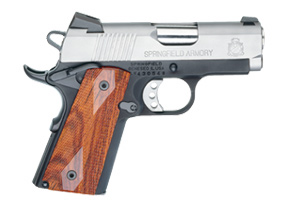
I finally had a chance to take my Springfield Micro Compact 1911 out to the range this weekend. Fit and finish are very good. The gun takes officer magazines, and is equipped with Novak low profile night sights. The whole gun is “melted” so there are no sharp edges. The gun has a bushingless barrel, an ambidextrous safety, a beavertail, with memory groove, It also has the Integrated Locking System, that you can simply ignore. The lock seems to have no effect on the trigger feel.
Earlier in the week I sorted through my ammo supply and dug up 3 different types of rounds (all were purchased in 1994).
- 185 grain, cone shaped with a flat nose. All lead
- 185 grain, cone shaped with a flat nose. Fully jacketed
- 185 grain +P, jacketed HP with a average sized opening
So over the weekend I grabbed an assortment of ammo and headed to the range. I took 200 rounds with me, providing an mixture of the three above mentioned types of ammo. I had 3 magazines. The two Springfield magazines that came with the gun, and one Chip McCormick 7 round Shooting Star magazine.
I started with an SA magazine and the all lead ammo. I had 2 jams with that magazine. One in the middle, and then on the very last round. The next SA magazine provided the same results. The McCormick magazine only had one jam in the middle.
After a bit of shooting I realized that the SA magazines have a dimple on the follower that seemed to cause the last round to in each magazine to fail to feed. The McCormick magazine had random failures, but never any last round problems. I switched to the fully jacked ammo and had similar results. When I switched to the HP ammo the failures to feed dropped considerably. But after just a little bit of shooting the failure to feed rate amongst all the ammo types started to drop off.
I would estimate that in the first 50 rounds, I had at least 1-2 failures with each SA magazine, and 1 failure each time I used the McCormick magazine . But as I got close to 50-60 rounds the failure rate was closer to 1 failure for each SA magazine , a 1 failure every second use of the McCormick magazine .
During the next 50 rounds I only had about 4-5 total failures to chamber, and only with the SA magazines, and these were only on the last round of the magazine. The final 100 or so round only had one minor failure. That was with an all lead, flat nose round, and the slide was just a 1/4 or so out of breech. I tapped the back of the slide, the round finished chambering, and I fired it. This happened at somewhere about round 140-150, so the last 50-60 rounds chambered and fired without any problem, using all 3 magazines.
I do have a couple more of the Chip McCormick magazines on order and will use them instead of the SA magazines for CCW, as they seem to be more inherently reliable, and they hold one extra round (7). I had no failures with the gun firing when the trigger was pulled. If there was a round in the chamber and you pull the trigger, it fired.
So it looks like it took about 200 rounds to break in the gun. I still want to put another 200-300 through it with no jams before I’ll declare it fully broken in. It seems that generally speaking, all of the 3″ micro guns made by the different manufactures tend to be a bit finicky at first. The physics of making a sub-compact .45 just seem to require much more thought than when designing a 5″ standard gun.
As for shooting, I was having some problems at first with it shooting low. Then I realized this gun really likes you to line up the 3 dots on the sights instead of the tops of all the sights. Once I did this it still shot low, but only a inch or two instead of four or five. Next time out I’ll be trying some 230 grain rounds and see if that raises the impact point.
I was using some homemade 8 1/2 x 11 inch paper targets and had no problems keeping all of the rounds on half of the paper.
By time I got through the break in period and got a feel for the sights, I had put about a 150 rounds through the gun. At that point I tried to see what types of groups I could get. At 30 feet a typical 5 shot group was 3-4 inches depending on ammo. I’m pretty darn sure I can cut that down by at least one inch with a bit of practice, using ammo that the gun likes. The short sight radius does present some practical limits when shooting.
There is a fair amount of muzzle flip, but the recoil in my opinion, is mild. I’ve never really been recoil sensitive, except a Ruger SP101 in .38 special I own. Shooting my Taurus 85CH with 158 grain +P rounds never proved to be uncomfortable, even though it’s smaller and lighter than the SP101. I guess the geometry of the grips on the SP101 just don’t match my hands. A problem that is easily solvable by buying a new set of grips.
It’s been a while since I’ve fired a .45, and I have to say that it was fun. I never really understood all of the stories about the “tremendous recoil”, and how “it will knock you flat on your a**” and so on that some people claim regarding .45s. Even with a 3 inch barrel, a alloy frame, and shooting 185 grain +P ammo, I felt that the recoil was no big deal.
A couple other people tried shooting the Micro and liked it. Like me, they all shot a bit low. The guy in the lane next to me let me try his Kimber Ultra (5″). After shooting the Micro, the full size gun felt like a .22!
So I’m really happy with this gun. I still need some more practice with it. It’s looking like long term reliability will be high now that it’s past the initial break-in period. I have no problem with having to put a few hundred rounds though a gun to break it in. Too many people buy a gun, loaded it up, and never fire it till then need it in an emergency. As this is my new concealed carry gun, I’d still be running a few hundred rounds through it on a regular basis, even if it had been 100% reliable from round #1.
My only other problem is that Springfield provides a manual that describes three different takedown procedures, none of which are for the Micro. I had no problem removing the slide, but I still can’t figure out how to remove the barrel. None of the three described methods in the manual, worked. Further research on the WEB led to the discovery that Springfield forgot to include a spring tool in the box. It’s just a small plastic clamp that keeps the spring compressed so you can remove the barrel. I called Springfield and they are sending me one.
I bought a Don Hume J.I.T. holster for it, and It’s really nice. It’s just a thin strip of leather that covers from the trigger guard, to the end of the barrel. Even though the Micro’s barrel and grip are longer than my Taurus .38 snubby, It really is easier to carry since it is so much flatter. Also it’s easer to carry spare ammo in a magazine, rather than a speed-loader. Once I get the two extra McCormick magazines I’ll have a standard carry of 21+1 rounds of ammo.
As for the carrying cocked & locked, something I was a bit wary of, I’ve already transitioned to carrying with a round in the chamber. The J.I.T. holster completely covers the trigger area, and the slide safety clicks on with a good solid click, and stays on. Carrying cocked and locked has ended up being no big deal. Of course I am also making sure that I keep my finger out of the trigger guard and off of the trigger at all time as no manually safety can be a substitute for good weapon handling.
I’m very happy with the Springfield Micro and would recommend it as a concealed carry gun. The quality is excellent and the reliability looks like it will very good.
Comments, suggestions, contributions? Let me know