
by Jan Haluska
Bottom line: get one with a PXT. For the full saga, read on.
Some people say that all compact 1911s are trouble. My gunsmith echoed the advice of many wise old-timers when he told me, “Anything smaller than a Colt Commander just isn’t reliable enough to bother with.” Still the idea of all that power in a tight package is pretty appealing, and for a couple of years I took every opportunity to shoot several of the “little beasts” as one gun article called them. In the process I learned some things.
Surprise: the recoil of a compact .45 isn’t bad at all. Yes, Colt Defenders, Kimber Ultra CDPs, and Springfield Ultra Compacts all bounce a bit more than full-size 1911s, but not one of them stings the hand like a comparably sized Makarov that still shoots only 9mm shorts. The result is more excitement from guns I can fire indefinitely without pain.
True, those little pistols all seemed to produce 30% wider groups than my target-tuned 1911. But a video featuring a master shooter who used a snubnose revolver to make hits at 200 yards gave me some hope. Maybe smaller barrel length and sight radius weren’t absolute barriers to accuracy after all. Apparently practice could lessen the problem, anyway.
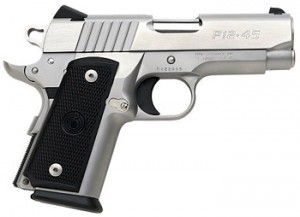
Finally I saw a brand-new Para-Ordnance P12 at an amazingly low closeout price. It had a 3.5 inch barrel like those other compacts I’d shot, but featured 10+1 capacity with 12+1 as an option, in a shorter, slightly fatter grip. It felt good in my hand and the trigger was crisp, so I took a deep breath and bought the thing. The 10 months since then have been interesting, and now I know enough to make a report about what has become my favorite pistol.
After the rear sight was nudged very slightly to the right, the gun shot exactly to point of aim. Off a Weaver stance it could hit shotgun shells squarely at 10 yards, and sometimes hit them again where they had landed, when my technique came together. Of course that was rare enough at first, and one-handed shooting was a disaster. A day or two per week at the range for several months did make my accuracy a lot better, until I had learned to shoot IDPA-style double-taps with enough control to try a match with the P12. I wasn’t going to beat a lot of people, but the target holes might not embarrass me too much either, even with my weak hand.
Still, other problems had surfaced by then. Only one of the two original mags was new, and the used one was a balky feeder, even with a new Wolf spring. A ProMag from Midway replaced it, and the feeding problems were over—when the pistol was clean. After about 30 rounds feeding would start to get sluggish, and cartridges would occasionally get stuck halfway into the chamber. I discovered that a bit of oil on the slide would fix the problem for a while, but by about 100 rounds, nothing would help. All the same, since one of our local IDPA matches requires something under 70 rounds, it might still work.
But as the gun had begun to break in, it had started jamming on empty hulls caught horizontally in the ejection port, backwards. Apparently it tossed them high enough to complete half a rotation, then jumped up and caught them again like a dog snatching a Frisbee. “Limp-wristing” was the term people used to describe the problem, telling me that I just needed to hold the gun tighter. But even a hand-trembling death grip didn’t cure the problem. My arms are kind of lanky; was I just too much of a girly-man for a P12?
I went to the next IDPA match anyway, and had reason to regret it. All that tapping and racking to clear jams blew my time to pieces, while there was no end of advice. “Those little guns never work right,” said a police firearms instructor. “Get yourself a Commander instead.”
“It’s probably the recoil spring,” advised another veteran shooter. “They get weak pretty fast in compact .45s. Try a new standard one, or maybe a stronger one, or . . .” he paused thoughtfully, “maybe you should clip a couple of coils off this one to make it a little softer. . . .”
I did every one of those things without any improvement whatever.
Then a friend lent me his Warthog while he was on vacation. Although it’s the P12’s little brother, it did not jam or misfeed at all in 100 rounds, even in my weak hand. One difference I noticed was that the Warthog has a PXT, Para’s so-called “power extractor” which fits into the slide like traditional ones, but has a bigger claw and an internal coil spring to maintain tension much more reliably. My P12 was one of the last made with a normal 1911 extractor. Maybe changing over would solve my problem.
I e-mailed some questions to Derek Brodka, the wizard who runs Para’s custom shop in Sevierville, Tennessee ([email protected]). He answered immediately, confirming that all the problems could be coming from a malfunctioning extractor that pinched the cartridges on the way in, causing misfeeds, and then gripped them too oddly for clean ejection later. Powder fouling would make it worse all right, while extra lubrication would help only a little and for a short time. He offered either to adjust my present ejector or retro-fit a PXT for $99. I chose the latter, sending him the slide and barrel for the job.
One week later I received the finished product and took it to the range, rapid-firing the P12 on three roasting July afternoons with no cleaning or lubrication in between. After a total of 220 rounds, the dirty little pistol still ran like a sewing machine in every grip mode. Even the bad magazine now fed cartridges as smoothly as if they were lumps of butter, and the ejected hulls tended to group pretty well in one area.
So after 10 months the P12 is finally what it should be: a really fun little .45 with an energetic but manageable kick, reliable operation, and surprising accuracy. I can hardly wait for the next IDPA match.
Comments, suggestions, contributions? Let me know