|
Kimber
Pro Carry:
A Modern Classic
I have a special interest in 1911 pistols that make
the news. Springfield did it with their FBI Model. Kimber did it with
their LA SWAT gun (the Classic II), and, with the
approval of the Pro Carry II for issue by the Tacoma police department,
the Kimber Pro Carry joined this elite club. The Pro Carry is a gun
meant for serious business. Everything about it says, “no nonsense, real
world working gun.”
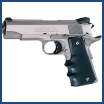
The Pro Carry is grounded in the legacy of the
Colt Lightweight Commander. It has an aluminum alloy frame and a
steel or stainless steel slide, depending on the model. The pistol under
consideration for this review is the stainless steel model. It weighs 28
oz. empty and has a 4” barrel. Unlike the Commander, the Pro Carry is
built on a bushing-less bull barrel design. It has the full-size grip of
the Government Model M1911A1 and uses the same magazines. It is,
however, considerably lighter. The Government Model weighs 39 oz. empty.
The difference in weight between an all steel Government Model and the
Pro Carry is 11 ounces, but it seems like a lot more. The Pro Carry is
much more comfortable to carry than a Government Model or even an all
steel compact model. It deserves the name, “Pro Carry.”
The Pro Carry is also richly appointed with the
"custom" features that Kimber established as standard configuration:
extended MIM beavertail, McCormick style combat sights dovetailed into
the slide, flat plastic mainspring housing, long lightweight trigger,
expanded ejection port, beveled magazine well, extended thumb safety,
over-sized magazine release, match grade and throated bull barrel,
McCormick Commander-style hammer, and a full length guide rod. When I
started shooting 1911's, the only way you could get this package of
custom features was to buy a Colt and then send it to a custom gunsmith,
wait a few months, spending nearly as much as the original price of the
gun, and then if you were lucky, you'd get back a pistol furnished with
the features it should have had in the first place. Although the Kimber
revolution slips rapidly into the realm of history, I retain an
appreciation for Kimber for their masterful re-work and evolution of the
1911 pattern. I don't mean this as a rap on Colt and Springfield,
because they have built some great guns, but at that time they seemed to
have become somewhat hide-bound in their thinking and it took Kimber to
come along and shake things up in terms of what constituted standard
design features for M1911 pistols.
Kimber aluminum frames are machined from solid
blocks of 7075-T7, the hardest and strongest aluminum alloy available.
Moreover, these frames are run on the same machines and hold the same
tight tolerances as steel frames. Kimber has tested the alloy frames to
20,000 rounds and claims no “meaningful” wear. In discussions of these
lightweight, aluminum-framed guns, the issue of frame cracks always
arises. As a matter of historical record, there are still quite a few
original Commanders built in 1950 that survive to this day without any
cracking. It is also a fact that frame cracks have occurred in aluminum
alloy pistols. The problem can be exacerbated using weak recoil springs
and shooting large quantities of hot loads.
The critique has been made that alloy-framed guns
are “carry a lot and shoot a little” guns. Is this fair? Well, to a
certain extent it is. Remember that the Commander was originally
designed in 9mm as a replacement for the M1911A1 for the armed forces.
The pistol is never considered the primary battle implement by the
military. It is a personal security tool for officers, a sidearm for
MP’s, and a weapon of last resort for soldiers when everything else is
empty or disabled. The Commander quickly became a favorite with civilian
law enforcement (at least among those who could get authorized to carry
it) because of its combination of light weight and power. Most police
officers do not run a thousand rounds a month through their guns. For
many soldiers and peace officers, their pistols are “carry a lot and
shoot a little.” When you’re humping an 80 lb. pack, a rifle, hundreds
of rounds of ammo, and God know what else, every ounce matters.
If your primary mission is to shoot a lot of
matches and hundreds of rounds at training and practice sessions, the
Pro Carry may not be your ideal gun. Get an all-steel gun for this kind
of shooting. (I will add that I haven’t heard a single report so far of
a Pro Carry frame cracking.) If you’re looking for a 1911 that is light,
powerful, reliable and accurate for carry, the Pro Carry is about as
good as it gets. The ideal setup would be a brace of pistols: a Pro
Carry for self-defense and a Pro Carry HD (all steel) for practice and
training.
Heavier guns are really better for matches and
practice. The muzzle settles down quicker for follow up shots, and they
absorb more recoil than lightweight guns. On our first session with the
Pro Carry, we ran a couple hundred rounds of hardball and several
varieties of hollow points in three hours. While I didn’t notice a great
difference in the way the gun felt when I fired it, I did find a light
bruise around the web of my hand later that night. There is a difference
in recoil between the lightweight and the all steel guns.
"I just wish Kimber
would've come out with this thing when I was still Rangerin'," Joaquin
said, his cigar hanging from the corner of his mouth. "This is what
I'd've been carrying. It's the best of both worlds – accurate as my old
Model 19, light in weight and with a higher capacity than a wheel gun."
– Texas Ranger Joaquin Jackson quoted by Bart Skelton
The Tacoma Tests
The Pro Carry HDII
and the Pro Carry II have been authorized as duty weapons for the Tacoma, Washington PD. (Officers also have the
choice of one of three Glock models.) The choice was based on an
evaluation of 37 models of handguns, from several major firearms makers
of duty type handguns. Makers like Glock, Sig, and Beretta – leaders of
the duty sidearm – went up against the Kimber Pro Carry HDII, an
up-start in the police firearms community, and the HDII prevailed.
Several things were considered when the Pro Carry
HDII was chosen, and amazing as it may sound, the way it fit the
officers was considered (which is rare). This was taken into account
because many Tacoma officers found the Beretta 92 to be too large to
shoot accurately and comfortably.
When testing the Kimbers, 16 different Pro Carry
II’s were shot, firing 23,000 + rounds. So impressed was the test staff
that they went out and purchased an off-the-shelf Pro Carry II and ran
5K through it. No problems were encountered. Other than the Kimbers,
pistols had a failure rate as high as 22%. Kimber had the lowest failure
rate Tacoma PD has recorded in over 20 years of testing for any type of
firearm – less than one half of one percent! They also determined that
the Kimber was safer than other test pistols when the safety was in the
“on” position. "The Kimbers we tested had the lowest failure rate of any
guns I have ever tested or shot, less than 1/10 of 1 percent. We tested
37 different guns and none of the others were even close," said Sgt.
Mark Jenkins, Tacoma Police Range Master.
There is a certain reverence afforded the Army
Ordnance Department blueprints of the M1911 pistol, as if these drawings
are somehow the Holy Grail of pistol design. I hate to tell you, but it
isn't so. The fact of the matter is that the drawings are really
interpretations of what Browning and the master gun makers at Colt did
in the Colt shop, back oh so long ago. The process was shop then
drawings, not drawings then shop. The first complete set of drawings was done to secure
the patent. The subsequent drawings were done to set up manufacturing
tools and to send to the subcontractors – Remington UMC, Springfield
Armory, North American – so they could set up their tools to build the
gun. In 1911, gun design was still more art than what we would recognize
as science today.
Where am I going with this? The Kimber pistols are
John Browning meets the computer age. The Kimber manufacturing process
relies heavily on Computer Numeric Control (CNC). When Kimber set up
their manufacturing process for the 1911 pistol, their engineers had to
analyze over a hundred part interfaces for reliability and fit. The
result of this analysis was a subtle but important re-tooling of the
classic design. The payoff is a pistol with excellent reliability and
accuracy, distinctly more reliable and accurate than the pattern from
which it was derived. The CNC process also insures greater consistency
from pistol to pistol, and a tool monitoring technology employed by
Kimber enhances the consistency of the process, and further reduces the
need for human corrections by hand to the manufactured output.
Don't get me wrong. I love the beautiful
hand-fitted pistols of Colt’s golden age, but we're a long way from that
time today. When we look for an explanation for why the Pro Carry
out-performed so many pistols in the Tacoma tests, I believe that the
answer may lie with the subtle re-tooling and the CNC process employed
by Kimber.
Reliability Testing
On our first range session with the Pro Carry, we had several incidents
of the slide failing to lock back on an empty magazine. We isolated this
problem to one particular magazine with an out-of-spec follower. The mag
would lock back a Colt but the Kimber didn’t like it. (The moral of that
story is to always test your mags with the gun you intend to use them
with.) Aside from this issue with this particular magazine, the Pro
Carry has been flawless. We have run a variety of hollow points and
hardball through the gun without a single instance of feed failure,
extraction problems or any other kind of malfunction. Kimber seems to
have solved the reliability issues that plagued Colt’s commercial
production in the 1980’s and early 1990’s. (Colt’s reliability and
quality control have improved a lot in recent years.) This is the third
Kimber upon which I have done extensive reliability testing, and all
three guns have been tremendously reliable without the need for tweaking
or gunsmithing. I feel a certain compulsion to get the obligatory 500
rounds through them for reliability testing, but I also have the feeling
that it isn't really necessary with these guns.
Nits to Pick
Kimber uses the metal injection molding process for a number of the
internal parts of the gun. These include the slide stop, beavertail,
hammer, sear and sights. Metal Injection Molding (MIM) is not greatly
different from injection molding of plastic. A solution of metal and a
polymer medium is injected into a mold to take a form. The part is then
heated to the extent that the plastic medium burns away, leaving just
the metal part. MIM parts are reported to be 98% the hardness of milled
bar stock steel. However, critics have claimed that the MIM parts are
softer than the 98% rating that is claimed. My experience with the
Kimbers is that guns that receive heavy use may very well require the
replacement of the MIM slide stop at some point. I have received one
report of the rear sight cracking, only one. I haven't received reports
of other MIM parts in the Kimbers failing. With normal use, probably
none of these parts will fail. I do feel, however, that these guns would
be better with bar stock milled slide stops.
Another controversial component of the Kimbers is
the plastic mainspring housing. Some users will replace these on the
feeling that they are not as durable as steel. I have never had any
trouble with the plastic mainspring housings. They are lighter, and
actually gentler on the palm of the hand than steel housings. As far as
I'm concerned, anything that will reduce the weight on a carry gun
without compromising performance is a plus. Also, they don't rust.
The following is not a nit to pick but rather a
praise: the gun that I reviewed was a "Series I," meaning that it lacks
the firing pin block mechanism of the “Series II" guns. Personally, I
don't like the Series II firing pin block. It makes the gun more
difficult to strip, adds more parts to break and fail, and addresses a
fear that is largely mythological and driven by the psychos in the state
of California who demand these sorts of gismos to approve guns for sale
in California. The incidents of 1911 pistols being dropped on their
muzzles from any realistic height so perfectly that they fire are
virtually non-existent. The firing pin of the 1911 just isn't a safety
problem except in the minds of anti-gun lawyers. If you’re really
worried about this hypothetical possibility, you can buy an extra-power
firing pin spring from Wolff Gun Springs that will insure that no drop
will cause the gun to go off.
Accuracy
When I ran into the slide lock problem, I grabbed a handful of magazines
and ammo, stepped off seven yards and began testing the mags by loading
one round and firing it to see if the magazine would lock the slide.
Since I had nearly a dozen mags to test, I worked through them casually,
loading, firing at the ocular cavity zone on an IDPA target, then
loading the next mag, firing, etc., until I was able to establish for
myself that it was an issue of one particular magazine rather than a
behavior of the gun. The point of this digression is to say that I
wasn’t really paying much attention to where the bullets were going.
After I had finished the test and some discussion with my buds about
what was causing the magazine to malfunction, I returned to my target
and only then noticed that I had shot a ragged hole with just a tiny bit
of vertical stringing. I’ll never make the finals at Camp Perry shooting
ragged holes at seven yards, but for me, it was pretty decent, and it
was done with a gun newly “out-of-the-box” without any trigger work,
accuracy work, or even a decent break-in period using bargain basement
ammo. This said to me that gun has more than adequate accuracy for its
intended purpose.
What I Really Think
The Kimber Pro Carry (Series 1) is truly my favorite pistol. If you told
me, “You have to get rid of all of your guns, and only keep one,” after
all of my ammunition was expended in trying to drive you off, the choice
I would make would be for the Pro Carry. It carries well, shoots well,
and looks good. It’s a .45 so you know it will do the job. It has never
even hiccoughed in terms of reliability, regardless of the circumstances
of the shot or the ammo being used. It’s a dream to maintain because the
alloy and stainless isn’t seriously affected by summer sweat or
humidity. You can drop it in the water and it’s un-phased (although I
don’t recommend that). It is more accurate than I am, and I trust it
completely. After many thousands of rounds, it has given me no reason
not to trust it.
The Series 1 Pro Carry is the best, most perfect realization of the 1911
concept that I have personally had the opportunity to work with. I will
say also, that I do the most of my .45 shooting with an
all-steel Combat Commander, Series
70. When my back is flared up, the lighter Pro Carry can get me
inflamed. The all steel Combat Commanders and Government Models never
do, but they are a bit heavy to pack around all day. When the mission is
sending thousands of rounds downrange, all-steel is the way to go. When
the mission is 14 hours of concealed carry, the Pro Carry is hard to
beat.
A Modern Classic
Modern because of its computer numeric control manufacturing and space
age metallurgy, and classic because it's a true M1911 and the
beneficiary of a hundred years of design attention and real-world
proving, the Kimber Pro Carry is a modern classic. If I had to go to the
store and buy a service sidearm on which I knew I would not have
time to do reliability testing – a gun that had to go to work right now
– it would be this one.
|
Specifications |
|
Caliber |
.45 |
|
Capacity |
7 + 1 (or 8 +1
with extra-capacity magazine) |
|
Operation |
Single Action
M1911-pattern autoloader |
|
Barrel |
4" match grade
bull barrel, twist rate 16 |
|
Length O/A |
7.7" |
|
Height |
5.25" |
|
Width |
1.28" |
|
Weight |
28 ounces |
|
Grip |
Black Plastic |
|
Sights |
Low profile
McCormick combat sights |
|
Finish |
Stainless steel
slide with aluminum alloy frame |
|
Magazines |
1 standard,
7-round |
|
Warranty |
Limited Lifetime |

|