|
Board
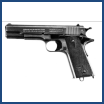
seemed to lose interest in further refinement of the M1911, and after
WWII, began to search for a smaller caliber, and a lighter weight pistol
with a smaller frame. Past 1926, design innovation of the M1911 was left
to Colt, the armorers of the Army Marksmanship Unit, and talented
civilian gunsmiths who applied their creativity and skill to the old
warhorse. Through the shared experience of soldiers, lawmen, gunsmiths,
metallurgists, competition shooters and others, a profile for the M1911
developed in the last half of the century: make it lighter, more
accurate, smoother, better sights; bring back the longer trigger and
flat mainspring housing of the M1911; make it able to handle modern
hollowpoint ammunition reliably; give it a match grade trigger, and make
it visually appealing. In the Pro CDP II, Kimber has done an excellent
job of capturing this profile.
While it
is arguably the most successful autoloader pistol design in the world,
the M1911A1 is not perfect (oooh, heresy… ). It’s big, heavy, has lousy
sights, and in its military form, has marginal accuracy. (Kuhnhausen
states that anything better than an 8” pattern at 50 yards was
considered acceptable by government armorers.) These days, pistol
shooters are demanding more out of their guns. It’s interesting to see
how Kimber has addressed the criticisms of the M1911 in the Pro Carry
and Pro CDP series of pistols.
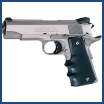
The first
major design innovation made by Colt to the venerable 1911 formula was
in 1949-1950 when the aluminum alloy framed Commander was introduced.
Colt did this in response to the Armed Forces' quest for a smaller,
lighter sidearm. Although the Commander was not adopted by the military,
the format proved to be immensely popular. At 28 ounces, the Commander
was considerably more comfortable to carry than the Government Model.
The Kimber Pro CDP is a Commander-format gun. It has the aluminum alloy
frame and Government-size grip of the Commander. Its slide and barrel
are 1/4" shorter than the Commander, and it uses a 4" bull barrel rather
than the 4.25" barrel with bushing of the genuine Commander. The
Commander format makes for a gun that is very easy to carry but still
large enough to have excellent accuracy and adequate muzzle velocity.
Kimber
made their mark in the M1911 pistol world by offering guns that had all
of the "custom" features that people had been adding to their guns for
years: extended beavertails, non-snag combat sights, extended
ambidextrous thumb safeties, etc. The Pro CDP has every custom nicety
that you can think of for a custom M1911.
"CDP"
stands for "Custom Defense Package" in Kimberese. These guns are hand
fitted in the Kimber custom shop and have a distinctive look. The frames
have a black anodized finish. The slides are bead-blasted stainless
steel with a "melt treatment" meaning that the sharp edges are rounded
off. The CDP pistols also feature Meprolight tritium night sights and
ambidextrous thumb safeties. The grips are rosewood. The small parts –
the slide stop, grip safety, grip screws, hammer, mag catch, and thumb safety – are
stainless steel to contrast with the flat black of the frame. The
mainspring housing is silver colored plastic and the trigger is
aluminum. For some, including me, this visual treatment is a bit flashy,
but it does create an eye-catching effect.
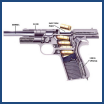
Kimber has
begun to install what they call the “Series II” firing pin block. (It is
essentially a resurrection of the Swartz safety developed for Colt
before the Second World War). When you depress the grip safety, a small
pin pushes a plunger up in the slide which unblocks the firing pin. I do
like it better in one respect than the Series 80 firing pin block of
Colt: it is activated by the grip safety, not by the trigger (see
diagram), so you get the clean trigger pull sans the click and crunch of
the Series 80 guns. You have to be careful when you field strip it and
reassemble it because if you hold it by the grip and activate the grip
safety, a little pin comes up next to the disconnector and it will stop
the slide from coming off or going on, and if you get muscle-bound with
it, you could shear the pin and render the gun unable to fire. Also, the FPB mechanism can only be accessed by removing the rear sight should you
need to do cleaning or maintenance on it. I’m not terribly wild about
this characteristic. (I still believe this is a lawyer-friendly answer
in search of a question. I continue to search for documented instances
of 1911 pistols going off from being dropped on their muzzles, and I
have yet to find one documented instance of an unmodified 1911 in good
repair discharging due to a drop on the muzzle from any kind of normal
height – if you find one, please send it to me).
One of the
persistent complaints about the M1911 pistol is that the venerable
Government Model would only feed 230 grain full metal jacket "hardball"
ammunition. The Government Model and the hardball cartridge were
literally built for each other. The development of the cartridge was
part of the development process of Browning and the Army Ordnance board.
The original M1911 and M1911A1 pistols are tremendously reliable with
the hardball cartridge. The problem emerges when shooters want to run
other types of ammo, particularly wadcutters and hollowpoints that don't
follow the hardball profile. The traditional solution for this problem
is to throat the barrel and hope for the best. Kimber seems to have
conquered this problem for the most part on their defensive models. The
barrel is given a wide throat at the factory, and, if you compare the
feed ramp of the Pro CDP with the feed ramp of a Series 70 Colt, you
will notice that the Kimber feed ramp is cut at a deeper angle than that
of the Colt. The Pro CDP has shown superb feed reliability. This gun
just hasn't jammed or failed to feed at all.
A common
complaint levied against the 1911 is that it's designed for
right-handers and is not south-paw friendly. This is mostly true: the
thumb safety and magazine release are on the left side of the gun and
are intended to be operated with the thumb of the right hand. Those of
us who are devoted to the 1911 pattern learn to operate the controls of
the 1911 with either hand, but many find the left hand operation of the
manual safety to be awkward and difficult. The user must bring the thumb
around the beavertail while holding the grip only between the palm of
the hand and four fingers. This is not a secure hold and may be
difficult for users with small hands. Kimber's response to this issue is
to install an ambidextrous thumb safety in the CDP line of pistols. The
magazine release remains on the left side of the frame only, but
south-paws can work the mag release with less awkwardness than the left
handed operation of the thumb safety. The index finger on the mag
release works well.
Another
common and well justified critique of the Government Model M1911 is that
the sights are too small and hard to see. Thin front sight blades and
narrow rear sight notches make for more precision in high accuracy
target work, but a thicker front sight post and wider rear notch make
for quicker target acquisition. The wider leaf and notch are also easier
to see for those with weak eyesight. Remembering that "CDP" stands for
"Custom Defense Package," The Pro CDP employs the wider notch and leaf
McCormick-style "combat sights" with Meprolight tritium insets for quick
low-light target acquisition. It's interesting to point the gun down a
darkened hallway to see how far off our basic intuitive pointing of the
gun can be. It's instructive. I like these sights.
Somewhat
more controversial is the full length guide rod employed by Kimber and
many other 1911-clone builders. M1911 purists are fond of quoting the
old saw, "the berm at Gunsite is littered with full-length guide rods."
The M1911 and Colt Commanders have partial-length guide rods. The
partial length guide rod reduces the weight of the gun and enables the
trigger-guard-and-spring-plug press check. Proponents of the full length
guide rod say the FLG gives more consistent lock-up and better
reliability. This is one of those debates that is interminable, like
.308 vs. 30-06, but the fact is that most pistol builders, including
those building 1911s have adopted the FLG. The Pro CDP uses a FLG. The
slide is disassembled by trapping the recoil spring with a small wire
tool that comes with the gun. When you lose the tool, and you will, you
can easily replace it with a paper clip straightened and bent into an
"L" shape.
The Pro
CDP sports another evolution away from the classic Browning design: it
eliminates the barrel bushing in favor of a bull barrel. This innovation
isn't new with the Pro CDP. Kimber started using it with their Compact
model. Bull barrels aren't new either. Karl Schuemann has been building them
for many years and they have been used in pistols from Clark Custom,
Para-Ordnance and many others. For maximum accuracy and reliability, the
barrel bushing of the M1911 should be hand fitted by an expert.
Eliminating the bushing simplifies the design and removes one thing that
can be a source of problems. Is the bushing-less design superior? For
guns with barrels of 4" or less, I think it is. Commanders and
Government Models seem to function pretty well with bushings, but
smaller guns do seem to benefit from the bushing-less design. The
compact Kimbers with bull barrels that I have tested have been
wonderfully accurate and reliable.
Hitting what you aim at:
Accuracy of the gun is quite rewarding (see test target). I find it easy
to put the bullets where I want them to go with excellent consistency.
No complaints here.
Trigger:
The trigger is OK, but not great. It is 4.5 lbs. with a little bit of
creep. It will smooth out with some use, but I think a "Custom Shop" gun
could be a bit cleaner.
Value:
With an MSRP of $1140, the Pro CDP is not cheap. Kimber claims that by
installing all of the “custom” features at the factory at production
time, the user is saved $500. When Kimber first began to provide factory
guns with custom features, this was certainly true and the Kimber Custom
was far and away the best value in factory produced 1911’s at that time,
especially if you wanted the standard package of custom features on a
Government Model pistol. These days, with Springfield Armory, Colt,
Para-Ordnance, and most other manufactures building the standard custom
features into their guns at production time, the added value pitch is
not as persuasive as it once was. The Pro CDP is a beautifully built
pistol, but I would like it better at a price point between $800 and
$900.
Cosmetics:
This is the place where I have the most ambiguous feelings about this
gun. If your aesthetic for guns and gear is tactical flat black, you
won't like this pistol. If, on the other hand, you like a little flash,
this pistol will speak to you. One of the delightful characteristics of
the 1911 is that it does lend itself to interesting custom finishes and
visual effects. The high-end custom shops, like Clark, Wilson and Brown,
have been producing two-toned 1911s for a number of years, and it's an
eye-catching effect. The contrasting and alternating tones of black and
stainless components create a visually interesting effect. The vibrant
orange-red color of the grips completes the visual impact, placing a
warm and moderating tone between the stark black and silver colors. This
styling has been grabbing my attention in display cases since Kimber
first introduced the CDP line of pistols. It's an attractive pistol, but
I haven't bought one for myself. It's just a bit too flashy for me.
Really, my favorite “look” is the “I’ve fought my way through a dozen
wars and I’m better than ever” look.
Notable negatives:
While it is true that I have definitely acquired "champagne tastes" in
1911 pistols and my complaints are tiny things that a thousand others
wouldn't even notice, a couple of things really bothered me. I could see
a slight sliver of daylight under the ejector and under the front sight
base (we’re talking jeweler’s loupe stuff here, not big gaps). Both
parts are firmly attached to the gun, and will probably never cause a
problem, but for a $1140 "Custom Shop" gun, I should not see any space
under these parts. It would really annoy me to see the front sight
flying away at some point in the future. The checkering on the grips is
coarse and sharp, not really comfortable. I think a finer checkering
should be used. The mainspring housing is gray plastic. I don't have the problem
with the plastic MSH that some people do – they reduce weight, don't
rust, and are actually kinder to your hand than a steel one – but this
one looks cheesy.
Notable positives:
I like the Meprolight tritium night sights. They're bright and they
really would assist in getting the gun oriented in a night time
defensive situation. I like the 30 lpi checkering on the front strap and
bottom of the trigger guard. The weight is great. It feels much like a
Lightweight Commander, but even lighter. I put a full mag in and
holstered it. The comfort brought about by the reduced weight is
immediately noticeable, especially in the holster. Slide to frame fit is
excellent. I haven't made up my mind about the melt-down treatment, but
a lot of people seem to like it. Trigger and accuracy were excellent
right out of the box. Reliability is typical of Kimber: it runs right
straight out of the box with any kind of ammo you feed it.
Summary:
The Kimber Pro CDP II is a pistol I would feel perfectly comfortable in
carrying in the defensive role or for use in a tactical match. It is a
visually appealing pistol with superb accuracy and rock-solid
reliability. Its heritage proceeds from the Colt Lightweight Commander, and
its design reflects 90 years of learning and experience with the M1911
single action autoloader design.
|


Colt (Lightweight) Commander


White arrow points to pin which engages
firing pin block plunger in slide

firing pin block diagram

Bull Barrel Muzzle and Full-Length Guide Rod

 |