
Part 3: Magazines
© 2000 by John L. Marshall
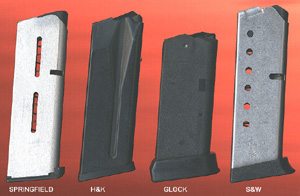
Magazines. Each pistol uses a different type of magazine. The Springfield and Smith & Wesson offerings are similar in that they both use single-stack 7-round magazines. The Smith & Wesson mag, however, is equipped with a flared, extended base plate which gives a better purchase on the pistol. The grip area of the S&W is not as long as that of the Springfield, and would leave the pinky finger to curl under the pistol were the magazine not extended a bit with the base plate. Thus, the S&W mag is about a quarter of an inch longer than its Springfield/Wilson cousin. This difference in grip depth, by the way, is caused by a fairly deep frame area on the Smith to accommodate its
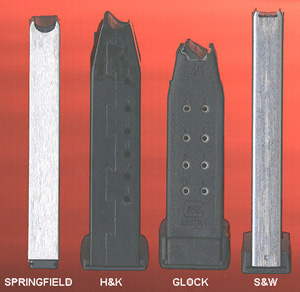
particular double-action design. The result is a bit higher line of recoil. More about that later. The Glock magazine is unique in that it uses a staggered-column mag which is polymer, surrounding a steel interior frame. While it’s the widest magazine used in these four pistols, it does give an overwhelming firepower advantage – 10 rounds in the mag versus 8 for the H&K and 7 each for the Springfield and S&W designs. The Glock’s polymer frame allows for a thin grip area (there are no add-on grips), and so Glock can get away with a double-column magazine. The result is that the Glock grip is only 1/10 of an inch wider than the H&K, 2/10 of an inch wider than the S&W, and matches the width of the Springfield. The H&K magazine is a bit of a compromise, using a semi-staggered design to cram 8 rounds into the height of a normal 7-round magazine. The downside is only a 1/10 of an inch increase in width over the slimmest grip of the four, the Smith & Wesson. While the H&K has a polymer frame like the Glock, it is noticeably slimmer and less “clunky” in the hand than the Glock. The company simply chose increased slimness over increased magazine capacity. One could make a good argument that using a .45 obviates the need for high magazine capacity, and this is the argument that H&K apparently bought into, as did Smith and Springfield to an even greater degree.
Comments, suggestions, contributions? Let me know