
By Sen. Mark Hillman
07-01-2003
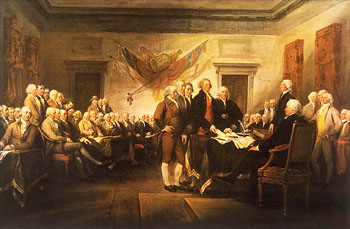
As we observe the anniversary of the Declaration of Independence this Fourth of July, we should consider the unique form of government for which our Founding Fathers chose to risk ‘their lives, their fortunes, and their sacred honor’ against the militarily-superior British.
The definitive passage in the Declaration reads: “We hold these truths to be self-evident, that all men are created equal, that they are endowed by their Creator with certain unalienable rights, that among these rights are life, liberty and the pursuit of happiness. That to secure these rights, governments are instituted among men, deriving their just powers from the consent of the governed.”
In these 57 words, the Founders established that:
– Our rights, better understood as “freedoms,” are given to us by a power higher than government. No matter what you believe about creation or evolution, you must acknowledge that government did not give us life.
– Government’s legitimate purpose is to protect the rights of the people. Just as government did not give us life, it did not give us our rights, either.
– Government’s powers are limited to only those given to it by the people.
“The whole point was to show how government might arise legitimately, not to assume its existence,” writes constitutional scholar Roger Pilon in The Purpose and Limits of Government published (Adobe Acrobat PDF) by Cato Institute.
Pilon’s insights are particularly useful because, as a libertarian, he does not advance a religious conservative agenda. Yet he acknowledges that the Founders’ common view of “the laws of Nature and Nature’s God” provide the cornerstone for all that follows:
We hold these truths to be self-evident….
The signers of the Declaration didn’t negotiate and compromise to define truth. They agreed that certain fundamental truths were obvious. For example:
…That all men are created equal, that they are endowed by their Creator with certain unalienable rights, that among these rights are life, liberty and the pursuit of happiness…
In that each of us exists because of the same creative process, the rights to which each of us are entitled are necessarily equal. Such rights are best understood as freedoms from interference, either by government or by other people which, of course, implies that others are entitled to be free from our interference.
Freedom encompasses not simply the opportunity to make choices but the responsibility for those choices. Freedom does not mean that because my choice seems “superior” I can bend others to my will, nor does it mean that when I make an irresponsible choice I can restrict the freedom of others to impose consequences.
…That to secure these rights, governments are instituted among men, deriving their just powers from the consent of the governed.
Once the Founders established a broad universe of rights, they discussed government, the sole purpose of which is to protect those rights. Again it is imperative to understand “rights” as freedoms – not as an entitlement taken at the expense of another¹s rights.
When government legitimately protects our freedom, it simply does that which we have a right to do ourselves. By contrast, government does not act legitimately if it secures my rights by taking the life, liberty or property of someone else.
Occasionally, the rights of two people may conflict; neither can fully exercise freedom without adversely affecting the other. The Founders concluded that in these circumstances, the boundaries between competing rights ought to be drawn by the people whom government serves. However, the consent doctrine does not empower majority rule to deny unalienable freedoms to the minority.
Sadly, this concept of vast individual freedoms and occasional areas of government power bears little resemblance to our federal government today, which is why it is so vitally important that our young people learn about the foundation of our government before electing someone to lead it.
Sen. Mark Hillman, R-Burlington, represents 12 counties on the Eastern Plains.
Comments, suggestions, contributions? Let me know