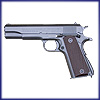
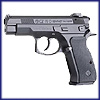
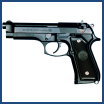
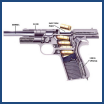
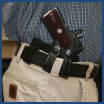
Glock fans seem
obsessed with comparing their pistols to the 1911, with the overall thrust of the argument
being an attempt to prove that the Glock is superior to the 1911 in every way. They will
most often point to reliability, durability, capacity, weight, and the simplicity of the
Glock design to demonstrate the point. My biases are as follows: I'm a 1911 fanatic and
I'm not wild about Glocks. But is the Glock superior to the 1911? The two systems are so
different that I have questions about the validity of any comparison beyond the fact that
they're both pistols and choices need to be made. Here are some areas of comparison which
lead me to prefer the 1911-pattern guns:
Reliability - I have seen more feed failures on 1911-pattern guns than I have
with Glocks (or Smith & Wessons and Berettas, for that matter). My personal 1911's, a
Springfield and a Kimber, don't experience feed failures, although the Springfield did
have a couple when it was new. At a recent IDPA match, I witnessed a Les Baer Custom and
Colt Gold Cup experience failure to feed. The original mil-spec 1911A1 is a very reliable
gun when using the mil-spec ammo around which it was designed, and contemporary 1911's
which are properly throated and broken in are also extremely reliable. The original 1911's
which were issued to the Army were built with very liberal tolerances–you could call them
loose–because the Army valued reliability under adverse conditions above pinpoint
accuracy. Many of the feed reliability problems with 1911 pistols arise from efforts to
tighten up the frame, slide, barrel and bushing in order to achieve "match
grade" accuracy. Glocks don't tend to suffer feed failures, but in order to achieve
this reliability, they have more of their chambers cut away, leaving more of the case
unsupported. This design feature has led to some blown Glock .40 S&W pistols.
For more on this, see Dean
Speir's Glock KaBoom FAQ. One
reliability issue which I've seen more with Glocks than other pistols is their occasional
failure to detonate primers. While Glock advocates will say that other pistols have the
same problem, I've only seen it happen on Glocks. While Glock true-believers are driven to
proclaim their guns as the ultimate in reliability, the NYPD has been experiencing
extractor problems and double feeds on their Glock 9mms.
The Eye of the Beholder - I am one of those people for whom the appearance of a
gun matters. I like beautiful guns made of high grade metals with fine finishes. I don't
like black plastic. To me, the Glock is one of the ugliest designs every conceived by the
mind of man. Although some custom finishes can be applied to the slide, the options for
dressing up the Glock are very limited. In contrast, 1911-pattern guns can accept a wide
variety of finishes, grip panels, custom components, engraving, and other modifications
which enhance the appearance of the gun. Glocks are made by one manufacturer whereas
1911-pattern guns have been made by scores of manufacturers since World War I, adding a
great deal of interest, variety, and individuality to the type.
Uniformity vs. Individuality - With 1911's you deal with a particular gun, the
one you're holding at that moment. Glocks are, for the most part, homogenous within model
types. Each 1911 has a personality of its own, even among examples of the same model and
production run from the same manufacturer. Whether this annoys or delights is a matter of
personal preference. Those who like personality and individuality in a pistol will find
the Glock uninteresting, and those who value absolute consistency will find their
confidence undermined by a fussy 1911 which refuses to feed their favorite load. Any
new-in-the-box 1911 is really a custom kit. The 1911 is to handguns what the `57 Chevy is
to hotrods or the P-51 Mustang to air racers, the ultimate platform for customization.
Pistoleros inclined to tinkering eventually find their way to the 1911. Aftermarket parts
abound for this pistol, and you can make it into almost anything your heart desires. The
design requirements for the pistol specified a gun which could be serviced in the field
with a minimum number of tools, and it can be completely disassembled using only its own
parts. Consequently, the 1911 is very accessible from a mechanical point of view. It is
relatively easy to install custom parts or modify existing ones. Few 1911s remain
completely stock for very long, unless they are those models which include the custom
features usually added to the mil-spec guns, such as extended beavertails, custom triggers
and hammers, full length guide rods, and decorative grips. For those who seek a
personalized sidearm, the 1911 is one of the best platforms from which to begin.
Durability - I have heard claims that Glocks have launched as many as 300,000
rounds from a single pistol without a failure. I've never seen any documentation which
would substantiate these claims, and I remain a bit skeptical about it. I'd like to see
the gun, the round, and the test conditions. The FBI tests did document 50,000 rounds
through the Glock .40 S&W without a breakdown, and that's an impressive performance.
The original Army endurance test for the 1911 was 6,000 rounds. A well-built 1911 can be
expected to have a service life of 150,000 rounds, although a part may break here or there
during its lifetime. Only time will tell if the first Glocks will still be serviceable
seventy five years from now. We know that many of the early 1911's are still functional
and greatly desired by collectors.
Accuracy - In my opinion, an average government model 1911 is likely to be more
accurate than the best Glock. In addition to that, 1911's can be tuned for greater
accuracy whereas the Glock can't be. Between a really outstanding match grade 1911 and a
Glock there is no contest in terms of accuracy. Glocks have acceptable accuracy for their
intended mission, that being close range combat, but they are not tack-drivers. I haven't
had opportunity to test one of the new long slide Glocks, but my initial impression is
that they are an answer in search of a question.
Trigger - The one thing the Glock and the 1911 have in common is that their
triggers are their greatest strength and weakness. The "revolutionary" design of
the Glock centers on the trigger, the so-called "Safe Action Trigger." The Glock
pre-cocks with the cycling of the slide so it can have a much lighter trigger than a true
double action gun. In order to increase safety, the Glock was given a very long trigger
pull and a little safety flange on the trigger which supposedly functions as a
safety–if
it isn't depressed the gun won't go off. But given the fact that it's on the trigger, it
strikes me as largely superfluous. Aside from this, there are no external safeties on the
Glock. If the trigger is pulled, the gun will go off, period. Personally, I find the Glock
"Safe Action" scary, and lacking in the backup safety features that I prefer to
see on an autoloader. Fans of the "Safe Action" point to the fact that there are
no levers with which to fumble in a crisis and compare the Glock to a double action
revolver (although very few revolvers have 3 lb. double action triggers). For a combat
gun, these are valid points–simplicity translates into speed and keeps Murphy at bay, and
light triggers give greater accuracy.
The single action trigger of the 1911 is light, crisp, and short. Since little muscle
action is required to break the trigger, trigger control is less of a problem on the 1911
than any double action or "Safe Action" system. Since the trigger pull is so
short, rapid fire is easy and fast. And then there's the dark side: for a single action
1911 to be ready for action, it must be carried "cocked and locked," which means
hammer cocked and and manual safety on. More than anything else, this looks scary. People
have come up with several strategies to avoid the cock and lock, also known as
"Condition
One." There is the "Israeli Draw" which means the pistol is
carried with an empty chamber and charged magazine ("Condition
Three"), and is
drawn and the slide racked as the gun comes up to fire. Some choose to carry with the
hammer down with a round in the chamber (Condition
Two). Condition Two is just a bad idea
for several reasons, but all of them have to do with the gun going off when you don't
expect it to. Some choose simply not to carry the 1911 at all due to their discomfort with
Condition One.
In my opinion, the Glock carries in Condition
Zero, that is, hammer cocked with no real external safety applied. I
don't acknowledge the trigger flange to be a fully functional external
safety, and the number of accidental discharges reported on the Glocks
tends to bear this out.
My own preference is for the 1911 trigger with its double safety system (manual thumb
safety and grip safety). Even if one were to forget to apply the manual safety, the grip
safety must be depressed and the trigger pulled for the gun to fire. With that said, the
1911 requires training and practice to be a safe and effective personal defense weapon.
The Glock trigger seems long and mushy, and since there are no external safeties other
than the trigger flange, it strikes me as being more prone to accidental discharge than
the 1911. For target and competitive shooting, the 1911 trigger is my favorite.
Weight and Capacity - In this category, the Glock has the clear advantage. The
Glock with its polymer frame is lighter and uses double stack magazines. Even the compact
Glock 30 carries 10 rounds in its magazine. Compact 1911's such as the Colt Officer's
model and the Kimber Compact can carry seven in the magazine. Government models can carry
eight rounds or ten with an aftermarket magazine which extends beyond the base of the
grip. A number of manufacturers such as Para-Ordnance, Springfield, and Kimber have
introduced "widebody" 1911-pattern guns which can accept 10-14 round double
stack magazines. To me, a true 1911 is a single stack gun. One of the strongest features
of the 1911 is that wonderful, single stack grip.
Touchy-Feely - One of the greatest features of the 1911 is the narrow grip and
short trigger configuration of the pistol. The grip of the 1911 remains the best feeling
grip of any pistol I know of. The narrowness of the handle allows the hand to really wrap
around the pistol and get a solid grip. The narrowness also benefits those with smaller
hands, since the grip is narrow and the trigger relatively close to the handle. Also,
within the configuration is a design feature which has been copied by the builders of most
autoloaders since–the magazine release button located where the trigger guard meets the
handle. Last, but very important, is the overall narrowness of the 1911 pistol which
allows even the relatively large government model to be surprisingly easy to conceal. By
way of contrast, Glock handles tend to be fat since they use double-stack magazine, and
are more difficult to conceal due to their width. To me, a 1911 feels like a pistol ought
to feel, whereas the Glock feels like a water gun.
Conclusion - Well, I warned you of my biases up front. Give me a 1911 any day.
Nevertheless, the Glock design has proven to be a watershed event in the development of
handguns. I really enjoy 1911's and practice regularly with them. My mode of carry is
always concealed, so I'm not in the position of scaring the public with a cocked pistol on
my hip. Patrol officers who may not be gun enthusiasts or enjoy a regular practice
schedule may be better served by a Glock-type pistol with its long trigger and greater
capacity.
"The police establishment is now properly
devoted to the Glock, and this seems to be a good choice. The Glock is
a difficult piece to shoot well, and its safety problem has been
solved by issuing it with a trigger that only a gorilla would love,
but it has been generally admitted that the police today cannot be
trained to shoot well - not so much because of time and ammunition
expenditures, but because of motivation. A man will do well only at
things he enjoys doing, and today's police departments are reluctant
to hire a recruit who enjoys shooting. Thus the Glock's "shootability"
is irrelevant. The piece is relatively cheap, it is usually reliable,
and the company's service policies are outstanding."
- Jeff Cooper, Cooper Commentaries, Volume V, Number 11.