|
The
True Story of the Beretta M9 Pistol.
By Tim Chandler
“You’re not a S.E.A.L. ‘till you have eaten
Italian steel…” Anonymous
Thus begins the sordid tale of the M9 that is oft
repeated in gun shops and firearms related web-boards the nation over.
Anyone who asks questions about the Beretta M9/92 pistol long enough
will inevitably hear about how a bunch of S.E.A.L. team members were
killed/maimed/deformed by the slides of the M9 pistol breaking in half
and flying back at the shooter, decapitating many brave men . Or maybe
you will hear about how the frames on the M9/92 pistols can shatter like
plate glass if you shoot more than 1,000 rounds through them. I am sure
there is somebody out there blaming the Titanic on a Beretta M9/92.
As any experienced firearms enthusiast knows,
rumors run WILD in the gun world. There are more silly fads and idiotic
rumors in the gun culture than there are among pre-teen girls. Sometimes
the bull flows so freely that a fellow needs hip waders and a lifejacket
to keep from drowning in it. Some stories, however, are true or have at
least SOME grain of truth to them. The trick is being able to wade
through the baloney to find the truth. With this in mind, I decided to
set out in search of actual proof of the M9/92 horror stories that so
many recite so freely.
The Saga Begins:
In the early 1980’s the Military began looking for
a new sidearm to replace the inventory of over 25 different pistols and
revolvers then in service with the military, and the more than 100
different types of ammunition for those sidearms. Chief among the
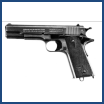
inventory of pistols to be replaced was the venerable old 1911 handgun
that had been in service for 70 years. According to a Comptroller
General’s report (PLRD-82-42) dated 3-8-82, the military had 417,448 .45
caliber pistols in inventory. The plan began to run into opposition when
it was announced that the new sidearm would be chambered in the NATO
standard 9mm cartridge. Many saw the move to a smaller caliber as a step
in the wrong direction. Still others questioned the need for the
adoption of a new pistol at all. According to PLRD-82-42, the General
Accounting Office actually recommended purchasing more .38 caliber
revolvers or converting the existing 1911 pistols to fire the 9mm round
as a less expensive alternative to adopting a new weapon.
The Army eventually made headway and in November of
1983 placed a Formal Request for Test Samples (FRTS) to several
commercial arms makers in the US and around the world. Eight makers
submitted a sample lot of 30 pistols by the deadline of January of 1984,
and by August of the same year the testing was completed. (NSIAD-88-46)
Of the eight makers who submitted test samples, 4 were technically
unacceptable and 2 removed themselves from competition. The two
surviving companies were SACO (importing Sig-Sauer pistols at the time)
and Beretta. (NSIAD-88-46) After a controversial bidding process (some
allege Beretta was tipped off about SACO’s bid so they could lower the
per unit cost on their candidate by $1.00 and win the contract) the Army
signed a contract with Beretta for 315,930 pistols. This number was
later increased to 321,260 pistols. The new pistols would bear the
military name of M9. (NSIAD-88-46)
The Problems Arise:
The M9 pistol program ran into trouble when in
September of 1987 the slide of a civilian model Beretta 92SB pistol
fractured at the junction where the locking block mates into the slide.
The broken half of the slide flew back at the shooter (A member of the
Navy Special Warfare Group) injuring him. (NSIAD-88-213) In January and
February of 1988 respectively, 2 more military model M9 handguns
exhibited the same problem, injuring 2 more shooters from the Navy
Special Warfare Group.
All three shooters suffered facial lacerations. One
suffered a broken tooth and the other two required stitches.
(NSIAD-88-213)
The Army was doing unrelated barrel testing on
current production civilian model 92SB pistols and military model M9
pistols and ran into the same slide separation issue. They fired 3 M9
pistols 10,000 times and inspected the weapons with the MPI process for
evidence of slide cracks. They discovered that one of the weapons had a
cracked slide. The Army then decided to fire all of the weapons until
the slides failed. Failure occurred at round number 23,310 on one
weapon, 30,083 on another, and 30,545 on the last weapon. (NSIAD-88-213)
Examination of the NSWG slides and the Army slides
showed a low metal toughness as the cause of the problems with slide
separation. The Army then began to investigate the production process of
the slides. (NSIAD-88-213) At the time the frames of the M9 pistols were
produced in the US, while the slides were produced in Italy. There are
reportedly documents from the Picatinny Arsenal that report a
metallurgical study blaming the use of Tellurium in the manufacturing
process for the low metal toughness of the Italian slides, but I have
been unable to independently verify this information.
After April of 1988, however, all slides for the
M9/92 pistols were produced in the US. (NSIAD-88-213) As a part of the
contract requirements, the Beretta Corporation had to build a plant
inside the United States to produce the M9. It naturally took some time
for the US plant (located in Accokeek MD.) to get into full production
swing, so the Italian plant made the slides for a time.
Several GAO reports and testimony from GAO staff
before Congressional Sub-Committees (NSIAD-88-213, NSIAD-88-46,
NSIAD-89-59 are a few…) report the total number of slide failures at 14.
Three occurred in the field with the NSWG and the other 11 occurred in
the test lab. Only 3 injuries resulted from the slide separation
problem. The Beretta Corporation changed the design of the M9 pistol so
that even if a slide fractured, the broken half could not come back and
hit the shooter causing injury.
Of the 14 slide separations reported, only 4 took
place at round counts under 10,000. (NSIAD-88-213) No further slide
fractures were reported after the change to the US manufactured slides.
The Beretta Corporation initially blamed the slide
failures on the use of ammunition. They questioned both the use of
non-NATO ammunition and the use of M882 ammunition. They suspected that
both types of ammunition caused excessive pressure buildup inside the
weapon causing barrel ringing issues during the initial testing of the
M9 weapon and the slide separations experienced by the military. The
Army determined that both barrel ringing and slide separation were
caused by low metal hardness and not by any specific pressure level in
the ammunition used. (NSIAD-89-59)
I have obtained documentation from a reliable
source that demonstrates that the M882 ammunition was not excessive in
its chamber pressures. Thus the explanation of metallurgical problems on
a limited number of M9 pistols remains the only defensible conclusion.
Frame-Up:
Another problem that cropped up with production of
the M9 pistol was a problem with frame cracks. In December of 1987 and
January of 1988 routine lot testing of the M9 production pistols
revealed frame cracks occurring at the rear of the grip area of the
frame just above where the trigger bar rides. The Army representatives
determined that the cracks did not affect the safety, reliability, or
function of the weapons and were merely “cosmetic in nature.”
(NSIAD-88-213)
The cracks, however, did violate the terms of the
M9 contract, so the lots were rejected. Beretta continued production
into February and March of 1988 with the affected frames, stockpiling
them in hopes of a retrofit. In April of 1988 an engineering change was
approved by Berretta and Army representatives that resolved the frame
crack issues. The previously rejected lots were retrofitted with the new
frame design and retested. The new frames did not display the cracking
problem or any other problem during the tests and were subsequently
accepted by the military. (NSIAD-88-213) There were 24,000 affected
handguns produced with the defective frame. ALL of them were rejected
and then retrofitted and accepted by the Army. (NSIAD-88-213)
The Magazine Controversy
Recent reports from Afghanistan and Iraq have
reported less than satisfactory reliability with the M9 pistols
traceable to the magazines. Until very recently, the magazines for the
M9 pistol were produced by Mec-Gar. The military decided to go with
another vendor, Checkmate, to supply the magazines for the M9. By all
reports I have heard from the field, the new magazines are not made as
well and are extremely sensitive to dirt and sand. Considering that the
troops are using the M9’s in an area of the world that is populated by
little else but dirt and sand, this makes the use of such magazines a
bad idea.
Many soldiers have “written home” to family and
friends and have managed to obtain the original production magazines
made by Beretta through back channels. (The original factory magazines
are of superior quality to any others I have found.) Reports have been
extremely positive with the use of the original style magazines. The
military has enough knowledge to understand that magazines and
ammunition are the most common causes of reliability problems, and so
their purchase of magazines that are not as reliable as the original
production magazines is puzzling. They should resolve this by going back
to the Beretta production magazines, or at least back to the Mec-Gar
produced ones as soon as possible.
The 9mm Controversy:
A great deal of the hostility aimed at the M9
pistol is the result of its use of the 9mm cartridge. The military
stated that its goals in searching for a new standard sidearm were to
improve effectiveness, reliability, safety, and operational suitability
of the sidearm over the .45 caliber pistols and .38 caliber revolvers
then in use. (NSIAD-89-59)
Effectiveness is measured by range and accuracy,
volume of fire, inherent lethality and lethality against body armor.
Somehow the military’s study on the subject of effectiveness produced a
proclamation that the 9mm NATO round was more accurate, had longer range
and greater lethality inherently AND against body armor than the .45
caliber bullet. (There are some who believe this, and some who do not.)
The method used to actually achieve these results is a shadowy
combination of numerical calculations rather than on good hardcore
scientific data like gelatin tests. (PLRD-82-42) The range and accuracy
“tests” also seem to have been rigged in favor of the 9mm round by doing
the measurements at 50 meters instead of 25. (The .45 caliber pistol’s
sights were only regulated out to 25 meters…) It is a well known and
documented fact that there are many .45 caliber 1911 pattern automatics
that are capable of shooting 3” groups at 50 meters, thus one wonders
how the military got the crazy idea that the .45 caliber bullet was not
as accurate at that range. The idea that the 9mm NATO ball round hits
harder at 50 meters than the .45 caliber round is also laughable.
Certainly a 9mm weapon that can hold 15 rounds in the magazine and one
in the chamber has greater CAPACITY than the 7+1 round .45 caliber
pistol, but whether or not that translates into greater “firepower” is a
matter of debate. (Is it better to hit someone with 3 puny rounds, or 1
round that knocks them out of the fight?)
The other measures are equally debatable. Is the M9
more reliable than the .45 caliber pistol? Well considering that many of
the .45 caliber pistols in inventory had been in use through WWII, Korea
and Vietnam, and that over 100,000 of them were no longer serviceable
according to the military’s numbers, I am sure that a brand new pistol
that had not suffered all of that abuse might indeed be a tad more
reliable. (The fact that the .45 survived three nasty wars and became
the favorite weapon of so many military and civilian shooters is a
testament to how good a weapon it is.)
Is the M9 safer than the .45 caliber pistol? The
addition of a firing pin safety in the M9 pistol does add safety should
the pistol be dropped. The long heavy double action trigger does make it
harder to accidentally fire the weapon through negligence, but most will
agree that relying on a long heavy trigger rather than proper training
to keep accidents from occurring is a poor strategy for safety. One
could also argue that the heavy DA trigger makes it harder to hit an
intended target when you need to, increasing the odds of missing a
threat in actual combat and thus making a soldier LESS safe than with
the single action 1911 pistol. Not to mention that the weaker 9mm round
would not be as effective at stopping the threat coming at you if you
did manage to hit it.
Another possible reason mentioned for adoption of
the 9mm pistol was to make it more shooter friendly for small stature
and female soldiers. While the 9mm is easier to control than the recoil
of the big .45 caliber pistol, the Beretta 92 platform is ergonomically
less than ideal for those smaller shooters. The wide grip and long
trigger reach are WORSE for smaller shooters than the 1911 pistol with
its short trigger and narrow grip.
Conclusions
The Beretta M9/92 pistol has been in service with
our military for almost 20 years now. After the production problems
documented previously were addressed, the pistol proved to be
mechanically sound and reliable, enduring hundreds of thousands of
rounds with little trouble provided proper maintenance was supplied. A
redesign in the locking block of the M9 pistol made changes to that
important piece less frequent, causing the pistol to require even less
time at the armorer’s bench.
The M9 is far from the perfect military sidearm.
The 9mm ball ammunition that our troops must use in the M9 is a dismal
man-stopper by most accounts. (Some disagree) The M9 itself is a large
and heavy weapon for its job. (There are other 9mm pistols that hold
more ammunition and weigh a fraction of what the M9 does.) The wide grip
of the M9 is too big for many shooters, and the heavy double action
trigger hinders accuracy. The Beretta M9’s competitor in the trials, the
Sig-Sauer P226, suffers from the same hindrances of caliber, size and
trigger pull. Many of the complaints against the M9 are the result of
what it is: A 9mm double action pistol. Any 9mm DA pistol would get the
same treatment.
After the initial bugs were worked out, the M9
pistol developed into a reliable combat proven weapon. Most
current/former military personnel that I have been privileged to speak
with while researching this article have stated a general satisfaction
with the weapon’s reliability while citing the concerns about the size,
weight and caliber that I have mentioned already. It has saved the lives
of soldiers, law enforcement officers and civilians alike over the
years. It remains today an accurate and reliable weapon suitable for
personal defense. Few military sidearms have proven themselves to be as
good a weapon as the M9 has turned out to be, despite the gun shop
gossip to the contrary.
It remains worthy of our consideration when
choosing a weapon.
DOCUMENTATION: All documentation cited in
parenthesis is from Government Accounting Office documents. The strange
number/letter combinations are the catalog numbers for these documents.
You can obtain the very same documents through the GAO.
Many thanks to the numerous military personnel and
others who helped me track down this information. It would have been
impossible to do without your help!
Many thanks also go to the members of AR15.com,
Berettaforums.net, and TacticalForums.com for their help in gathering
information.
This article is used by
permission of the author. All rights reserved.
|