T. E. Lawrence (Lawrence of Arabia) and the M1911
George Amin Hoffman
After reading that T. E. Lawrence used a Colt
frontier revolver during World War One, I sought to determine what
model he used and its current location. No one seemed to know the
answers to these questions - not even the experts at the Imperial War
Museum. Finally, on reading a letter to Lawrence from his brother
Frank, I was able to deduce the model of pistol he used at the
beginning of the war. However, I have not been able to determine its
current location or even if it still exists.
T. E. Lawrence - "Lawrence of Arabia" -
was an archaeologist, soldier, writer, and designer of high-speed
boats. He was a man of keen intelligence and great energy and athletic
ability. In high school he could run a mile in under five minutes and
in his thirties, without training, he could broadjump twenty-two and a
half feet. In Arabia he gained the respect of the tribesmen by being
able to mount a running camel and outride their best riders. Winston
Churchill considered him one of the greatest geniuses of the twentieth
century and John Buchan, the author of "The Thirty-nine
Steps" and Governor-General of Canada, said he was one of the few
men that he would follow anywhere.
Lawrence was born the illegitimate son of an
Anglo-Irish baronet and educated at Oxford where he (and his brothers)
learned to shoot at an Oxford rifle club and in the Officers Training
Corps. His intelligence and good judgment were shown in his choice of
weapons and, especially, in his deployment of them in battle in World
War One. Even as a university undergraduate traveling in the Middle
east in 1909, he carried a modern weapon of good quality, a Mauser
model 1896 semi-automatic pistol with a capacity of ten high-velocity
cartridges. He mentioned this pistol in a letter to his mother written
in October 1909, informing her that he "sold my Mauser pistol (at
a profit) in Beyrout on my departure (5 pounds)". When he went to
war in 1914 officers could use the pistol of their choice and
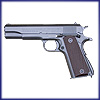
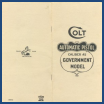
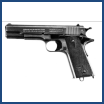
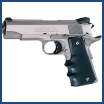
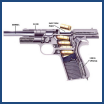
Lawrence, like Churchill, chose the Colt Model 1911 which is still
considered one of the finest combat pistols of all time.
After graduating from Oxford, from 1911 to the
spring of 1914, Lawrence participated in an archaeological excavation
at Carchemish near the Euphrates River in Turkey. His leisure
activities included marksmanship practice and occasional hunting.
Firearms he mentions in his letters are a Mauser pistol and a
Mannlicher-Schoenauer carbine. A photograph of Dahoum, a close friend
of Lawrence's, shows him holding a pistol, presumably Lawrence's. It
appears to be a Colt automatic, possibly a model 1908.
His letters from Carchemish indicate a high level of
skill with both rifle and pistol. In February of 1913, he reported
hitting a six gallon petrol tin with a Mannlicher-Schoenauer carbine
four shots out of five. In June of that year he wrote that he hit a
medjijie (a Turkish coin) five shots out of seven at 25 yards with a
Colt automatic pistol rapid fire. He also stated that he has been
getting sure of medjijies and eggs at 25 yards, hit an orange crate
five times out of five at 500 yards with the Mannlicher carbine and
finally put three shots out of ten in a meter square target at 1,200
yards. In October 1913 he wrote that when two people came, they had no
meat for them so he shot two ducks with a pistol, targeting the head.
Lawrence served in the British Army from 1914 to
1918, rising in rank from second lieutenant to colonel. He served in
the Geographical section of the General Staff (Intelligence) in London
until December 1914, then transferred to Cairo. There he was engaged
in the preparation of maps, interviewing of prisoners and writing
intelligence reports. In 1916, he became a liaison officer to the Arab
forces in the Hedjaz and began the campaign that resulted in his name
becoming a household word for most of this century.
Lawrence used a variety of small arms during the
war. On september 18, 1914, he received two Colt automatic pistols
from America, sent at his request by a friend travelling there. (There
was a shortage of pistols in England for several weeks after the war
broke out.) Lawrence did not mention the model, but a letter from his
brother Frank, who became an officer at the outbreak of the war and
was killed in France in 1915, contains information that leads one to
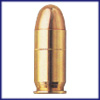
the conclusion that it could only have been a Colt Model 1911 in .45
caliber. Frank Lawrence wrote to T. E. Lawrence in September 1914:
The Colt is a lovely pistol. The more I examine it
the more I like it. There is a vast gulf between it and the ordinary
revolver.
If you want anything in connection with it which
you don't want to write for I could get it for you. They keep two
weights of bullets, I think 200 and 230 grains. The lighter weight
has considerably higher velocity and penetrating power, though I
suppose less shock.
This would indicate that both Frank and T. E. had
Colt automatics that used the 200 or 230 grain bullets. In 1914 this
would have been the .45 caliber Model 1911. (The British also used the
Colt 1911 in .455 caliber, but this chambering was not introduced
until 1915.)
Like most British soldiers, if not most officers,
Lawrence used a Short Model Lee-Enfield rifle. Perhaps not
surprisingly, his rifle had a rather colorful history. The rifle,
originally issued to the Essex regiment, had been captured by the
Turks at Gallipoli. It is one of four that had been inscribed in gold
with the legend "Part of our booty in the battle for the
Dardanelles" and presented by Enver Pasha, the Turkish ruler, to
each of the sons of the Sherif of Mecca. One of these sons, Feisal,
the leader of the Arab forces fighting with Lawrence against the
Turks, presented his to Lawrence. Lawrence's initials, T.E.L., and the
date 4.12.16 (for December 4, 1916) are carved in the stock just above
the magazine. There are also five notches carved in the stock, each
representing a Turk shot with this rifle before Lawrence stopped
counting his kills. After the war, Lawrence presented the rifle to
King George V. It was later place in the Imperial War Museum where it
is now on exhibit. Lawrence mentions this rifle in "Seven Pillars
of Wisdom", his story of the Arab revolt.
Lawrence was quick to recognize and adopt
technological advances. He became an early advocate of the use of
automatic weapons, replacing his rifle with a light machine gun which
he carried in a scabbard on his camel. This weapon was a Lewis
machinegun in the aircraft configuration without the heavy radiator,
casing and shoulder stock found on the models typically used in the
ground role. The Lewis used 47 or 97 round magazines and , according
to Lawrence, fired "a wonderfully dispersed pattern". After
his exploits became known to the Turks and they offered a large reward
for his capture dead or alive, Lawrence recruited a personal bodyguard
that numbered up to ninety men. This group had extraordinary firepower
for its size, for in addition to their rifles, pistols and daggers,
they were equipped with one machine gun for each two men.
After the war, Lawrence wrote his memoir of the Arab
revolt, served with Winston Churchill in the Colonial Office and then
enlisted in the Royal Air Force where he remained until shortly before
his death in a motorcycle accident. Lawrence did little recreational
shooting during this period. He is reported to have kept a Webley
revolver in his cottage, Clouds Hill and fired it at a tree on his
property. One collector removed the bullets from that tree when it was
cut down.
Today Lawrence memorabilia, from his letters and
Arab robes to his daggers, is in great demand by collectors. The
locations of many Lawrence-associated items are known. One dagger with
a gold hilt and sheath, which he had made in Mecca, is in the vault of
All Souls College in Oxford, England. Another of his daggers is in a
private collection in San Marino, California. His letters and robes
have sold for thousands of dollars at auctions. Unfortunately, except
for the gold-engraved SMLE in the Imperial War Museum, the locations
of Lawrence's firearms seem to have vanished from record.
Visit George Amin Hoffman's web site at:
http://www.wenet.net/users/titangh/ |