The MKIV/Series 70 Colts
By Syd
If you ask Colt auto fans which series is their
favorite, many will say the Series 70. A case could be made that the
pre-war commercial Colts are more elegant and finely rendered, but
surviving examples of these are expensive collector items, often
commanding several thousand dollars in like-new condition. The Series
70 Colts, while no longer in production, can still be found in
excellent condition at reasonable prices. The Series 70 Colts were
produced between 1970 and 1983 in Government Model and Commander
sizes.
|
|
What is it?
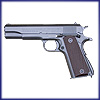
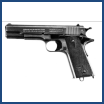
To all outward appearances, the Series 70 is a
gussied-up M1911A1. It has the frame, sights, and arched mainspring
housing of the M1911A1. The roll stamping, seen at the right, makes
clear it's commercial intention. Inside, there are some refinements. It has
been often noted that the G.I. M1911 and M1911A1 pistols were designed
for reliability, not pinpoint accuracy. They were deliberately built
with liberal tolerance so that they would continue to shoot if they
were dirty, or dropped in the mud or sand.
On the issue of accuracy,
Kuhnhausen says: |
|
“Some hang up on the 50 yard target
performance of the G.I. M1911A1 Pistols. Moderately loose G.I. Pistols
typically printed 5” to 6” groups with G.I. ammo. Max. spec.
(loose) pistols typically fired 8” to 10”+ groups. Keep in mind
that personal defense range is typically less than half of 50 yards.
Also consider that a 10”/50 yard group would correspondingly reduce
to about 5” at 25 yards and to about 2”+ at 10 yards. This tells
us that the accuracy of the average G.I. pistol was more than adequate
for its intended purpose. From the ordnance development viewpoint,
trying for match accuracy was counter productive – in fact,
downright silly, in a combat pistol – it was better to opt for a
pistol that would shoot, no matter what.
M1911A1 National Match
Pistols, on the other hand, were toleranced differently (i.e., with
maximum target accuracy in mind), which follows because National Match
pistols were intended for use in competition and not in combat where
overcoming dirt and grit was a necessity….As an old armorer friend
used to say: ‘If the M1911 had been standardized as a match pistol,
that’s how it would have been made… Even so, human nature being
what it is, our main ambition now would be finding ways to loosen
M1911’s to make them shoot better full of dirt.’”
|
The Collet Barrel Bushing
Human nature, being what it is, will always lead
some to search for the best of all possible worlds – match accuracy
and 100% combat reliability. It was this quest that led to the most
distinctive innovation of the Series 70 pistols: the collet style
barrel bushing and it’s accompanying barrel.
Prior to the advent of the Series 70, Colt auto
shooters had two basic choices: the very tight, target-tuned National
Match or the M1911A1, albeit repackaged and finished nicely. The
Series 70 attempted to hit the middle ground between the National
Match and the M1911A1 by delivering better accuracy than the M1911A1
and better service reliability than the National Match.
|
 |
| |
The
Series 70 Collet Barrel Bushing |
Accuracy in an autoloader comes from a consistent
barrel lock-up when the gun cycles and reloads itself. If the front of
the barrel is wobbling around, the lock-up will not be consistent. In
the M1911A1 this means having a barrel bushing which is closely
fitted. Colt engineers were faced with a choice: either they could
hand-fit the bushings and thereby create a prohibitively expensive
manufacturing process, or they could design a bushing which, in
essence, fitted itself by its shape. They chose the latter and the
collet bushing was born. |
 |
|
The Series
70 Barrel. The area above the red bracket is the raised part
of the barrel which contacts the bushing |
The collet barrel bushing has four “fingers”
rather than the solid tube of the G.I. bushing. The
"fingers" exert a sort of spring tension between the barrel
and the slide to produce a better lock-up. The Series 70 barrel
is raised slightly in the area where the bushing makes contact with
it.
The collet bushing, like every other modification
of the original Browning design has proven to be controversial. While
it does deliver improved accuracy, its design made it prone to
breakage. Also, it fits much more tightly than the M1911A1 bushing,
making it harder to remove and many gunsmiths advise pulling the slide
back about an inch or so to relieve pressure on the bushing before
removing it.
The Series 70 pistols do not have the lawyer-safe
firing pin block mechanism of the Series 80 Pistols.
Jerry Kuhnhausen on the Series 70 Collet
Bushing
“From the beginning, it has been known that
M1911 accuracy could be improved by uniformly controlling the closed
and locked position of the barrel in the slide. Naturally, this
control would start at the muzzle end, with closer bushing to slide
and bushing to barrel tolerances. This costly hand work would make
production pistols much too expensive. But, nonetheless, the buyer was
demanding greater accuracy. This market requirement is probably what
influenced Colt in the adoption of the collet type bushing which
became standard with the Series 70 Models.”
From “Doc” O’Meara at Gun Tests on the
Series 70 Collet Bushing
“Good support at the front and the rear of the barrel is
essential to accuracy, but one doesn’t have to fit a match bushing
and have the lugs welded and re-cut to do it. If your pistol is a Mark
IV Series 70 Colt with a collet bushing, half the battle is won …
The collet bushing has four flexible fingers that grip the bell shape
of the forward end of the Series 70 barrel under mild spring tension.
With continued use, it wears slight grooves into the barrel and, with
time, accuracy actually improves rather than deteriorates, which you
might not expect.”
Aesthetics
Many of the most eye-catching Colts are Series 70 pistols. These were
built prior to the usage of stainless steel and they have rich nickel
plate or blued finishes. I have heard nickel plated Colts with mother
of pearl grips called "pimp guns" but the do have a way of
standing out in a display rack. The blued finish is rich and deep.
These guns have the "classic" look and are cherished by
their owners.
MKIV/Series 70 Production
Information
The Series 70 Government Model Colts were
chambered in .45 ACP, .38 Super, 9mm Parabellum and 9mm Steyr (for
overseas sales). The Government Model has a 5” barrel with checkered
walnut grips adorned with the Colt medallion. They were produced in
Blue and Nickel finishes. Series 70 models were manufactured from 1970
until 1983. They were serialized with “SM” prefixes (approximately
3,000), “70G” prefixes from 1970 through 1976, “70L” and
“70S” prefixes, “G70” suffixes between 1976 and 1980,
“B70” suffixes between 1979 and 1981, and “70B” prefixes
between 1981 and 1983.
Variants
Series 70 Combat Government –
.45 ACP bluish-black metal finish, features modifications for
combat shooting and is the forerunner to the Combat Elite. |
Series 70 Lightweight Commander
– Chambered in .30 Luger, 9mm Parabellum, .38 Super, .45 ACP. This
pistol has a 4.25” barrel, full size grips and is denoted by a
“CLW” prefix on the serial number. These pistols were produced
from 1970 until 1983. 500 Lightweight Commanders were manufactured in
7.65mm (.30 Luger) during 1971. Most were exported but 5 were sold in
the U.S.
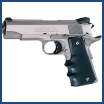
Series 70 Combat Commander –
produced in bluish-black metal finish and satin nickel. The satin
nickel models are very rare. |
 |
|
Rare
satin nickel finish Series 70 Combat Commander |
|