|
The Remington Government Model Pistols
By Syd
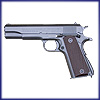
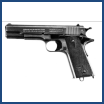
Two Government Model .45 autos carrying the
illustrious name of Remington have served our nation’s armed forces.
Would it surprise you to know that one of them was built by a
typewriter company which had no experience in building firearms?
Here’s the story.
In 1873,
E. Remington & Sons
embarked on a new venture, and in September of 1873, the first
Remington typewriters were produced. While it took them 13
years to figure it out, E. Remington realized that they were a
firearms builder and not a typewriter company, and in 1886
Remington sold the
typewriter business. This business would later become Remington
Rand, then Sperry Rand.
These were
difficult times for Remington however, and in March
1888, E. Remington & Sons was acquired by Marcellus Hartley and
partners. E. Remington & Sons was reorganized, and the new
company was named the Remington Arms Company. In later years, in
order to better utilize the potential of the Remington Plant, the
company would produce sewing machines and cash registers. (I
guess they just couldn’t stay away from the gadgets.) In 1912, The
Union Metallic Cartridge Company of Bridgeport and Remington Arms
Company were combined into one company and became Remington-UMC, and
just in time for World War I.
As the United States was drawn into the war, War
Department planners in 1917 estimated that a total of 765,000 pistols
would be required. The estimate was later revised upward, first to 1.3
million and then to 2.7 million. There was no way that Colt was going
to be able to build that many guns. Orders were placed with Remington-UMC,
Winchester, Burroughs Adding Machine Co., Lanston Monotype Machine
Co., National Cash Register Co., A.J. Savage Munitions Co., Savage
Arms Co., and two Canadian firms, Caron Brothers Mfg. Co., and North
American Arms Co., Ltd. Of those firms, only Remington-UMC delivered
any meaningful quantity (21,677 of 150,000 ordered). North American
did make some pistols, but the total was probably less than 100. Some
authorities dispute if North American even completed those.
The
Remington-UMC M1911 Pistol
The Remington-UMC contract specified a
”target” production rate of 3,000 pistols per day to be reached as
soon as possible. The company immediately ran into problems because
the necessary production blueprints and specifications were not
available. Since interchangeable parts were required, production could
not begin until Colt provided drawings. Eventually, a complete set of
production drawings and specifications were obtained by Remington-UMC,
and the company began to tool up for manufacture of the M1911.
Colt was not being deliberately resistive here.
Truth be known, Colt probably didn’t have a complete set of
blueprints which would enable another company to quickly tool up and
produce pistols. Colt’s manufacturing style in those days relied
heavily on the acquired skill and knowledge of the craftsman who
worked in their shop, and it is quite likely that many of the
“secrets” had never been committed to paper.
The first Remington-UMC pistols were delivered to
the government in August 1918, but the company was never able to
achieve the desired production rate. The company’s M1911 production
contract was cancelled in December 1918, soon after the signing of the
Armistice, although production did not actually cease until early
1919. By the end of the war, Remington-UMC had only delivered 13,152
pistols. Total production was only 21,677 pistols when the final
deliveries were made in early 1919.
The Remington-UMC M1911s were serially numbered
consecutively from 1 through 21,677. The pistols were stamped with
inspectors’ initials (either “B” or ”E”). The left sides of
the slides were marked with Colt patent dates, the “Remington/UMC”
logo arrayed in a circle and “Manufactured by/ Remington Arms UMC
Co. Inc./ Bridgeport, Conn., U.S.A.” The left sides of the receivers
bore the same “United States Property” markings found on the Colt
and Springfield Armory M1911s.
Early production guns should have the
"E" stamp on left side of trigger guard, bottom of main
spring housing, and back of slide. “E.E.C.” is the mark of Edward
E. Chapman who inspected 1911s at Remington in 1918 and 1919.
The Remington-UMC pistols were finished in the
same rust blue as was found on the pistols made by Colt and
Springfield Armory and were fitted with the same type of checkered
walnut stocks. Although the company never achieved the production
goals envisioned by the government, the Remington-UMC pistols
nevertheless helped arm the Doughboys of the American Expeditionary
Force. As was the case with the Colt and Springfield Armory pistols,
the vast majority were subsequently rebuilt and refinished after World
War I, and few are found today in their original “factory”
condition. Surviving examples of all World War I and earlier vintage
M1911 pistols in original condition are very rare.
The Remington Rand M1911A1
When World War II broke out, Remington-Rand had
been a typewriter company for 55 years, and they made a right decent
typewriter (I owned one), but they were a long way out of the firearms
business. Nevertheless, Uncle Sam needed war material and any number
of manufacturers were pressed into service building things that they
had never built before for the war effort. But why didn’t Uncle get
Remington Arms to build the pistols? The answer is really pretty
simple. The War Department needed Remington Arms to do what it did
best and that was to produce ammunition. Other folks could crank out
the pistols.
Remington Rand was awarded its first order on
March 16th, 1942, for a total of 125,000 1911A1 pistols. The company
had no experience building pistols at the time it was awarded the
contract. Remington Rand formed a new division to take charge of
building the pistols. The division formed was designated Remington
Rand "C" Division. After winning the contract, they
converted a vacant plant once used for building typewriters to the
production of M1911A1 pistols. The old plant was located on Dickerson
street in Syracuse, N.Y.
The first 255 production pistols where accepted
by ordnance inspectors in November of 1942. In the beginning, some
manufacturing equipment was still unavailable and this caused
Remington Rand to acquire parts from other sources to complete the
early pistols. They purchased barrels from High Standard, Colt, and
Springfield Armory; disconnectors from US&S; grips safeties from
Colt; and slide stops from Colt and Springfield Armory (2,865 left
over from WWI).
By March of 1945 they where building the lowest
price pistol in the war effort and quality was considered second to
none. It is important to note that in March 1943, James Rand, Jr.
stopped production due to interchangeability test failures. The guns
where not meeting the government requirements for parts
interchangeability and had a very high rejection rate. After a change
in management, production resumed in May of 1943 with the
interchangeability and rejection rate problems solved. By the end of
the war Remington Rand had produced over 875,000 pistols, almost twice
as many as Colt and Ithaca combined.
The most amazing part of the story is in how many
of the Remington Rand pistols are still in service today, 55+ years
after they were built by the typewriter company in Syracuse that knew
nothing about building guns. Their owners swear by them, and if they
haven’t been abused, they’re still solid and dependable pistols. I
wish I had a dozen of them.
Sources:
“Non-Colt U.S. M1911s” by Bruce Canfield, American
Rifleman, June 2001
Ty Moore, CoolGunSite.com,
http://coolgunsite.com/index.html
Remington Arms Company, History of the Firearms Business:
1816-2000
http://www.remington.com/aboutus/corphistory.htm
|