|
The
Randall Firearms Company History 1983-1985
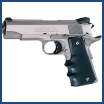
Stainless steel semi-auto handguns are
now common, even passé. But this fact of life in the '90's would
never have come to be had it not been for a small, now defunct company
which dared to show the rest of the firearms industry the pathway to
the future. Randall Firearms Company of Sun Valley, California,
U.S.A., made it all happen with a line of high-quality Model 1911
derivatives.
Although Randall pistols were
manufactured from only June 7, 1983 to May 15, 1985, they ushered-in
an entirely new era for handguns, thus carving for themselves a place
in the history of firearms around the world. This historic niche,
coupled with the fact that Randall pistols are exemplary specimens of
their genre, has made every single one of the 9,968 Randall pistols
eminently collectible.
Enhancing the collectability of
Randall's is the fact that, in all, there were 24 different models
with 12 variations in three different caliber's. This means there were
never very many of any one style made -- never.
Among Randall's many trend-setting
innovations were two of the most significant breakthroughs in the 1911
field since John Moses Browning designed that form of semi-auto in the
first place. One of these breakthroughs came when Randall made the
very first production pistol of its kind in stainless steel. The
second was the introduction of a true mirror image of the 1911 in a
left-handed configuration. Again, this had never been done before on a
production basis.
It actually all began with a small
company called KEN-AIR, Inc., which had been in the aircraft
instrument repair business in the San Fernando Valley area of Los
Angeles County [in the State of California, USA] since the mid-1950's.
Then, in 1981 the company entered into a diversification program which
ultimately led to the Randall pistol.
The "KEN" in KEN-AIR stands
for Ken Lau founder and chairman of the company. Lau and World War II
Air Force hero, Brigadier General Russell Randall, met while working
together as advisors to China Airlines. More about that later.
In 1981, Lau and his KEN-AIR company
received a contract from the government of South Korea to build .45ACP
handguns. By the time production facilities at the Sun Valley,
California, manufacturing plant were established, the Korean
government changed its mind and canceled the contract.
This left Lau's firm with the
facilities to produce Model 1911 handguns, but no customer. By then,
Lau had done a lot more than just set-up another firearms production
line. He had relied upon his long experience in manufacture of parts
for the aerospace industry when formulating exactly how the line would
operate, and even used his knowledge of materials seen in the
aerospace business as a basis for a series of momentous decisions
which helped make the Randall pistol so unique.
In addition to the manufacturing
hardware and engineering, Lau also assembled an unparalleled team of
management experts from throughout the firearms industry, insisting
that everyone who was going to make decisions had held responsible
posts at other companies like Colt, Smith & Wesson, Remington,
Winchester, Vega, Detonics and Thomas. Working under one roof in a
suburb of Los Angeles was a hand-picked cadre of experts, ready to
blaze revolutionary new trails through firearms history.
Not only were Lau and Gen. Randall
close personal friends, but they were also business associates, which
included Randall as a member of the board of directors of the company
when it incorporated in January of 1981. In addition to Randall's
association with Lau in China Airlines and KEN-AIR, the General was
also as an advisor with Litton Industries.
Trading upon the General's worldwide
name identification, the new gun company was named after him: Randall
Firearms Company. When the Korean government contract fell through,
Lau decided to continue with the project, and court the civilian
markets instead. By November of 1982, everything was set, and Randall
announced the introduction of its first handgun -- the
all-stainless-steel auto.
Except for some minor changes
necessitated in manufacturing, the Randall pistols were much unchanged
from the traditional Browning design. However, because every part
except for the grips was made of aircraft quality stainless steel,
this really was a new gun, and quickly became known as "The Only
Stainless Steel Auto Fit For Duty".
FULL SIZE SERVICE MODEL .45 ACP PISTOLS
Although some prototype pistols were
made as early as 1982, the first production Randall's came off the
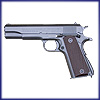
line on June 7, 1983. They were the Service Model A111, which was a
standard 1911A1. It featured the typical round top slide with fixed
sights and a five-inch, 10-groove barrel. The A111 pistols were
produced throughout the life of the company, and, in all, there were
3,431 produced in a serial number range of RF02000C through RF09208C.
All A111 Randall's were chambered in .45 ACP.
Next came the Model A121 on September
14, 1983. Initially, the A121 was also called a Service Model, but
since there was some confusion with the designation, the marketing
folks at Randall decided to make a change. In 1984, it became known as
the Combat Model, and at that time those guns were roll-marked
"Combat" just under the ejection port. The only other
changes in that model at that time were cosmetic: the hammer was
rounded, and Pachmayr grips were supplied as standard. Although
catalogs of the era stated that it would be supplied with a flat
mainspring housing, no such guns were ever actually produced.
The only other distinguishing factor
between the A111 and the A121 was the A121 had a flat top slide rather
than the rounded top on the slide of the A111. Both models had fixed
sights and were in .45 ACP only. Model A121 pistols were in the
Randall line through June 11, 1984. In all, 1,067 of these pistols
were made in a serial number range of RF02211C through RF08620C.
By September 28, 1983, Randall was
ready to offer a third variation in its line of .45s, which was the
Service Model A131. The only difference between the A121 and A131
pistols was that the latter model sported a Millett Model 100 Gold
Cup-type adjustable rear sight which fit into a milled slot atop the
rear of the slide.
This model also stayed in the Randall line throughout the life of the
company. In all, 2,083 of these pistols were made in a serial number
range of RF02135C through RF09201C. The last model A131 pistol was
built on October 22, 1984.
Collectors should note that more than
322 Service Models were made from parts outside the factory after the
company closed. These pistols are not as highly collectable and do not
command Blue Book prices.
SERVICE MODEL 9MM PISTOLS
Introduced on January 11, 1984 was the
first Service Model A112 in 9mm Parabellum. Essentially, this was the
same gun as the A111, except for caliber. In fact, the slides for the
A112 pistols were made from the same 17-4 stainless steel investment
casting, as were the slides for the A111 in .45 ACP. This model
remained in the line until July 23, 1984. In all, 301 of these 9mm
pistols were produced in a serial number range of RF04666C through
RF07599C.
Although there were relatively few
Randall A112 pistols ever made, a change in production early on
resulted in what was essentially two separate sub-models. The first
Model A112 pistols employed Stainless steel, six-groove standard
Colt-type barrels and barrel bushings. The outside diameter at the
muzzle of those barrels was 0.495-inch.
By 1984, it became apparent that the
company could facilitate production by using a fatter barrel, which
would allow the standardization of barrel bushings. These later
production Model A112 pistols featured barrels that had the same
outside diameter as the standard .45 ACP. And, there was more of a
change than simply the outside diameter of the barrel in these
latter-day Model A112 handguns. Randall at that time went from
six-groove rifling to its hallmark 10-groove configuration in theses
9mm Fat Barrel units. The rifling was changed to enhance accuracy, and
it also made the number of grooves standard throughout the Randall
line since the .45s always did have 10-groove barrels.
Production of the Combat Model A122
began on July 23, 1984, and ended December 13, 1984. It was
essentially nothing more than the Model A121 (.45 ACP) in 9mm. This
meant that it differed from the Model A112 9mm in that it had a slide
with a flat top and fixed rear sight, a round hammer and Pachmayr
grips. Only 18 Model A122 pistols were ever made, making it the rarest
of the right-handed, full size service pistols Randall ever produced.
Of the total production of 9mm Randall's, nearly 75% were exported to
the European countries of England, Germany, Austria, Switzerland, and
France. Only 35% of those 9mm Randall's had the fat barrels. Of
Randall's total production of full-size, right-handed service models;
the 9mm pistols represented a scant 3.2 percent.
"COMMANDER"-SIZE .45 ACP
PISTOLS
By August of 1983, Randall expanded its
line of pistols to include the Service Model-C configuration. The
"C" stood for compact. Initially, these handguns were even
roll-marked "Service Model-C." However, in the beginning of
1984, the company decided to give the guns a new identity, and dubbed
this configuration as the "Raider," so-named for General
Randall's unit which had been known as Randall's Raiders.
Introduced August 31, 1983, the first
in the Service Model-C series was the A211, which featured a round-top
slide and fixed sights. Barrel length was 4.25-inches, making the
over-all length .75-inch less than the standard A111. Magazine
capacity (7) and height remained the same. Weight of the A211 was 36
ounces, compared to 38 ounces for the full-sized Model A111. After 992
of the Model A211 pistols were made, production of that model ceased
on September 6, 1984. The serial number range went from RF02001C
through RF05808C.
Next came the Model A231, which
differed from the A211 in that it had a flat top slide and Millett
Model 100 Gold Cup-type adjustable rear sight. The Model A231 was
introduced on November 7, 1983. Only 574 of these pistols were
manufactured, with a serial number range of RF02009C through RF03814C.
The last of this model was manufactured on October 6, 1984.
"COMMANDER"-SIZE 9MM PISTOLS
The Model A212 was introduced on
February 1, 1984. Like its .45ACP counterparts, it also went through a
name change in 1984, becoming another in the "Raider"
family. Primarily, the biggest difference between the A212 and the
A211 (.45 ACP) was the caliber. However, the A212 also was made in two
different barrel widths -- the latter are rarer being the Fat Barrel
guns. In all, there were only 76 of the A212 pistols manufactured, or
which a mere 25 had fat barrels. The serial number range was RF02359C
through RF03815C. The last A212 was manufactured on December 13, 1984.
Randall Model A232 came on-line on
October 11, 1984, and differed from the A212 in that it had a flat top
slide with the Millett Model 100 adjustable rear sight. In all, only
five Model A232 pistols were ever produced, and it is believed that
they all were exported to Europe since none have surfaced since in the
United States. The serial number range was from RF02473C through
RF03777C. The last of this model was made on November 12, 1984.
This completes all of the right-handed
Service Model-C and Raider pistols produced by Randall, accounting for
16˝% of total pistol production during the life of the company.
THE CURTIS E. LeMAY 4-STAR PISTOLS
In 1984, Randall expanded its line with
the introduction of a true compact .45 auto, which was designed by Air
Force General Curtis E. LeMay. Among his many accomplishments, LeMay
had been responsible for establishing the Air Force's Marksmanship
Training Unit.
When LeMay created his pistol design,
he intended it to be used by members of the Strategic Air Force
Command. The general initially tried to have the diminutive .45
produced by Colt. But, that never occurred. As it happened, Art Hanke,
who was the head of manufacturing and engineering for Randall, was a
personal friend of General LeMay. It was through this liaison that
Randall Firearms Company came to produce the LeMay model line of
pistols.
First of the LeMay pistols was the
A311. It sported a 4.25-inch, 10 groove barrel. The slide had a round
top and a fixed rear sight. The handle and magazine were shortened by
a half-inch, limiting the magazine to six rounds. Overall weight was
35 ounces. Exclusive to the LeMay models were factory-squared trigger
guards.
In all, 361 of the Model A311 pistols
were made in a serial number range of RF02011C through RF03114C. The
first A311 was made on March 1, 1984, and production of that model
ended on October 25, 1984. Next came the A331, which featured a flat
top slide and Millett Low-Profile adjustable rear sight. The top of
the slide was milled deeply so the rear sight would sit low enough to
preclude its catching on clothing when drawn. There were 293 of this
model produced in a serial number range of RF02010C through RF03169C.
The first LeMay A331 was made on March 1, 1984, and the last one was
completed on October 23rd of that same year.
Among the rarest of all the Randall
pistols was the Model A312 which was introduced March 1, 1984, but
which was never a production gun because only two sample pistols were
ever made. The company intended to market this model in Europe, and
had Randall Firearms Company survived, it no doubt would have made
regular production runs. The company failed before any orders were
taken. This pistol has a round-top slide and fixed rear sight. The
only difference between the single Model A312 and the production A311
is the caliber. The A311 is a .45 ACP, and the A312 is in 9mm. Serial
numbers were RF02012C and RF02031C respectively.
Also quite rare is the 9mm Model A332.
It differs from the A312 in that it has a flat top slide with Millett
Low Profile adjustable rear sight. Only nine were ever made, and
production of this model was limited to the period between March 1,
1984 and December 13, 1984.
Of all the pistols produced by Randall,
6.7% were in the right-handed LeMay family. The LeMay is also one of
the most highly collectible of all Randall pistols. Randall LeMay
models were shipped from the factory with a dog-leg magazine,
featuring a finger extension on the bottom. For every two of the
dog-leg magazines, however, Randall produced one without an extension.
All LeMay magazines are rare and command premiums, even more so for
the LeMay magazines without the dog-leg. Also, most of the LeMay
pistols were shipped in a pistol rug rather than in a factory box. Add
15% in price for LeMay pistols with a factory box.
Collectors should note that more than
225 LeMay pistols were assembled from parts outside the factory after
the company closed. These pistols are not as highly collectible and do
not command Blue Book prices.
.
LEFT-HANDED RANDALL PISTOLS
Randall shocked the firearms industry
during the week of May 17, 1984 when it introduced the first of 10
left-handed models. These pistols were entire mirror-images of their
right-handed counterparts, including the reversal of twist in the
rifling from the left-to-right in the right-handed guns to
right-to-left in the left-handed guns.
What the Randall Company did was to
make the entire breadth of its line available to southpaws in
left-hand configuration. All left-handed Randall's are considered to
be extremely desirable and highly collectible, due to the fact that
only 7.4% of total production was in the form of left-handed guns.
In order to make this truly left-handed
handgun, it was necessary to re-tool for 17 major parts changes. This
even meant that special left-handed magazines needed to be produced.
First among the lefties was the Service
Model B111, which was a full-size government model with five-inch,
10-groove barrel and round-top slide with fixed sights. There were 297
pistols of this model made, with a serial number range of RF02100C to
RF03092C. The first Model B111 was made on May 17, 1984, and the last
one came off the line September 7th of that same year.
Next was the B121, which sported a flat
top slide and fixed sights. Otherwise, it was the same as the B111,
and it differed from the right-handed A121 in that Pachmayr did not
make left-handed grips, so it lacked the rubber grips of the
right-handed counterpart. Randall produced 110 B121 pistols with a
serial number range of RF02132C to RF03078C. The B131 was essentially
the same as the B121, except that it was furnished with a Millett
Model 100 adjustable rear sight. There were 225 of the B131 pistols
produced in a serial number range of RF02110C through RF03092C. The
first B121 was made on May 17, 1984, and the last one was completed
August 28, 1984. The first B131 was made on May 24, 1984, and the last
one was completed August 28, 1984.
Also among the most collectible of the
Randall pistols are the Models B122 and B123. These left-handers were
made in 9mm and .38 Super respectively, and were otherwise
counterparts to the B121. There were only two each made of these
models, and those were special-order guns when they were produced.
All of the full-size, left-handed
pistols represented only 6.4% of Randall's entire production. There
were also three different production variations of the left-handed
LeMay profile pistol. These were the B311, B312 and B331. The B311 was
a LeMay with round-top slide and fixed rear sight in .45 ACP, and
there were 52 manufactured in serial number range of RF02100C through
RF02207C. The first B311 and B331 were made on July 13, 1984, and the
last ones went off the line slightly more than a month later on August
29, 1984.
The B312 was the left-handed LeMay in
9mm with a round-top and fixed rear sight. Only nine were
manufactured. The B331 was the LeMay in .45 ACP, with a flattop and
Millett Low Profile adjustable rear sight. There were 45 of these
manufactured in a serial number range of RF02100C through RF02207C.
All B312 pistols were made on or about August 23, 1984.
The left-handed LeMay series
constituted only one percent of the Randall factory's production.
FACTORY RARITIES AND VARIATIONS
Starting in 1984, Randall produced and
experimented with a number of model variations. They are, by model:
-
B2/321 -- Only one of these was
produced, and it was made on special custom order for Texas-based
collector Robert F. Mueschke, who has the largest collection of
left-handed Randall pistols in the world. This variation was built
on a left-hand Raider receiver and a left-hand LeMay (B321) slide.
Its serial number is RF03069C.
-
B312 with a .45 ACP Factory
Conversion unit. There was only one of these produced. It was a
9mm left handed LeMay
with a .45 ACP conversion unit. Its serial number is RF02164C.
-
A131/SO -- A right-handed Service
Model with a flat top slide and adjustable sight, chambered in
.451 Detonics Magnum. Only one was made, with serial number
RF00451C.
-
B131/SO -- A Left-handed Service
Model with a custom low profile Millett Model 100 rear sight,
custom squared trigger guard, scrimshawed ivory handles, custom
metal checkering covering 40% of the guns surface, and a special
slide conversion stamped with both Randall .38 Super and Randall 9
MM with respective barrels and ejectors. Only one B131/SO
3-Caliber Conversion was manufactured.
-
A111/B111 Matched Sets -- There
were four such sets manufactured. These were standard government
configuration pistols, and the right-hand and left-hand in each
set shared a common serial number. Those serial numbers were
RF00000C, RF00001C, RF00010C and RF00024C. Interestingly, the
RF00010 pair was originally made for the television series
"Magnum P.I." However, those two guns were never
delivered to the television production, and have since found their
way into a private collection in the state of Arizona.
-
C211 -- A lightweight Raider in .45
ACP with a round-top and fixed sights. There were five
manufactured for law enforcement evaluation as off-duty carry
weapons.
-
B321 Set -- This set was based on
the left-handed LeMay, and it was the only set to have all three
individual slide variations fitted to a single receiver. The
receiver and all three slides were identically engraved in a high
relief pattern by Byron Burgess. The set was mirror-polished and
was fitted with custom ivory grips bearing scrimshanded Randall
logo on each side. Scrimshaw work was done by Mark Tate and all
custom work by the Hal Jankofsky at the RFMC Custom Shop. The set
was delivered in a custom-fitted walnut presentation case. It has
the serial number of REK 1.
-
AUSTRIAN RANDALL'S -- Five Randall
A111 pistols were sent to the Austrian government for law
enforcement evaluation. Upon entering that country, the guns were
processed through the Austrian proof house, where they received
proof marks on the barrels, receivers and slides. When the
Austrian government learned that Randall had gone out of business,
the guns were returned to Randall's San Francisco-based exporter.
Since then, a Central California-based investor has acquired all
five.
PROTOTYPES
All Randall prototype serialization
begins with the letter "T" followed by a two-digit number.
In all, there were 43 prototype pistols made in 15 different model
designations. Prototypes included many factory variations that never
saw production, such as guns with an all-black oxide finish, black
oxide and silver finish, and a pink and purple LeMay.
Generally, prototypes are valued at
about 150% of the same production model as listed in the Blue Book of
Gun Values.
SERIALIZATION VARIATIONS
Production serial numbers on Randall
pistols generally began at 02000 for right-handed models, and 02100
for left-handed models. However, by special order there were 78
pistols with custom serial numbers under 02000. All but about the
first 200 serial numbers started with the letters "RF" and
ended with a B, C, or W. A few mis-marks are in circulation. Most
Randall's had serial number prefixes like the following: RF, RF0,
RF000, 2RF0 or 2RF000. The breakdown of Randall serial numbers to
satisfy the U.S. Bureau of Alcohol, Tobacco and Firearms is simple.
The RF signified Randall Firearms, and the last letter in the serial
number designated the vendor who machined the receiver. In the case of
letter "B," the vendor was Bellmore-Johnson of Vermont. In
the case of the letter "C," the vendor was Caspian Arms of
Hardwick, Vermont. In the case of the letter "W," the vendor
was Ward Machine Company of Santa Ana, California. It is believed
there could have been a few factory errors in which the serializing
machine malfunctioned, resulting in serial number suffixes of
"D," "E" and "F". These would be
extremely rare.
HOW TO IDENTIFY THE VARIOUS MODELS
Randall models are designated by a
single letter prefix, followed by a three-digit number. Prefixes are
A, B or C. Prefix A designates a right-handed pistol. Prefix B denotes
a left-handed configuration, and prefix C represents a right-handed,
featherweight model.
In a logical sequence, the first
numerical digit reflects the frame type, the second digit is for the
slide configuration and the third number denotes caliber.
The first numerical digit is 1, 2 or 3.
If the first number is 1, it means Service Model. A number 2 refers to
Service Model-C or Raider, and a 3 denotes the LeMay model.
The second digit is 1, 2 or 3. A 1
refers to Round-Top, Fixed Sight Slide. A 2 stands for Flat top,
Fixed-Sight Slide, and 3 is for Flat top, Adjustable-Sight Slide. The
third digit is 1, 2 or 3. A 1 refers to .45 ACP, a 2 is for 9mm
Parabellum and a 3 is for .38 Super.
For example: A Model A231 would be a
right-handed gun (shown by the letter A), and it would be a
commander-size pistol (indicated by the number 2 following the letter
A). The number 3 refers to a flat top, adjustable-sight slide, and the
last digit, 1, indicates it is a .45 ACP.
COLLECTIBLE TIPS
A marketing upgrade affected most
Randall pistols made from late November of 1983 through the end of
production. All Randall's sold had slide stops and grip safeties
upgraded to "Extended" and "beavertail" types
respectively. Long triggers were installed. This was not retroactive
to pistols already sold. All Randall's were shipped with extended
safety locks.
Were it not for the fact that Randall
Firearms Company contributed so significantly to the firearms industry
as a pioneer in the manufacture of all-stainless steel handguns, as
well as being the first company to offer true left-handed autoloaders,
the collectability of these guns would be diminished, and possibly
relegated more into the curio arena.
But having pioneered stainless steel
construction and left-handed configurations, Randall carved itself a
unique place in the history of semi-auto handguns. This, alone, would
merit notice. It is in the numbers game that the collectability of
Randall pistols literally explodes. In only two years of production,
Randall cranked out an astounding 24 models in 12 variations and three
different calibers.
Simply put, there were relatively few
of any single model ever produced. What this means is that within the
Randall line, there are rarities within rarities. Also of significance
is the fact that virtually every single Randall pistol which was ever
produced, including prototypes, can be documented. It is exceedingly
rare that such complete documentation exists for any firearms
manufacturer.
Further, the Randall Firearms Company
had a beginning and an end. No more original Randall's will ever be
made. And, since these were high quality firearms when they were made,
they also merit premium consideration as collectibles. The Randall
Firearms Company officially stopped production on December 15, 1984,
and closed its doors on May 15, 1985.
There were many reasons why Randall did
not survive. To a number of industry observers, it appeared as though
the fledgling firm may have attempted to accomplish too much, too
quickly. The company's agenda was packed with so many innovative
approaches and ideas that the production output could not keep up with
the voracious R&D appetite. One thing can be said of Randall for
certain: The company did not fail for a lack of trying.
Blue
Book Publications and Krause
Publications offer the most comprehensive lists of models and
current price trends for Randall pistols (and all other guns) in the
industry. This data is updated annually, and appears in the "Blue
Book of Gun Values" which is available by contacting Steven P.
Fjestad at Blue Book Publications, 1 Appletree Square, Minneapolis,
Minnesota, USA 55425-1631. Phone: 1 (800) 877 4867. Fax is (612) 853
1486. This is invaluable information for anyone who collects Randall
pistols.
Krause Publications also offers a
complete updated section on the Randall Firearms Company in its latest
edition of the Standard Catalog of Firearms by Ned Schwing. This
edition also covers most every firearm made since the mid-1800's.
Prices for this edition were not available at the time of printing.
Contact Krause Publications at 700 East State Street, Iola, WI., USA
54990-0001 or call 1(715) 445 2214.
©1992-2000 Rick Kennerknecht
This article is used with permission.
|