Notice that the pistol is not jammed with sand, the operator has not
been taken prisoner and the smiling newly liberated locals are obeying
commands. The pistol is loaded with 230g FMJ ammunition running at 830
fps. Not bad for a 92-year-old relic.
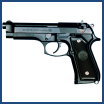
Primary function: Modified .45 caliber pistol
Builder: Specially trained armorers at the Rifle Team Equipment
(RTE) Shop, MCB Quantico, Virginia
Length: 8.625 inches (21.91 centimeters)
Length of barrel: 5.03 inches (12.78 centimeters)
Weight:
Magazine empty: 2.5 pounds (1.14 kilograms)
Magazine loaded: 3.0 pounds (1.36 kilograms)
Bore diameter: .45 caliber
Maximum effective range: 164 feet (50 meters) for
specially-trained user
Muzzle velocity: 830 feet/252 meters/second
Magazine capacity: 7 rounds
Unit Replacement Cost: $600
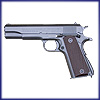
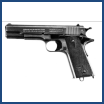
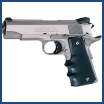
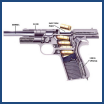
Features: This weapon is a modified M1911A1 .45 caliber pistol
sometimes referred to as "near match" or "combat accuratized." The
MEU(SOC) Pistol is the designated "backup weapon" of Marines armed with
the 9mm MP5-N Close Quarters Battle weapon. The M1911A1 was chosen for
this role (and its modifications generated) because of its inherent
reliability and lethality, and because the MEU(SOC) modifications make
the M1911A1 design more "user friendly."
The unique characteristics of the MEU(SOC) pistol are:
commercial/competition grade ambidextrous safety, precision barrel,
precise trigger, and rubber coated grips, rounded hammer spur, high
profile combat sights, and an extra-wide grip safety for increased
comfort and controllability (which aids in a quick follow-up second
shot). The issue magazines are replaced with stainless steel
competition-grade magazines with rounded plastic follower and extended
floor plate.
Description of Modifications: "The MEU(SOC) pistol starts out as
a stripped government contract M1911A1 frame, as manufactured up until
1945 or so. The frame is inspected, and the feed ramp polished and
throated. The entire weapon is dehorned. All internal parts are replaced
with current commercial items. King's Gun Works supplies the beaver-tail
grip safety and an ambidextrous thumb safety. This last piece is often
thought of as a superfluous device, added on as a derigueur item on
hordes of IPSC pistols. Here it has some usefulness. The pistol must fit
any operator in the platoon, whether he is right or "wrong" hand
dominant. Future rebuild pistols will have a "memory bump" on the grip
safety. Currently, many operators are unable to depress the grip safety
when having their thumb (properly) on top of the thumb safety. Some,
understanding that your priority safety rests between your ears, have
taped this useless grip "safety" closed. This is now forbidden, and will
continue to present problems until the rebuild pistols are brought on
line. Videcki aluminum Match triggers are installed, and tuned to a pull
of between 4-5 pounds. Colt Commander hammers replace the standard spur
hammer.
Slides are commercial contract. Initially,
one vendor supplied all of the slides, but after the initial purchase
problems developed. Caspian and Springfield Inc. currently supply all
of the slides. The new rebuilds will have forward slide serrations to
enhance chambered round verification (the oh so important press
check).
Barrels are provided by Bar-Sto. The barrel
bushings are form King's Gun Works. The front sight is also form
King's Gun Works and is staked on. While many have shunned this method
of front sight installation, preferring instead to dovetail it in, the
Marine Corps has apparently got this procedure down right. I cannot
ever recall seeing a front sight come off of the pistol.
The high profile rear sight is custom made at the
RTE shop. This is an excellent unit, providing a good sight picture.
It is secured to the slide by a hex head screw. The ejection port is
lowered and scalloped to improve ejection. A fiber recoil buffer is
installed. This controversial device is both cursed and praised. There
is no doubt that the buffer absorbs some of the battering, but they do
deteriorate, and debris can insinuate itself into the nether regions
of the pistol. This does no appear to be a problem in the Marine
Corps, as weapons maintenance takes on almost religious proportions.
Flat mainspring housings are used, and as these
are working guns, a lanyard loop is added. The lanyard themselves are
made by the operators. A commercial telephone cord, the snap hook from
an issue lanyard, and cable ties work out nicely. Pachmayer rubber
grip panels finish out the package. Once used on a lot of 1911's,
these are now considered to be somewhat Jurassic by some operators.
There is no checkering on the MEU(SOC) pistol. This may be contrary to
the exhortations of legions of pistolsmiths, writers, and wannabe
commandos who insist that without such checkering the pistol will just
slide and jump around in one's hand when they are wet, bloody, etc."
-- Patrick A. Rogers, Tactical Shooter Magazine, June 1999
Inventory: 500
Background: The weapon modifications were designed in 1986 to
meet the requirements of the MEU(SOC). Each pistol is hand-built by
specially trained armorers at the Rifle Team Equipment (RTE) shop,
Quantico, Virginia.
See also
The Marine Corps MEU(SOC) Pistol by PATRICK A. ROGERS
Some MEU's still carry proven M1911 .45's
- Not everyone in the U.S. military carries Beretta’s M-9 9
mm handgun. A small group of Marines still carry .45-caliber pistols —
but they’re a far cry from Grandpa’s World War II gun.