|
History and Development
of the M1911/M1911Al Pistol
by Jeff Lesemann
John Moses Browning
(1855-1926) was born and raised with an arms making heritage. His
father, Jonathan, had been born among the sparsely settled Tennessee
hills, northeast of Nashville, in 1805. In those early days the
flintlock rifles, fowling pieces, and pistols of the era were among the
basic tools of daily life, necessary for self defense and hunting.
Jonathan took a strong interest in guns at an early age, attracted by
their mechanisms and construction, rather than by their utility. While
he was still in his teens, he apprenticed himself to a blacksmith near
his family's homestead, in order that he might learn the gunsmith's
craft. Later, he made his way to Nashville, where he worked at the shop
of an established gunmaker until his own skills were fully developed. In
1824, while he was still only nineteen years old, Jonathan completed his
apprenticeship by making his own fine flintlock rifle. He then set up
shop in Sumner County, Tennessee, married, and settled down to his
life's work and the raising of a family.
Jonathan Browning
was not destined, however, to remain in Tennessee. In 1834 he loaded his
family and their belongings onto wagons and set out on a four hundred
mile trek to Quincy, Illinois, a new and fast growing town on the
Mississippi River, squarely in the path of westward migration. It was
here, during the next eight years, that two elements came together in
Jonathan s life, with results that would shape the destiny of his yet
unborn son, John M. Browning.
The first of these
elements was a rifle which Jonathan invented and built in his Quincy
shop. Percussion cap ignition had been invented just a few years
earlier, and it quickly swept the flintlock aside. The cap was far more
reliable than the flintlock, and it opened new possibilities for
further developments, such as repeating arms. Jonathan exploited this
potential by inventing a truly elegant repeating rifle. It was a .45
caliber underhammer design, with a horizontal opening cut through the
receiver. The magazine was a simple steel block, made to fit into the
opening. It was bored with five or more chambers, which could be
preloaded with powder and ball. At the base of each chamber, a snug
nipple held the primer cap. The block was placed in the rifle, and each
charge could be locked into position by means of a simple lever mounted
on the side of the weapon. As each round was fired, the shooter would
unlock the block and move it into position for the next shot. Although
the rifle had flaws, such as poor horizontal balance, the possibility of
losing the primer caps, and the necessity of handling the hot magazine
manually, it was a remarkable gun for its time.
The second factor
that was to shape the remainder of Jonathan Browning's life was part of
a much larger turn of events, over which he had little control. Joseph
Smith had founded a new religious sect, called the Church of Jesus
Christ of Latter-Day Saints, otherwise known as Mormons. Their theology
was based on a series of prophesies, which, according to Smith, had come
to him in visions. The zeal of Smith's followers was to intense that the
Mormon Church was the fastest growing religious group in the United
States, but there had also been serious problems. Some of Smith's
teachings were viewed with scorn by more orthodox society, and the
Mormons aggravated the uneasiness of outsiders by adopting a clannish
and isolated lifestyle. This led to suspicions and to several incidents
of persecution and violence against Smith and his Mormon followers.
In response to
these difficulties, the Mormons embarked upon a mass migration, in
search of a homeland where they could practice their beliefs freely. In
1839 they established a settlement in Illinois, a little more than
forty miles north of Quincy. They named their new town Nauvoo, and it
quickly became a model Mormon community, from which they reached out in
search of still more converts. One of these converts was Jonathan
Browning.
In 1842 Jonathan
moved to Nauvoo, where he again set up his gunsmith's shop. Just a few
years later, however, he and his family were swept up in the great
Mormon exodus. Joseph Smith 5 was set upon and killed by a mob in 1846,
and Brigham Young, one of Smith's more ardent followers, decided that he
would lead the faithful westward, in search of a safe haven. In 1847 the
Mormons moved to Kanesville, Iowa, which is now the city of Council
Bluffs. There Jonathan once more set up shop, remaining for five years,
while the main body of Mormons moved on to Salt Lake, Utah. It was
Jonathan's task to furnish as many of his rifles as possible for the
Mormon settlers. Finally, in 1852, he joined the migration and settled
in the town of Ogden, Utah. In 1854 Jonathan married the second of this
three wives, polygamy being an accepted Mormon practice at the time. On
January 23, 1855, John M. Browning, the first child of this second
marriage, was born.
Jonathan did not
continue to manufacture guns after the move to Utah, but he did continue
his work as a gunsmith. At an early age John became a pupil and helper
in the shop, to such an extent that he would later refer to the
gunsmithing shop as his only real school. Although John Browning's
apprenticeship was just a natural part of growing up around his father's
shop, he learned so well that the career which followed caused him to be
recognized, world-wide, as the most prolific and successful genius in
the history of firearms.
In 1878, while
Jonathan was still alive to see his son's talent blossom, John invented
his first gun, a sturdy, single-shot, falling breech rifle, which was to
become the Winchester Model 1885. He then went on to invent the famous
Winchester Model 1886 lever action rifle, and a host of other guns,
including all of Winchester's subsequent lever action and pump action
rifles and shotguns. When Winchester balked at accepting John Browning's
design for a semi-automatic shotgun, he sold the weapon to Remington,
and went right on inventing! He next turned his attention to the
development of one of the first successful automatic machine guns, and
it was from this work that his greatest legacy emerged, in the form of
the modem self loading pistol. All of Colt's automatic pistols have been
based on John Browning's patents, and, of these, the Colt "Government
Model" .45 caliber pistol has become the most widely built and used,
high power, auto loading pistol of all time.
John Browning
became interested in automatic and self loading weapons when he realized
that much of the energy produced by the detonation of a cartridge was
wasted. His first experiments aimed at harnessing this energy were
focused on the gas pressure which built up behind the bullet. By tapping
the gas pressure near the muzzle, and using it to operate an actuating
lever, Browning succeeded in developing the gas operated machine gun.
His gun was built by Colt, and later, under license, by Marlin, as the
Model 1895 Machine Gun. It won acceptance by both the Army and the Navy,
as well as by several foreign customers. Although machine guns and
pistols may not seem to have much in common, Browning's self loading
pistols were, in fact, direct results of his work on the machine gun.
Browning added a simple spring loaded disconnector device to the trigger
mechanism in order to achieve interrupted, or semi-automatic fire, and
it was this device which made semi-automatic pistols, rifles and
shotguns possible.
Parallel
developments of a similar nature had been taking place in Europe, and
the early auto loading pistols designed by such pioneers as Bayard,
Bergmann, Borchardt, Mauser and Schwarzlose were at least functional,
though terribly complicated and unwieldy. In contrast, Browning's first
auto loading pistol was a gas operated, toggle action design which
introduced the smooth and graceful lines that became common to all of
his later models. The pistol made use of a detachable box magazine,
housed in the grip frame, which also contained the firing mechanism. The
mechanism was connected to the trigger by means of a cleverly designed
link, which was wrapped neatly around the magazine. Compared to the
early European pistols, Browning's prototype was simple, compact, and
highly reliable.
Good as this first
pistol was, however, it was never placed into production. John Browning
had no sooner completed fabrication of the prototype when he surpassed
it with two entirely different designs! The first was a small pistol, in
.32 caliber, with a blowback action. It became the prototype for the FN
Model 1900 and the Colt Model 1903 pistols. This was quickly followed by
a recoil operated pistol in the same caliber (.38 Colt Automatic) as the
gas operated prototype. (see fig. 3). It was to become the Colt Model
1900, and it was gradually improved and modified until the Model 1911
emerged in final form.
Browning concluded
that a recoil operated pistol would provide the most satisfactory means
of locking the breech during firing, without the necessity of providing
complicated linking and actuating mechanisms. A locked breech was
absolutely mandatory in order to safely use high power ammunition, and
Browning's method of accomplishing a secure lock was so simple and
effective that it has been used almost universally ever since.
The major
components of the Model 1900 pistol consisted of the barrel, the slide,
the magazine and the frame. The barrel was attached to the frame by
means of pins which passed through pivoting links, located beneath the
muzzle and the breach. The slide was fitted into channels in the frame,
and with the action closed it covered the barrel almost to the muzzle.
Corresponding ridges and grooves were machined into the top of the
barrel at the chamber, and on the inside of the slide. With the action
closed, the grooves would interlock and the firing pin housing closed
off the chamber, completing the lock-up.
Upon firing, recoil
forced the slide and barrel to travel rearward together for a distance
of about one quarter of an inch. The links caused the barrel to pivot
downward at the same time, in an action similar to that of a draftsman's
parallel ruler, until the slide and barrel were freed from the locking
grooves. The slide then continued rearward to full recoil, extracting
and ejecting the spent cartridge case and cocking the hammer. With the
slide at full travel and the recoil spring fully compressed, the spring
then took over, pushing the slide closed again as it stripped a fresh
cartridge from the magazine and loaded it into the chamber.
The Model 1900
pistol worked quite well, and it was soon placed into commercial
production. A small number of pistols were also sent to the Army for
trials, but initial reaction to this new weapon was negative. The
Infantry, Artillery and Cavalry all had their own ideas about the
desired qualities of a side arm, and all three branches shared a
deep-rooted preference for revolvers. Among the more valid objections
raised by the first trials of the Model 1900 pistol were complaints
about unreliable operation, the necessity for two hand operation during
loading and cocking, and the lack of safety features. These problems
would be corrected, one by one, as Colt and Browning worked together to
refine the pistol.
In 1902 Browning
added a slide stop to the pistol, so that the action would be held open
after the last cartridge had been fired. Other changes included deletion
of the early safety, a lengthened grip frame, with a corresponding
increase in magazine capacity from seven to eight rounds, and the
addition of a lanyard ring. A number of cosmetic changes were made to
the pistol during its production life, including changes in the location
and configuration of the slide serrations, and several variations in the
hammer. The 1902 Military Model came closer to meeting the Army's needs,
and it was produced commercially until 1927, but it still was not the
final answer.
Part of the
problem, as seen by the Army, was the small caliber of the pistol. The
.38 ACP round was hardly a pipsqueak, with velocity and energy levels
that were superior to .38 Special. Nonetheless, the Army had determined
that nothing smaller than a .45 caliber handgun round would deliver
sufficient power for a sure knockdown. It is ironic to note that the
thinking on military handguns has now gone full circle. The newly
adopted Beretta, in 9 millimeter, returns to ballistics very similar to
the numbers that were rejected back in 1902.
In 1905, Browning
and the Colt factory made another step toward meeting the Army's
requirements with the development of the .45 ACP round. The Model 1905
pistol, made for this new round, was a scaled up version of the Model
1902. When the Army tested this basic design in 1905 and 1907, the
results of these tests were finally encouraging enough to generate real
interest in a .45 caliber automatic pistol. A formal competition was
scheduled, with the promise of a rich contract for the winner.
The formal
competition drew several other entries, including serious challenges
from Luger and Savage Arms. Browning, in turn, continued to introduce
refinements to the Colt pistol. A grip safety was added in 1908,
followed by a major development in 1909, which brought the pistol to the
brink of final success. The two-link system relied upon the slide block
key to hold the entire pistol together. If this block should happen to
fail, or if a careless shooter should happen to fire the weapon while
the block was not in place, the slide could blow off, right into the
shooter's face! To solve this potentially deadly hazard Browning devised
the single link recoil system. The new configuration replaced the front
link with the barrel bushing, which encircled the barrel. The bushing
was locked into the front of the slide, and it was held in place by the
recoil spring plug. This system resulted in much greater safety and
reliability, and the competitive pistols soon fell by the wayside,
unable to match the performance of the Colt.
In 1910 the final
prototype for the Model 1911 pistol, incorporating the addition of the
manual safety lever, was put through an exhaustive test regimen. At one
point, six thousand rounds were fired through a single pistol without a
single jam or failure. On May 5, 1911 the Colt pistol was officially
accepted as the "Automatic Pistol, Calibre .45, Model of 1911."Following
its adoption by the Army, the M1911 was also accepted by the Navy and
the Marines. It was also adopted by Norway, for use by their armed
forces. Supplemental production capacity was set up at Springfield
Armory, in order to meet the heavy demand for the pistol. When the
United States entered World War I, demand for the pistol was so great
that contracts were let out to several other manufacturers. Only
Remington/U.M.C. actually went into production, however, before the war
ended, resulting in the abrupt cancellation of all outstanding
contracts.
In service, the
pistol was widely used as a side arm by officers and non-coms, as well
as by such specialized units as the Military Police. It won a reputation
for ruggedness, reliability and effectiveness, but a few more
improvements were still to follow.
It was found that
the pistol was somewhat difficult to control, especially in situations
which required rapid fire. John Browning collaborated with the engineers
at Colt, in what was to be one of the last projects of his lifetime, and
the resulting modifications brought about significant improvement,
without altering the basic design. In fact, all but one of the
modifications involved components which were interchangeable with parts
from earlier pistols.
The modifications
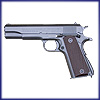
made to the M1911 are described as follows. The main spring housing was
arched and checkered, in order to fit the hand better, with a more
secure grip. The grip safety tang was extended, in order to reduce the
"bite" of recoil. Beveled cuts were machined into the frame, behind the
trigger, in order to provide a more comfortable fit, and the trigger,
itself, was cut back and its face was checkered. Finally, the front and
rear sights were widened, in order to provide for a clearer sight
picture. These changes were all adopted in 1924, and the designation of
the pistol was changed to "Model 1911A1."
Because all of the
modifications, except for the cuts in the frame, involved component
parts or sub-assemblies, the years between the two World Wars saw the
use of surplus M1911 slides, mated to M1911A1 frames. The resulting
"Transition Model," as it is known to collectors, is a highly prized
item, indeed. Of somewhat less interest, though no less authentic, are
those M1911 pistols which were returned to depots or arsenals during
their service and modified, using M1911A1 parts.
Following its
adoption by the military, the pistol was also placed into commercial
production. In addition to the .45 caliber pistols, it has also been
produced in .38 Super and in .22 LR caliber. Other variations have been
developed, including the lightweight "Commander" versions and the
"National Match" pistol, with greatly improved accuracy and target
sights. Colt has produced well over 3,000,000 pistols, and during World
War 11 it was built under license by Remington Rand, Ithaca Gun, Union
Switch and Signal Co., and in very small numbers by Singer Sewing
Machine Co. Argentina also built both licensed and unlicensed versions
of the pistol. In Spain, it has been copied
by Star and Llama, and copies have also been produced in Poland and the
Soviet Union. The original patents have long since expired, and in
recent years Essex Arms, Arcadia Machine Tool Co. (A.MT), Randall Arms,
Auto Ordnance, M.S. Safari Arms, Arminex, Springfield Armory (the
private company), and others have all built their versions of the
pistol. The compact and sophisticated Detonics pistol is a descendant of
the original design, and the end of the line for the M1911 and its
offspring is nowhere in sight.
Modifications to
the pistol are also possible, and many of them can be accomplished by
the home gunsmith. Such modifications can produce an "accurized" target
weapon or a highly customized weapon for various forms of competitive
shooting. Indeed, the shooter can literally design his own pistol in
order to suit almost any preference.
BIBLIOGRAPHICAL
NOTES
For those who wish to learn
more about the pistol or its history, we recommend the following
sources:
Colt
Automatic Pistols, by Donald
B. Bady; Borden Pub. Co.
John M. Browning
American Gunmaker, by John
Browning and Curt Gentry; Doubleday & Co. Handguns of the World, by
Edward C. Ezell; Stackpole Books
Know Your Colt
.45 Auto Pistols, by
Hoffschmidt Blacksmith Co.
Syd Weedon, The Sight M1911,
History of the M1911 Pistol
John Caradimas, M1911 Web Site, http://www.m1911.org
Sam Lisker, The Colt Auto Web Site, http://www.coltautos.com
Dave Arnold, "The Colt 1911/1911A1," Guns & Ammo: The Big Book
of Surplus Firearms, 1998.
Oliver de Gravelle, Model
1911A1.com WWII production of 1911A1's by Colt, Remington, Ithaca, and Union Switch.
|