The
Guns of Frank Hamer
The nemesis of Bonnie and
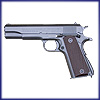
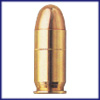
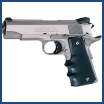
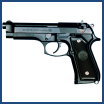
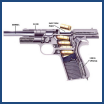
Clyde packed an M1911 but it was a .38 Super
By Rick Cartledge
After some discussion with fellow Thompson book writer Rick Mattix
and the helpful Dee Cordry, we voted that the following might be of
interest to the knowledgeable OklahombreS readers. Writers have churned
out much on Frank Hamer's skill with guns, not enough about his ability
as a detective, and almost nothing about his thorough knowledge of
firearms. Most of this article springs from research for an article on
Bonnie and Clyde which will appear in the July issue of Machine Gun News
and will be subsequently included in the new Thompson book edited by
Tracie Hill. Some of this drops from a fortunate experiment done by a
friend of mine in 1939. Finally, a small part of this comes from having
spent the last 23 years in the good company of State Troopers, those
most adaptable of lawmen.
Rangers Hamer and Gualt patrolled on horses before they got cars.
History records numerous examples of Ranger adaptability with the most
famous being called Patterson and Walker. When Lee Simmons and Ma
Ferguson put Frank Hamer on the trail of Bonnie and Clyde, the Ranger
not only changed his car but his guns. The legendary lawman always
carried a rifle and a .44 Triple Lock Smith and a C engraved single
action .45 Colt called "Old Lucky". Frank Hamer believed justifiably
that he could hit any target and had proved on numerous occasions that
he could kill any target that was shooting at him. Given that Hamer had
supreme confidence in his ability to equal anyone in a gunfight, the
formidable lawman would not have changed the guns he was comfortable
with without a very good reason.
Since he kept "Old Lucky" and changed the other two guns, I believe that
he had a very good reason and that reason was penetration. I believe
that the savvy Ranger knew that Clyde's thick bodied V8 Ford was, to all
but high powered guns, an extremely fast and bullet-proof car. Hamer may
have suspected body armor. Hamer chose guns comfortable to him that
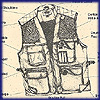
would pierce the body of the V8 Ford and the bulletproof vests sometimes
worn by lawmen and outlaws of the day. The two guns Hamer bought were
both semi-automatic. Given his mission and the level from which it was
launched, Capt. Hamer could have had any weapon he wanted. He selected
for his rifle a Remington Model 8 in .35 caliber. For his pistol Hamer
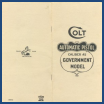
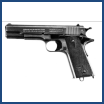
chose what has often been described as a .45 Colt automatic. This writer
has never believed that the Colt was a .45, but more about that later.
Frank Hamer had owned an engraved Remington Model 8 in .30 caliber for
years and knew well the excellent qualities of the weapon. He opted for
a larger caliber to deliver more punch to the target. He ordered the
standard .35 from Jake Petmeckey's store in Austin, Texas and was
shipped serial number 10045. Hamer also contacted the Peace Officer
Equipment Company in St. Joseph, Missouri for it's "police only" 20
round magazine for the Remington rifle. Some years ago Frank Hamer Jr.,
a distinguished lawman in his own right, gave a filmed interview in
which he showed the nimble .35 that his father had bought especially to
go after Bonnie and Clyde. As to the rifle's ability to tear holes in a
V8 Ford, Frank Hamer had an unimpeachable source - Clyde Barrow. Though
Clyde and Bonnie escaped the Sowers ambush by Dallas County authorities
in November of 1933, Clyde ditched his shot up car near the Ft. Worth
Pike and commandeered a less damaged car to make good their flight to
freedom. The abandoned V8 spoke volumes to the able lawmen of Dallas
County and to the Rangers. Ted Hinton had hit the car 17 out of 30 shots
with his Thompson submachine gun and hadn't penetrated the car body.
Veteran Deputy Bob Alcorn had chugged away with his hefty Browning
Automatic Rifle and ripped some respectable holes all the way through
the car. Hinton called his Congressman, got a BAR from the government
and a back seat full of ammunition, and learned how to shoot the roaring
automatic rifle.
Two months later, Frank Hamer opted for the Remington .35 as his hole
puncher and he picked an interesting pistol to go with his
quick-pointing rifle. To front for "Old Lucky", Capt. Hamer stuffed a
blue steel Colt commercial automatic in his belt and it is this gun that
is most interesting to this writer. I had long suspected that this Colt
was not a .45 but one of the then new .38 Supers and I had three reasons
for believing this. First, gangsters (Dillinger, Nelson, etc.) as well
as lawmen had caught on to bullet proof vests and their resistance to
.45 caliber penetration. Second, gangster use of the .38 Super to
telling effect was known and thugs had even hammered the .38 Super into
the extremely deadly machine pistol configuration. Two of these 22 round
magazine equipped death machines were confiscated in a raid on John
Dillinger's apartment in St. Paul in April of 1933. These Supers
belonged to Nelson and were assembled from kits made by the Monarch Gun
Company of Hollywood, California by underworld gunsmith H. S. Lebman of
Texas. Nelson killed Federal Agent Baum at Little Bohemia with a .38
Super machine pistol. The third reason springs from a fortunate
experiment done by a friend of mine in 1939 on a dare. Joseph Pinkston
in his excellent book, with Robert Cromie, "Dillinger, A Short and
Violent Life" writes of the apprehension of Dillinger gang member Leslie
Homer and of his advice given to Racine officers in November of 1933.
Since Capt. Hamer was known to have followed the Dillinger case as a
matter of professional curiosity, he may well have been familiar with
Homer's published remarks which were "If you want to give your coppers
an even break with present-day gangsters, you want to equip them with
the new Super .38 caliber. A gun of that type will shoot a hole right
through any bulletproof vest ever made."
A friend of this author who sold Thompson submachine guns in the 1930's
and 1940's proved Leslie Homer's assertion in 1939 although he had never
heard of Leslie Homer or his assertion. After an afternoon of shooting
with another associate and a local policeman, my friend and the other
man were dared to shoot the policeman in his bulletproof vest. The other
man, armed with a .38 pistol, shot the policeman and knocked him to the
ground but did not otherwise injure him. My friend was equipped with a
.38 Super, and, more sense than the other two. He told the policeman
that be would shoot the vest if he put it on a post, which the policeman
did. My friend said the .38 Super cut a hole in the vest as neatly as a
drill press. Had the policeman been wearing the vest he would have been
killed instantly.
This story teaches two lessons. First, a contemporary gun using
contemporary ammunition blew a hole in a gangster era bulletproof vest.
Second, my friend was knowledgeable of guns in the 1930's. So was Frank
Hamer. Several months ago, this author was discussing this story with
friend Mike Thacker. Thacker said he had something tucked away in his
files that might help. Two days later, Mike handed over a copy of Guns
and Ammo's "Handguns for Sport and Defense" magazine. In this March 1992
issue, Jim Wilson tells of an interview with Frank Hamer Jr. in which
Mr. Hamer confirms that his father's Colt was indeed a .38 Super. Mr.
Hamer's comment that his father did not particularly like automatics
seems to hammer home the thought that the Ranger picked the gun for a
reason. Finally, at about 9:15 in the morning of May 23, 1934 while the
rifle smoke still hung in the air, the gun Frank Hamer held in his hand
as he approached the bullet riddled 1934 Ford V8 was the .38 Super.
Should either of the murderous pair still have breath in their bodies
and strive to fire one more defiant round, the legendary lawman was
packing iron that would go right through the car body. Most printed
lists of the death car's armament list a number of .45 automatics. Ted
Hinton, in his book "Ambush", declares that two of the colt automatics
were .38 Supers. On the subject of penetration it seems that Clyde may
also have known. It's for damn sure that Frank Hamer did.
THE END
SOURCES:
Girardin, G. Russel and William J. Helmer. "Dillinger - The Untold
Story"
Helmer, William J. "The Gun That Made The Twenties Roar"
Hinton, Ted. "Ambush"
Jenkins, John and H. Gordon Frost. "I'm Frank Hamer"
Jones, W. D. "Riding With Bonnie and Clyde", Playboy magazine 1968
Pinkston, Joseph and Robert Cromie. "Dillinger - A Short and Violent
Life"
Quimby, Myron J. "The Devil's Emmissaries"
Toland, John. "The Dillinger Days"
Treherne, John. "The Strange History of Bonnie and Clyde"
also, Rick Mattix, Bussey, Iowa; Janice A. Reece, Waco, Texas; Bob
Weesner, Dexter, Iowa; Joyce Hick, Stuart, Iowa; Larry Joyner, Arcadia,
Louisiana; James Ballou, Salisbury, MA; Tracie Hill, Newark, OH; Jim
Foster, Dallas, TX; and Vida Ford, Hot Springs, AR .
This article was originally published on the Oklahombres site. Since
that site has gone down it is impossible to provide a source link for
this material.
Other links on Hamer and Bonnie & Clyde:
The Posse
Bonnie & Clyde: Romeo and Juliet in a Getaway Car Final Miles
Bonnie and Clyde Revisited
Frank Hamer
Bio
The
Remington Model 8 Autoloading Rifle |