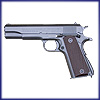
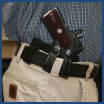
Ballester-MolinaType: Self Loading
Locked Breech Semiautomatic Pistol
System of Operation: Recoil
Caliber: 11.43x23mm (.45 ACP)
Capacity: 7+1 rounds
Sights: Fixed blade front, notch rear drift adjustable for windage
The history of the Ballester-Molina dates back to 1929 when two enterprising Spaniards,
Arturo Ballester and Eugenio Molina established a company for producing Hispano-Suiza
automotive products in Buenos Aires. The name of this company was Hispano Argentina
Fabrica de Automoviles Sociedad Anonima (HAFDASA), or Spanish-Argentine Automobile
Factory, Incorporated. Several years later, HAFDASA hired a pair of engineers, the
frenchman Rorice Rigaud, and Carlos Ballester Molina (a member of both the Ballester and
Molina families). Rigaud eventually became HAFDASA's chief design engineer, while
Ballester Molina, originally responsible for metallurgy, heat treatment, and production
methodologies, became HAFDASA's Chief Executive Officer (CEO).
HAFDASA won a contract with the Direccion General del Material del Ejercito (DGME), or
General Directorate for Army Materiel, to supply the Argentine military with trucks,
buses, and engines. The DGME later commissioned HAFDASA to investigate the potential
manufacture of small arms.
In 1936, in response to the DGME request, HAFDASA began to design and manufacture small
arms. There was nothing revolutionary about HAFDASA's work. The factory established a
pattern of adapting existing designs to satisfy the requirements of the Argentine military
and police forces using indigenous materials within HAFDASA's production capabilities. To
this end, in 1936, HAFDASA unveiled a semiautomatic carbine based on the Beretta M1918/30
in calibers 9x19mm and .45 ACP.
Following the introduction of the two carbines, the DGME requested HAFDASA to produce a
pistol chambered for the .45 ACP cartridge to serve as an (indigenously produced)
replacement for the .45 ACP pistols then in service with the Argentine military and police
forces. The contract required HAFDASA to produce a pistol along the general lines of the
Modelo 1916 and 1927 Colt pistols then in service and to have barrels and magazines that
were interchangeable with those pistols.
The HAFDASA engineers began work on this contract in late 1936/early 1937. The decision
was taken modify the original Browning design to facilitate and economize production along
the same lines as two Spanish companies Bonifacio Echeverria, S.A. (Star) and Gabilondo y
Cia, S.A (Llama). The main changes introduced by these companies were the elimination of
the grip safety, a backstrap integral to the frame, and a pivoting trigger with a side
mounted sear bar and disconnector. These changes, as applied to the Star Model B pistol
were of particular influence to HAFDASA's designers.
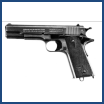
Consequently, while the completed HAFDASA design bore a strong external similarity to
the Colt M1911A1, only the barrel and magazine are interchangeable with the Colt pistol.
Note: Barrels and magazines made by HAFDASA are identifiable by the marking "HA"
inside a diamond. The following is a list of differnces between the HAFDASA pistol and the
M1911A1:
a) The hammer strut on the HAFDASA pistol is much shorter than that of the M1911A1.
b) The firing pin stop on the HAFDASA pistol is not recessed on the side as it is on the
M1911A1.
c) The safety lock on the HAFDASA pistol is redesigned with a larger diameter pin, and it
can be applied with the hammer cocked or fully down.
d) The mainspring housing on the HAFDASA pistol is an integeral part of the frame.
e) The HAFDASA pistol has a pivoting trigger with a single extension along the right side
that cams the side mounted disconnector and engages the sear.
f) The magazine catch on the HAFDASA pistol is assembled differently.
g) The HAFDASA pistol has no slide stop disassembly notch.
The HAFDASA pistol was adopted as the Argentine Army service pistol in 1938. Early
pistols were marked "Pistola Automatica Calibre .45 Ballester-Rigaud, Modelo DGME
1938." These early pistols have checkering on the grips and backstrap, and there are
twenty fine slide retraction grooves, as on the M1911A1. The slide right side is marked
with the Argentine crest and the text "Ejercito Argentino."
The next iteration of the HAFDASA pistol were modified to speed up and economize on
production accordingly: The backstrap checkering was replaced by horizontal serrations,
the wooden grips had long vertical serrations, and the fine slide retraction grooves were
replaced by groups of vertical grooves separated by wide gaps. Additionally, the Modelo
1938 designation was dropped, and the pistol was now known as the "Pistola
Ballester-Rigaud."
At some point between 1940 and 1942, HAFDASA changed the trademark name of the pistol
from "Ballester-Rigaud" to "Ballester-Molina," with the change
reflected in the markings on the slide of the pistol. At the same time HAFDASA began to
use plastic, instead of wooden, grips on the pistol. It was also around this time that
HAFDASA received an order from the British government for between 8,000 and 10,000 .45
caliber pistols. Payment for these pistols was made, in part, with steel supplied by the
British government. Due to the scarcity of raw materials in Argentina due to the Second
World War, it is highly likely that the steel was of U.S. origin supplied to England via
Lend-Lease, and consequently not prior to March 11, 1941. According to Alejandro
Gherovici, noted expert on Argentine service pistols, no steel salvaged from the pocket
battleship Graf Spee or any other warships was used to produce the British contract or any
other HAFDASA pistols. Production of the British Contract pistols started in 1942 and
continued until mid-1944. British Contract pistols are easy to identify as they bear a
serial number prefixed by a "B," between the 12000 and 21000 serial number
range.
After the end of the of the British Contract, HAFDASA continued to produce pistols for
Argentine government and commercial usage until 1953. Starting in 1947, the HAFDASA
pistols had been supplanted in Argentine use by the DGFM Sistema Colt M1927 pistol, a
clone of the M1911A1. While the HAFDASA pistols began to be withdrawn from Argentine
service in the 1960's, many served until the mid-1980's when they were finally replaced
and sold as surplus on the US market. It is believed that HAFDASA produced between 80,000
and 90,000 .45 caliber pistols.
The following is a loose serial number to year correlation:
| Serial Number Range |
Date Range |
| 1 - 12,000 |
1938 - 1942 |
| 12,000 - 23,000 |
1942 - 1944 |
| 23,000 - 108,000 |
1944 - 1953 |
HAFDASA exported pistols to Bolivia, Colombia, Ecuador, Peru, Uruguay, and
Venezuela.
BIBLIOGRAPHY
Gherovici, Alex, Military Pistols of Argentina, (Self
Published, Philadelphia, Pennsylvania: 1994)
This volume can be purchased by writing to the author at:
Alex Gherovici
P.O. Box 58506
Philadelphia, Pennsylvania 19102
U.S.A.
Article borrowed from CRUFFLER.com |