The M1911 Trials
Donald Bady
On November 10, 1910, the Ordnance Office directed the Commanding
Officer of Springfield Armory to convene a board of officers”…to make
tests of such automatic pistols, caliber .45, as may be presented to
them for that purpose…”. The board met on November 10, 1910.
“The President of the Board (Major Kenneth Morton) announced that two
pistols had been submitted for test, and presented them to the board.
The two pistols…were found to be semi-automatic, cal. .45, latest model,
one manufactured by Colt’s, and the other manufactured by the Savage
Arms Co. …”
This trial was of major importance. The pistols submitted were the
most advanced specimens thus far developed by either manufacturer. In
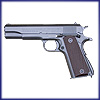
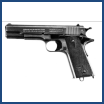
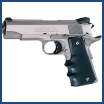
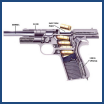
the case of Colt’s, the weapon was the Special Army Model 1910; the
Savage pistol was a specially improved version of their Model H. Colt’s
was represented by its President, Col. W.C. Skinner; two Vice
Presidents, Mr. P.C. Nichols and Col. C.L.F. Robinson; plant
superintendent James J. Peard; John Browning, two engineers and a
mechanic were also present. Savage was similarily represented, it’s
President, Vice-President, and plant superintendent were on hand; Elbert
Searle, inventor of the Savage pistol, and two mechanics were present.
The tests commenced with a detailed examination of the pistols;
special attention was paid to the safety devices. Field strip and
complete disassembly was performed and timed. The Colt was more readily
dismounted for field stripping. On the other hand, the Savage could be
completely disassembled in less time than the Colt. The Colt was listed
as having 64 separate components, includind the magazine; the Savage had
45 components. In the next examination, the velocity at 25 feet was
obtained: 858.4 f/s for the Colt, 846 f/s for the Savage. In the
accuracy trial, the Colt proved better than the Savage by shooting an
average group of 1.94″ compared to 2.84″ for the Savage. The penetration
tests were puzzling; the Colt did better on pine boards whereas the
Savage did better on solid oak blocks. In the combined accuracy-rapidity
tests the Colt was faster and more accurate than the Savage. An
exhaustive endurance trial was now performed. 6000 rounds were to be
fired from each weapon. The firing was to be done in cycles of 100
rounds, at which time water would be poured through the barrel. After
every 1000 rounds the pistol could be cleaned and oiled.
In the first thousand, the Colt had 5 malfunctions, three of which
were due to lack of adequate oiling. The Savage had 4 malfunctions; its
sear had broken off and the right grip piece split and came off.
In the second thousand, the Colt had 4 malfunctions; toward the end
of that run, the barrel split and had to be replaced. The Savage had 22
malfunctions; it’s extractor broke and was replaced.
In the third thousand, the Colt had 2 malfunctions; the mechanical
safety broke, but this did not disable the pistol. The Savage had 7
malfunctions; grip pieces split and the bolt stop broke.
In the fourth thousand, the Colt had no malfunctions, but the slide
lock failed to act properly and the grip piece screws came loose on
several occasions, several jams were caused by incorrect feeding, the
extractor broke, and the magazine floor plate broke. Upon examination
after firing, the Savage was found to have a broken barrel lug and bolt
lock spring. A new barrel and spring were installed.
In the fifth thousand, the Colt had one malfunction. The Savage had
five malfunctions and a broken sear lock.
In the sixth thousand, the Colt had no malfunctions but the grip
piece screws continued to work loose. The Savage had 5 malfunctions
resulting from a faulty magazine.
It is interesting to note the performance of a .45 caliber Colt
Revolver Model 1909, fired throughout the tests as a control. The
revolver had 2 malfunctions during 6000 rounds; the first was due to the
absence of powder in a cartridge, the second was due to a sticking
latch.
A summary of broken parts in both automatic pistols revealed that the
Colt automatic pistol required 4 replacements; the Savage 13.
On March 15, 1911 the trials were reconvened after both companies had
made improvements to their weapons.
“The endurance test was now begun. 6000 rounds were to be fired in a
series of 100. Between series , the pistols were allowed to cool for
five minutes. The pistols were to be examined, cleaned, and oiled after
every 1000 rounds.
In the 1st thousand rounds, both pistols worked perfectly, without
malfunctions. In the 2nd thousand rounds, the Colt functioned perfectly.
The Savage had 4 malfunctions. In the 3rd thousand rounds, the Colt
functioned perfectly. The Savage suffered a broken bolt stop which was
replaced. In the 4th thousand rounds the Colt functioned perfectly. The
Savage had 4 malfunctions; the bolt stop and sear were found to be upset
from constant pounding, the firing pin spring was found to be shortened.
In the 5th thousand rounds the Colt functioned perfectly. The Savage
developed a magazine release defect, and dropped its magazine five
times; there was further upsetting in the bolt stop and the bolt was
found to contain cracks. In the 6th thousand rounds, the Colt functioned
perfectly. The Savage had 31 malfunctions; a new extractor was required,
the breech plug had cracked, and thefiring pin had acquired a permanent
set., the safety slide broke and the retractor spring had acquired a
permament set. At the end of the firing, a careful examination of the
Colt failed to reveal any defective parts.
A series of tests were performed with under-loaded and extra-loaded
cartridges. Cartridges with thinned primers were also fired, and
velocity was taken once more. The Board listed the following findings,
conclusions, and recommendations:
“…Of the two pistols, the Board is of the opinion that the Colt’s is
superior, because it is the more reliable, the more enduring, the more
easily disassembled when there are broken parts to be replaced, and the
more accurate…”
“…The Board therefore recommendsthat the Colt Caliber .45 Automatic
Pistol of the design submitted to the Board for test be adopted for use
by foot and mounted troops in the Military service in consequence of its
marked superiority to the present service revolvers and to any other
known pistol, of its extreme reliability and endurance and of its
fulfillment of all essential military requirements…”
This report was rendered on March 20th. On March 23rd, the Commanding
Officer of Springfield Armory concurred. Concurrence of the Chief of
Ordnance and the General Staff followed. On March 29th, 1911 the
Secretary of War approved the change.
Bady, Donald. Colt Automatic Pistols 1896-1955. |