Selecting a Pistol for Concealed Carry
By Syd
If you are reading this, perhaps you haven't made up
your mind or have questions about your selection of a personal defense
handgun. There have been many articles written on this subject, most
of which boil down to a discussion of calibers and actions. While the
caliber and action discussion is important, I find it incomplete and
lacking in some important considerations for a person who carries a
concealed handgun for self defense. Hence, my point of departure is
what it means to live with a pistol every day.
Conceptual Basis
The paradox of the concealed personal defense weapon
is that it is something you hope you will never have to use for its
intended purpose, but with which you must achieve a level of mastery
and familiarity comparable to the other tools you use to survive and
get through your day. You wouldn't drive to work in a car that you
didn't know how to operate. You wouldn't wear a coat that was three
sizes too small or use a carpenter's saw to slice up a pot roast. No,
you use the tools appropriate to the job and you learn how to work
with them competently. The same holds true with a self defense pistol.
You should know how to operate it and have the level of skill
necessary to use it safely and effectively. It should fit your hand
and your lifestyle because you will be spending a lot of time with it.
It should be comfortable to shoot and hopefully to carry, although
when asked if a carry gun should be comfortable to wear, master
trainer Clint Smith said, "Your carry gun should be comforting,
not comfortable." Your pistol should be powerful
enough to do the job and accurate enough to hit the target. It should
be completely reliable, and its operation should be as familiar to you
as riding a bicycle or brushing your teeth. You must also have a clear
understanding of the legal issues surrounding the use of deadly force
-- when you can and when you can't -- and the methods and techniques
of using a gun in a self defense situation. Sounds like a lot? You're
right; it is, and if you are unwilling to master the skills and
concepts of lethal force, do yourself a favor and just don't carry a
gun. (See also The Psychology of
Self Defense and the Force Continuum)
Skill and Familiarity
Handguns are not easy to shoot well. The ability to
consistently put bullets into a target quickly and in the places which
will stop an attacker is a skill that requires a lot of practice. Too
many people have the notion that a pistol is a kind of magical
talisman and the user need only take it out and wave it around and the
problem will magically disappear. Nothing could be further from the
truth. A gun brandished at the wrong time and without the fighting
skills necessary to employ it effectively will make a whole bunch of
new problems, including getting you killed or arrested and charged
with some very serious crimes. Hence, making the decision to carry a
gun should be made only with the commitment to practice and learn.
This may take the shape of attending classes or participating in a
practical shooting sport like IDPA. At the very least, a regular
practice schedule should be part of the package. This means that you
will be spending a lot of time with your pistol. The gun should be
comfortable in your hand, have manageable recoil, and be sturdy enough
to stand up to heavy use in practice sessions, matches, and classes.
The gun should also have reasonable accuracy. You should be able to
consistently put all of your shots in an area the size of a saucer at
ten yards quickly.
Types and Sizes: Pros and Cons
Pocket Guns
When many folks think of a concealed carry gun, they
think of little-bitty pocket pistols that will easily disappear into a
pocket or purse. While these may be light and convenient, that's all
they are. Aside from that, they're pretty useless. They lack the power
to put down a determined attacker and they lack the accuracy to hit
anything at more than spitting distance. But even more importantly,
most little guns are unpleasant to shoot. Being very light and having
small handles, their muzzle flip is very bad. After a few rounds your
hand may begin to hurt. Shoot a match or take a class at Gunsite with
one of these pocket guns? Forget it. If you don't learn to use it, how
much good is it going to do you when the chips are down? In this
group, I would include the small Berettas, Airweight snubnose
revolvers, Seecamp .32's, Kel-Tek .32's and derringers. There may be a place for
these pistols, but they all suffer from serious inadequacies. (I am
particularly fond of the Airweight snubnose .38 Special
revolver, but
it can be an unpleasant gun to fire.)
Medium Frame Revolvers
Even though they have been around for 165 years,
revolvers remain an excellent solution. These pistols are simple to
use and accurate. They can handle hot loads and larger bullets making
them effective personal defense weapons. Examples of this class of
pistol are the Ruger GP Series and the S&W Model 66. The ideal
revolver would have a 3" to 4" barrel, a six-round cylinder,
and a grip that fills your hand. The biggest drawback of these pistols
is the speed of reloading, but with practice, a revolver can be
reloaded as quickly as an autoloader.
Medium Frame Auto Pistols
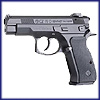
The overwhelming majority of professional trainers,
operators, law enforcement and military people prefer medium to large
framed autoloading pistols. These pistols have the best combination of
speed, firepower, accuracy, and power. These pistols will generally
load 8-10 rounds in their magazines (or more if you can find the
magazines), have full-length grips, and 3.5" or longer barrels.
These guns tend to have adequate accuracy and power, and large enough
grips to be comfortable. Examples of this type of pistol would be the
Glock 17, 19, 21 and 22, the S&W 39xx, 59xx, and 69xx series, the
SIG 22x series, the H&K USP and P7, the Kimber ProCarry and
Compact, the Springfield Champion, Para-Ordnance P12, and many others.
Large Frame Pistols and Revolvers
I like big pistols. They shoot more accurately,
absorb more recoil, and develop greater muzzle velocity due to their
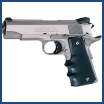
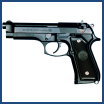
longer barrels. I would include in this group the Beretta 92, the Colt
Government Model M1911 (and clones), The N Frame S&W revolvers,
Colt Python, Anaconda and their copies. Characteristically, these guns
have 5" barrels and weigh 36 oz. or more. The biggest drawback of
these pistols is their weight. They get heavy and small framed people
may have difficulty concealing them.
Autoloader Action Types
There are four types of actions around which
semi-auto pistols are built. It's important to understand the
differences:
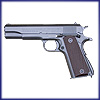
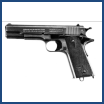
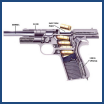
Single Action - M1911 Colt .45 ACP and Browning
Hi-Power 9mm
This is the oldest autoloader design still in
service, designed by John Browning
(with the help of the Army
Ordnance Board) during the period between 1905 and 1911. The hammer
must be cocked, generally by racking the slide, for the gun to fire.
This design in .45 ACP, .40 S&W and .38 Super is favored by
competitive shooters, FBI SWAT, FBI Hostage Rescue Team, and many
special forces units because it has the best trigger, outstanding
accuracy and is very fast. For the gun to be carried in a state of
readiness, the hammer must be cocked and the manual safety applied,
"cocked and locked" (see "The
Conditions of Readiness"). This looks scary and is not
recommended for novices or those suffering from attention deficit
disorder.
Double Action/Single Action - Beretta 92F (Armed
Forces M9), most Smith & Wesson autos, SIG, Walther, and some
Rugers.
This has been the standard design for most autos
for the last 50 years. These pistols are cocked by the first trigger
pull, but subsequent shots are cocked by the action of the slide
cycling back. Consequently, the first trigger pull is long and
harder (Double Action) since it is also cocking the hammer.
Subsequent trigger pulls are easy (Single Action) since the hammer
is already cocked. These guns have an external safety lever which
puts the gun on safe and de-cocks the hammer. This is generally
thought to be the safest design since the long, heavy first trigger
pull and the external safety which blocks the firing pin tend to
prevent the gun from going off by accident. The criticism of this
design is that it forces the shooter to learn two different trigger
pulls and accuracy often suffers on the first double action shot.
Most accidental discharges with these sorts of pistols are the
result of the shooter forgetting to de-cock the hammer.
Double Action/Single Action with De-Cocker Only -
Ruger and SIG
This is a variant of the DA/SA which is used by Ruger and
SIG. It functions just like a DA/SA
except the "safety" lever is not a safety. It only
de-cocks the hammer, but the gun will still fire when the de-cocker
is applied and the trigger is pulled. I personally do not like this
design since the de-cocker looks just like a safety lever but does
not put the gun on safe.
Double Action Only - Glock, Smith & Wesson
Sigma, some Berettas, some Rugers, Kahr, Kel-Tec, and others.
This is the newest action design made popular by
Glock. With these pistols every trigger pull is the same and they
have no external safety or decocking levers. The hammers are not
cocked by the cycling of the slide (except for the Glocks which are
pre-cocked by the slide cycle, and are not true double action). DAO
pistols depend on the long double action trigger pull to prevent
accidental discharges. In a sense these are autoloaders which fire
like revolvers. Triggers vary from model to model. Some, like the
Glocks, have very light triggers. Other DAO triggers can be quite
heavy and long, and can be very unpleasant to shoot. The advantage
of this action is its simplicity and the fact that every trigger
pull is the same.
Calibers and Power
Here we get into mysticism and voodoo, and I will
just give you my personal opinion and you can take it for what it's
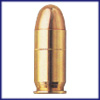
worth. I like the .45 ACP and the .357 Magnum the best. Just under
them in effectiveness are the .40 S&W, the .44 Special and the
9mm. Below them are the .38 Special and the .380 ACP. There are other
cartridges, but these are the most common for personal defense weapons
and the ammunition is readily available.
I wouldn't be comfortable with anything smaller than
a .380 (actually, I wouldn’t be comfortable with anything smaller
than a .45 ACP, but that’s a different
argument. See also Jim Higginbotham's "Case
for the .45 ACP"). My personal
favorite handgun cartridge is the .45 ACP because of its power and
accuracy, but smaller cartridges will do the job if you do your part.
Like the selection of the gun, the selection of a cartridge should be
based on your ability to shoot it well. A good hit with a .380 is
better than a miss with a .45. So, as a general rule, your self
defense cartridge should be the largest and most powerful load that
you shoot well.
The Selection Process
Don't be in a rush to buy the first gun you see.
Give it a lot of thought. Ideally, shoot as many pistols as you can
before you make a decision. Most gun ranges have pistols you can rent
to see how they feel. If you have friends who own pistols, go shooting
with them. Most will be happy to let you shoot their guns and share
with you their experiences with them.
Be careful about the advice of clerks at gun stores.
Some are very knowledgeable but many others are total idiots. Just
because someone works at a gun store doesn't necessarily mean that he
or she is an expert on personal defense pistols. They will all offer
an opinion, whether they actually know anything about the matter or
not.
I would also maintain a healthy degree of skepticism
toward articles in popular gun magazines. They don’t make money by
trashing the offerings of their advertisers.
Consider how you dress and your lifestyle.
How will
you carry the pistol? Can you adjust your wardrobe to accommodate your
pistol? Particular body shapes may present special problems. Your
physical strength and conditioning may also be a factor, i.e.,
powerful auto pistols tend to function better for people with strong
arms and hands. How much time do you have to devote to practice? As a
rule of thumb, autos require more training than revolvers, so don't
pick a single-action .45 auto if you're not willing to learn to use
it.
As important as any other single factor is the size
and geometry of your hand. Hand size varies greatly between people and
it is very important to handle a gun and note carefully the comfort of
the grip and the position of the controls on the pistol. If you can't
easily manipulate every control on the gun with either hand, then find
a different gun. People with short thumbs may have trouble with the
safety of an M1911. People with short palms may have difficulty with
the thick handles of the double-stack 9mm and .40 pistols. People with
meaty hands may be "bitten" by the slide of a small auto
when it cycles.
Does the gun feel good in your hand? Is the trigger
smooth or is it rough and heavy? Is the frame fairly narrow so that it
will conceal well? Does the gun have the right balance of power, weight and
size? (Remember, bigger is better for shooting and power, but can you
carry it for 8 hours if you have to?)
You will notice that I have said nothing about
price. I really hate to hear people making a decision on a handgun
based on price. No one wants to pay more than we have to or what is
fair, but price should be the last consideration. You won’t remember
a hundred or so dollars extra you paid for the right pistol, but you
will remember the ill-fitting bargain pistol that doesn’t shoot
right or feel good.
To summarize, hold it, feel it, fire it if you can,
and recognize that you're going to spend a lot of time with the
pistol. Remember also, that it may be called upon someday to defend
your life. No, it isn't easy, and you may end up buying two or three
pistols before you find the one with just the right balance of weight,
power and comfort.
Holsters
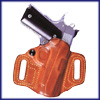
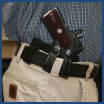
The selection of a holster which fits the gun you intend to carry
is critically important. For a detailed discussion on this matter,
click here.
Reloads
Most of the tactical gurus recommend the carry of at
least one reload. If you observe police officers, they often carry 2-4
extra magazines or speed-loaders. If your gun is an autoloader, the
second magazine is a good idea for two reasons: (1) you may need the
extra rounds (and it's better to have them and not need them than to
need them and not have them), and (2) magazines sometimes fail and
having a backup will ensure that you won't get caught with a
non-functioning gun. Hopefully, very few of us will ever need twenty
one or more rounds, but the carry of a spare magazine or speed-loader is
just a wise practice. One of the reasons I prefer an autoloader to a
wheel gun in this role is that the flat shape of a magazine is easier to
carry on your belt than the rounded and somewhat bulky shape of the
speed-loader used for revolvers.
Summary of Selection Criteria
- Your personal defense weapon should be as large
and as powerful as you can shoot accurately and carry with a
reasonable degree of comfort and concealment.
- Your personal defense weapon should fit your hand
perfectly.
- You should be able to manipulate the controls of
your weapon with either hand alone.
- Your personal defense weapon should be of sturdy
construction and be able to withstand heavy use and rough
handling.
- Your personal defense weapon should be accurate
enough to consistently hit a target the size of a saucer at 10
yards quickly.
- Select the largest caliber you can shoot well,
and a caliber for which ammunition is readily
available.
- A good quality holster must be available for the
model of pistol you intend to carry.
What
Pistol Do I Carry? Click Here
Related Articles:
Pistol Packin
by Jim Higginbotham.
Concealed Carry and the 'Large' Auto Pistol by Jim Higginbotham. Custom Auto Pistol Modifications for
Serious Duty by Jim Higginbotham
Defensive
Marksmanship by Jim Higginbotham
Handgun Power by Jim
Higginbotham
Recommended Modifications to
the Colt .45 Auto for Self-Defense Use by Les Bengtson
The Case for the .45 ACP by Jim
Higginbotham
The Psychology of Self Defense and the
Force Continuum by Syd
The .45 ACP Cartridge - Development, Specs, and Performance
Selecting a Holster for Concealed Carry |