Pistol Packin
By Jim Higginbotham
Several commentators have offered various
"rules to a gunfight" lists. While they vary in length they
all begin with a universal rule "Bring a Gun". While
that is not the only thing important to surviving a lethal encounter,
it is certainly arguable that it is a top priority. It is amazing how
few people understand this concept or at least take it to its logical
conclusions.
Unbelievable as it seems I have encountered people
who actually choose to go unarmed or "underarmed" (carrying
a more convenient weapon of questionable caliber), explaining that
they do not frequent "bad" places or live under
circumstances that make an attack likely. They insist that if they
were going to such a place that they would indeed carry a better
weapon. This of course is sheer folly. If you know you are
likely to be in a gunfight (and you are not compelled to go by some
overriding reason) then STAY AWAY from there! And if you cant, then
take a rifle or a shotgun.
The purpose of the pistol is to be there for those
situations which you cannot predict or in which your activities
preclude you having better weaponry at hand. Even the best defense
pistol is not a sure fire thing when it comes to stopping violent
attack and thats when it is well used.
This then is the rule always have your pistol
within easy reach ( unless some legal reason precludes it ). It will
do you no good to have a pistol in your car when the criminal predator
grabs you on the way to it from the mall (a substantial percentage of
armed robberies happen at your car door). Also leaving a pistol in a
car unattended is not a good idea because it may soon end up in
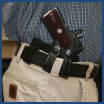
nefarious hands. For the most part, this means wearing it in a holster
and now we finally get to the subject of the exercise. What do we look
for in a holster?
First, it must be reasonably comfortable, since if
it is not then you will find yourself leaving your pistol at home or
in your car. This means you will have to chose a holster and position
of carry which allows normal activities such as walking, bending,
lifting, sitting and so forth without the pistol rubbing or poking
uncomfortably on your body.
It addition it of course must be concealable for
most normal use since we dont make a habit of open carry, even
though it is perfectly legal in many locales. There are many types of
concealment holsters and, of course, their usefulness varies with the
type of garment you are wearing. A little thoughtfulness in choosing
your wardrobe can give a lot of flexibility on how you carry your
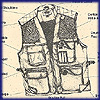
weapon, extra ammunition and accessories. Loose fitting light jackets
like a "bush jacket" or a photographers vest can
hide a multitude of weaponry. I once gave a class wearing a summer
weight vest and 2 hours into the class I asked the students to guess
how many guns I was wearing. Some guessed 2 or 3 ( they knew there had
to be some since this was a security class and the subject was
spotting armed people). In fact I had on 11 handguns including 2 .44
magnums, 4 .45 autos, 2 10mm autos and a variety of .357s and even a
.410 gauge single shot. Even after being frisked no one caught a .45
auto Officers Model, a .38 Chiefs Spl and a .22 pen gun. However I
was a bit uncomfortable so this is a short term thing. A word of
caution. Concealed carry is an increasingly popular subject in the
media, photog vests, fanny packs and backpacks are becoming a
"trademark" of folks that carry firearms concealed and are
becoming an automatic indicator to some that the person wearing them
is likely to be armed. There is nothing at all wrong with being
legally armed, but the element of surprise is a powerful advantage to
the defender. Try not to look like you are the aspiring gunman (or
gunwoman).
A good guide as to whether the holster is
concealable or not is that it tucks the butt of the weapon in against
your body so that a finger passed between you and the stocks will
touch both at the same time. If this is not the case then the butt of
the weapon will "print" or cause a recognizable bulge
this is a bad thing.
Another area of consideration is security. No, I am
not talking about protection from a "gun-grab". First off,
if your gun is concealed no one should know where it is to try to grab
and secondly, any holster that is secure enough to prevent a snatch is
secure enough to prevent a proper and rapid draw eliminating its
usefulness. The security I am referring to is that the gun is held
firmly in the holster and will not easily fall out in case of
strenuous physical activity. It is embarrassing to reach for your
weapon and find that it was left somewhere laying on a car seat or
dropped , previously unnoticed, back at McDonalds. It would be very
fortunate indeed if embarrassment was the only thing it was. The
holster need not have a strap or fastener to make it secure, though
this is certainly an option. It can use any number of friction or
passive holding devices which are overcome by the draw but not normal
activity, even strenuous activity.
Another consideration is position. This is in
addition to considerations previously mentioned of comfort and
concealment. I strongly recommend against carrying your main handgun
in a cross draw. The reason is simple. Lethal confrontations are
likely to be up close and personal. The astute defender will position
himself in a fighting stance, which means he leads a little with his
weak side and balance his weight forward well before there is any need
to draw his pistol. If his primary weapon is on his weak side he has
to cross his body to get a grip on it. The assailant will not only see
that he is reaching for a gun, he will be able to interfere with the
draw by blocking or grabbing the arm, tying up the defender. On the
strong side, which is away from the assailant, not only is the arm and
gun protected by the body, the opponent may not be able to tell that
you are about to produce a weapon, which could be factor in your
favor.
This is not to say that cross draw is out of the
question at all for a "backup" gun and that it has certain
advantages which make this a desirable position for that gun. The main
advantage is for drawing from a seated position, especially from an
automobile seat with a seatbelt employed. It is also useable when
seated at a table or desk (there you have a natural barrier to prevent
the previously mentioned block). Cross draw is a little slower but not
enough to be a major factor for the backup gun. Yet another reason to
carry a backup in this position is that it is available to the weak
hand for drawing in case the strong hand is injured or otherwise
occupied. This is important as there is a high incidences of people
getting shot in their gun or gun hand perhaps it has something to
do with focus in a fight.
Some people prefer to place their backup in the
small of their back where it is available to both hands. This is
viable but be warned if you place it directly over your spine you are
risking a serious injury in case of a slip or fall if you land on it.
Of course shoulder holsters are often thought of
since Hollywood seems so enamored of them. All I can say is they
surely did not have to wear one for long. Most shoulder holsters do
not get worn 8 hours a day, every day. They hurt! Especially with a
reasonable sized gun but even with guns as small as a Chiefs
Special. There are some exceptions but they are not very common and
the best are out of production.
The question arises, inside or outside the
waistband. Folks new to the concealed weapon field automatically
assume that the former is more concealable and, to be technical, they
are right. However, with the proper clothing the only part that is not
concealed as well is the barrel and slide front of the pistol. There
are quite concealable holsters, using minimal material, which print no
worse than an IWB holster but which have the comfort of the OWB. This
is mostly a factor of your personal build and clothing choices. A good
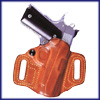
"pancake" or "belt slide" holster is quite
concealable if you garment is of sufficient length. The important part
of the gun to conceal is the butt.
Naturally the holster should hold the weapon where
you can get a firing grip on it while it is still holstered. Also it
should cover the trigger guard in order to encourage proper safety
habits keeping the finger out of the trigger guard until the
sights align on target is a very important safety rule.
Finally, avoid cheap "one size fits all"
holsters. In truth just because a holster will accept a pistol does
not mean that it actually fits. Purchase well made holsters of top
rate material (used to we could say leather but some synthetics are
coming along now) and one that actually fits your weapon. Well
maintained it will serve you a lifetime of course a poor holster
will lead to a shorter lifetime!
This Months Quote:
" Among the many misdeeds of the British rule
in India, history will look upon the Act depriving a whole nation of
arms, as the blackest." Mahatma Gandhi, from his autobiography. |