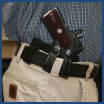
Selecting a Holster
for Concealed Carry
By SydThese days, I often find myself thinking
more about holsters than guns. Comfort, accessibility, mode of dress,
and anticipated activities are all factors in a complex equation.
The holster and the gun are two components of one
self-defense system. Don’t cut corners on a holster. A good holster makes the carry
much more comfortable and safer. A good holster will allow you to carry
a heavier gun with less discomfort and greater concealment. A properly
fitted holster facilitates and contributes to a smooth, fast draw. A
fine holster will be thin yet strong. It will shield the trigger but not
grab it. The choices in holsters can be bewildering, but if you let your
common sense, your mode of dress, and logic guide you, the problem
simplifies.
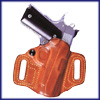
The best draw is from a belt holster on the strong
side. The strong side belt holster provides for a faster draw, better
retention, and fewer problems than other styles of holsters. In my own opinion, the strong side belt holster is the fastest
and most comfortable holster. Their weakness is that they provide very
little concealment and you must either wear a shirt with a very long
shirt tail out (a look I don’t really like) or you need a long coat. If
you normally wear a traditional blazer, the belt holster is no problem.
Also, belt holsters of all types tend to pull down on the belt,
necessitating a fairly tight cinch-up to keep the weight from dragging
the belt and pants down.
If you prefer your shirt tucked in and intend to
only wear a short jacket or sweatshirt, the “Inside the Waistband” (IWB)
holster is an excellent solution. These holsters ride inside your pants
with only straps or a clip being outside the waistband of your pants.
Generally this holster is worn just behind the crest of the hip on the
strong side. This style provides excellent concealment and holds the gun
to you very securely. A short windbreaker or jacket will completely
cover this type of holster. The tension of your belt pulls the gun in
toward your body, enhancing concealment and rendering retention snaps
unnecessary. This style is my second favorite and I use them a lot. The
downside of these holsters is that they are not quite as comfortable as
the belt holster and tend to be a bit harder on the finish of the gun.
The IWB holster also requires that you use a belt that is approximately
2" longer than you would normally wear.
The shoulder holster is way cool for looks and
style. Most of my TV detective heroes used them, but they require that
you always wear a coat. They make you reach across your body to draw (OK
if you’re sitting in a car, but slower everywhere else), and most
shoulder holsters require a thumb break to hold the gun securely. People
of large girth may find the draw from a shoulder holster difficult. I
have warmed up to shoulder holsters because they do have some special
advantages for particular applications. If you spend most of your time
riding or driving in a vehicle, the shoulder holster is an excellent
option. For long rides, it is more comfortable to have the gun suspended
from your shoulders than to have it pressed against your kidney between
yourself and the seat. Especially on bumpy roads and in cars with hard
suspensions, an IWB will get uncomfortable. Also, seat belts make it
difficult to access the gun when it’s in a strong side belt holster, be
it a pancake or IWB. With a shoulder holster, the gun is easily
accessible while seated in a car with a seat belt on. Shoulder holsters
usually provide carriers for two spare magazines – two rather than one
because the two counterbalance the weight of the gun better. This is
more spare ammo than most civilian CCW carriers carry, and it could be
an advantage in a bad situation.
Pocket guns and pocket holsters are an important
option for concealed carry. I will leave the question of
combat
effectiveness of pocket guns for another article, but the fact is that
many people choose to carry small, compact pistols because of their size
and relatively light weight. I do think that it’s important to carry a
pocket gun in a holster for two reasons. First, the holster breaks the
lines of the gun and enhances conceal-ability. Second, a good pocket
holster will cover the trigger of the gun and protect you against the
possibility of getting foreign objects into the trigger guard which can
cause the gun to go off. The trick with the pocket holster is to find a
design which will stay in the pocket when the gun is drawn. This may
require a coordination of the holster design with the pockets of the
particular clothing you intend to use. While you probably won’t do a
whole lot of practice with a pocket holster, it is important to test the
draw to make sure that the gun comes out of the holster smoothly without
hanging up.
Some styles I’m not too fond include “small of the
back” and ankle holsters. The “small of the back” holster has some
problems. The draw is dicey and kind of difficult. There is a danger of
sweeping the muzzle of the gun in directions you don’t intend to cover.
This is an easy holster to disarm. Someone can come up behind you and
grab the pistol, and due to its position on your back, it is very
difficult to stop them from taking it. Lastly, should you fall on your
back, the small of the back holster is a steel bar across your spine
that could accentuate the impact of hitting the ground and perhaps hurt
you worse. The leg holster is only really valid as a backup
option and it’s not really great as a backup. The ankle holster is great
concealment, but the draw is so problematic that it is almost useless.
When you
select your gun, you will need a holster that works with it so it is
important to know if the right holster is available for the gun you
intend to carry. The gun and the holster are two parts of a single
system which must work perfectly together. The equation is complex. The
gun must be combat effective but not so huge as to be uncomfortable and
impossible to conceal. The holster must fit the gun well, provide
adequate concealment and yet ready accessibility in an emergency.
Women
Females face special difficulties with concealment holsters. The vast
majority of holsters are designed for men. The problem is that men and
women are built differently. The female torso tends to be an "hour
glass" shape and shorter from hip to shoulder. The complaints most
frequently heard from women are that their holster "rides way too high,
and the grip of the gun is up around my armpit." A holster designed
around the male body will ride uncomfortably high on a woman. A woman's
curving hips tend to push the muzzle of the gun outward, causing the
grip of the gun to jam into her ribs. A number of quality holster makers
including Del Fatti,
Kramer,
Chris
Cunningham,
Blade Tech,
Sunrise Leather, and many others build holsters specifically
designed for women. For an excellent article on fitting a holster to the
female shape,
click here. The important learning here is that women have special
needs in a holster and there are products out there which address these
needs. Don’t let a clerk at the local gun store stick you with a holster
that doesn’t work and digs into your ribs.
Belts
The best belt holster in the world won’t do you any good if your skirt
doesn’t accommodate a belt. For folks who don’t wear belts or don’t wear
belts which are wide enough and firm enough to support a holster and
reload, paddle style holsters are a viable option. These holsters are
much like belt holsters except that, instead of loops or slits for a
belt, they have a “paddle” affixed to the back of them which slips
inside your pants or skirt and holds the gun to your side.
If you do select a belt holster, plan on wearing a
belt which is thick enough and wide enough to hold the holster firmly to
your side. This usually means a belt of 1 1/8" - 1 1/2" in width, and
thick enough to be strong. If your style of dress dictates half inch
belts, the belt holster will move around too much.
This returns us to the issue of gun selection and
lifestyle. The mode of dress must be able to accommodate the firearm.
You can’t carry a Colt Anaconda in your pocket. If you really must dress
in a particular style, the gun must be able to adapt that type of
clothing. This is a terrible trade-off, but it’s better to have the
Kel-Tec
P32 in your pocket than to not have the Government Model .45 which you
had to leave at home.
Bags, Packs and Purses
While there is certainly a role to play for these modes of carry, they
all suffer from serious tactical problems. Most of these difficulties
have to do with the difficulty of the draw and the issue of control of
the weapon. Packs, planners, satchels and purses are a control
nightmare. Carrying them all the time may look extremely unnatural and
leaving them laying around unattended is very risky and dangerous.
Access to the gun may be slow and awkward. Muggers will often grab a
woman's purse first, and if he succeeds, he not only gets your wallet
but he is suddenly armed with your gun. For many, the fanny pack
screams, "GUN," but this often depends on the area where you are. In my
area, lots of people use fanny packs that don't carry guns, but usually
when I see a male with a fanny pack, I look to see if he has a wallet in
his hip pocket. Odds are good that if the wallet is in the pocket, a gun
in in the pack. Also, getting the gun out of the pack and into action
can be pretty slow.
Training
An additional advantage to strong-side belt holsters and IWB styles is
that these holsters are the styles that are generally “legal” for IDPA
and similar types of pistol matches. (Fanny packs, shoulder holster,
small of the back, and cross-draw holsters are not allowed for any kind
of match shooting I know of.) Participation in these kinds of
matches provides valuable practice in drawing and firing the gun.
To return to a familiar refrain: practice,
practice, practice. Drawing a .45 automatic from concealment, acquiring
the target and placing two shots in the "A zone" is not a skill most of
us are born with. It must be learned and practiced in order to perform
it safely and effectively. The holster is a critical component of the
system.
See also
Pistol Packin' and
Concealed Carry and the "Large" Auto Pistol By Jim Higginbotham.
Selecting a Gun for Concealed Carry |

Bianchi Askins Avenger and Belt
"Pancake" Strong-Side Belt Holster

"Inside-the-Waistband" (IWB) Holster

Shoulder Holster

Pocket Holster

"Small-of-the-Back" Holster

Ankle Holster

Del Fatti SLP/F Holster designed
specifically for Women

 |